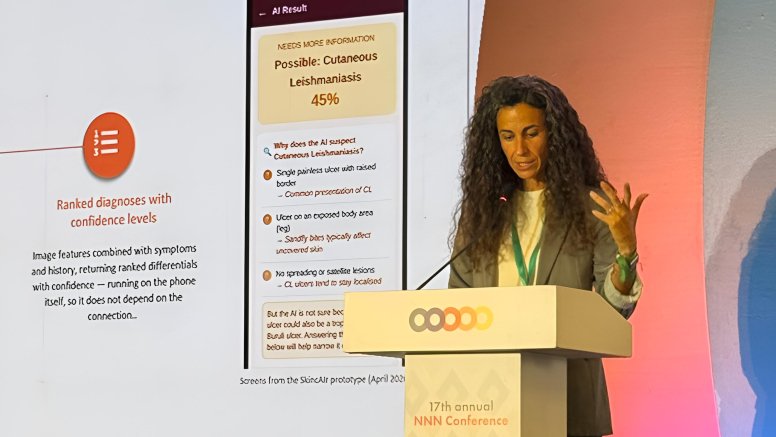
The engineer Carla Rodríguez, who leads the SkincAIr project —a medical innovation initiative through artificial intelligence for dermatologists in Africa to detect skin diseases such as leprosy, scabies, or leishmaniasis that affect more than 1.2 billion people worldwide, has just presented her preliminary results at the international NNN 2026 conference (Network of Tropical Diseases) in Kigali, Rwanda. .
The advances of the mobile application, designed and coordinated from Lanzarote by the firm Sherwood Science together with twelve African and European partners, are being collected by a team of 23 dermatologists deployed in Kenya, Ethiopia, Nigeria, Senegal, and the Democratic Republic of Congo.
“Last week we were already at 780 patients and almost 6,000 images collected,” reveals Rodríguez, who explains that, to train the AI, “you have to imagine that we are training a young dermatologist who has just graduated from university and is specializing,” clarifies the co-scientific director.
Reaching this point has required overcoming significant bureaucratic and logistical barriers. “At the beginning, we started in only two countries, Kenya and Nigeria, because obtaining ethical approvals from national committees takes a lot of work and it was quite an epic task to respond to every technical detail,” explains the expert.
"Some of these diseases are never seen in hospitals"
After that initial phase, the DRC was incorporated, Senegal in mid-year, and Ethiopia in August. One of the biggest findings of this fieldwork has been to confirm that the most serious conditions are not found in urban centers.
“African cities are very advanced and Kigali looks like Europe, but in rural areas the reality is another world where it is very difficult for funding to reach,” clarifies Rodríguez.
“Five or six of these diseases are never seen in hospitals because the patients live in rural areas hundreds of kilometers away; so we have to go to them with campaigns targeting isolated villages.”
Ethics by design: "A tool that gives reasons and not verdicts"
Unlike other commercial developments, SkincAIr has been conceived under strict ethical principles from the software's own architecture.
The system requires rigorous informed consent, which is explained to patients in their local languages; if the patient does not give their explicit authorization, the application's camera does not even open.
Furthermore, the design of the algorithm responds to the direct demands of frontline health personnel. “We are not working with an AI that gives a verdict, but on a tool that helps primary care health professionals reason the diagnosis”.
The priority objective covers twelve neglected tropical skin diseases, as the WHO calls them —among which are leprosy, scabies, leishmaniasis, or Buruli ulcers—, which affect more than 1.2 billion people in the most vulnerable communities on the planet.
However, the final dataset will include a total of 74 skin conditions, combining 22 common skin diseases, another 40 pathologies with similar appearances, and samples of healthy skin.
“In pathologies with so much internal variability like leprosy, we need about 18 images per patient or variant to refine the diagnosis”. In Senegal, they have also begun to conduct interviews with survivors of these diseases “to understand the stigma they have suffered since childhood”.
Clinical validation before deployment in public healthcare
Currently, the effort is focused on building the world's largest open-source database on dark skin, to subsequently proceed with clinical validation in health centers.
“Starting in March 2028, we will test the app for one year without the AI, six months with the AI activated, and another six months without it to see how much learning they have retained,” explains the engineer about the evaluation that will be carried out with frontline healthcare workers in Kenya, Senegal, and Ethiopia.
The health ministries of the five participating countries have already formally expressed their interest in integrating the tool into their public health systems once it passes the validation period.
Add La Voz de Lanzarote as a preferred Google source.
Stay informed with the latest current news.