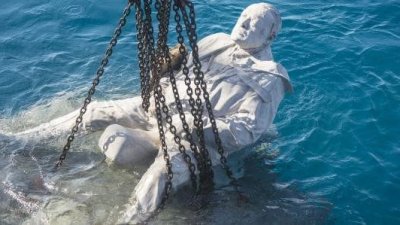
Far from improving, the visitor numbers to the controversial underwater museum, opened more than two years ago by the Tourist Centers next to the illegal Marina Rubicón marina, continue to fall. According to information made public this week by the Cabildo's own Data Center, the Atlantic Museum has received an average of 17.8 visitors per day in the first four months of 2019 and has lost 8.8% of visitors compared to the same period of 2018, while in the entire network of centers visits have increased by 2.32% (from 972,286 to 994,879).
In total, between January and April of this year only 2,137 people accessed the submarine museum facilities, compared to the 2,344 who did so in the first four months of 2018. Thus, the Atlantic Museum lost 207 visitors compared to last year.
According to the Cabildo Data Center, the Atlantic Museum had 447 visitors in January of this year and 401 in February, while in March 524 people accessed the submarine museum and 765 in April.
Compared to the first four months of 2017, the submarine museum has also registered a decrease in the number of visitors, although in this case smaller, since then the attendance was lower than that registered in 2018. Specifically, 2,215 people visited the Atlantic Museum from January to April 2017, only 78 more than in the current year and 129 less than in 2018.
Million-dollar investment and direct payments to Marina Rubicón
In addition to the million-dollar investment involved in the creation of this museum commissioned to Jason DeCaires Taylor, the Tourist Centers and the Cabildo have continued to approve new investments of hundreds of thousands of euros, which are added to the expenses in advertising and the rent of the premises that the CACT were paying for years to Marina Rubicón, owned by Juan Francisco Rosa, Rafael Lasso and Francisco Armas. In theory, those premises were rented to serve as a workshop for Jason De Caires, but when he finished the museum's sculptures, the artist continued to use them for his private work.
"The museum's income doesn't even cover what has been spent on advertising and rentals," warned Carlos Meca, then a councilor for Podemos in the Cabildo, back in 2017, who for years had been demanding that the institution abandon those premises, especially after the Yate case ruling.
"We already know that it is an illegal marina, that bribes were paid, we have been repeatedly bringing motions to the Cabildo to disassociate once and for all the work of promotion and financing of the Cabildo of a company that has already been shown to have bribed the former mayor of Yaiza," claimed the councilor, who again denounced that this museum "was built almost solely and exclusively to finance the family of the CEO of the Centers," José Juan Lorenzo, who is the nephew of one of the owners of the port and cousin of the manager, Rafael Lasso Lorenzo.
That is precisely where most of the controversy surrounding the creation of this museum was focused, which was promoted by Pedro San Ginés and by Echedey Eugenio as head of the CACT, who decided to hire DeCaires Taylor to create a new tourist center in front of this illegal marina and incorporate it into the network of centers created in its day by César Manrique.

Add La Voz de Lanzarote as a preferred Google source.
Stay informed with the latest current news.