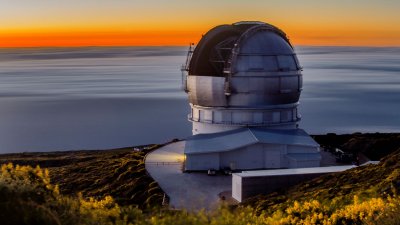
The Gran Telescopio Canarias (GTC), located at the Roque de los Muchachos Observatory, in La Palma, will advance in the design of two new scientific instruments aimed at improving the quality of astronomical images and expanding the possibilities for studying the universe. The work has a contribution of 2.7 million euros from the Ministry of Universities, Science and Innovation and Culture, processed through the Canary Agency for Research, Innovation and Information Society (ACIISI).
This funding corresponds to the 2026 annual installment of the agreement signed between the Government of the Canary Islands, the Ministry of Science, Innovation and Universities, and the GRANTECAN company, which establishes the contributions of both administrations for the operation and development of this scientific infrastructure until 2030.
The Minister of Universities, Science and Innovation and Culture, Migdalia Machín, points out that "astronomy is part of the scientific identity of the Canary Islands and constitutes an area of knowledge that connects our islands with the international research community. Its development requires a long-term vision, capable of providing continuity to the work of those who make this activity possible".
New tools for observing the universe
The investment will focus on two technological developments. The first, called MGTCAO, will improve the telescope's adaptive optics system, a technology that corrects distortions caused by the Earth's atmosphere and facilitates obtaining sharper images of celestial objects.
The second, known as OPTIR, involves the design of equipment capable of performing simultaneous observations in visible and near-infrared light. This combination will allow for the acquisition of complementary information about astronomical bodies and the study of phenomena that require different types of measurements.
Both systems are part of the GTC's scientific planning for the coming years. Their development responds to the need to update the capabilities of this facility in the face of the emergence of new ground-based and space telescopes.
The manufacturing of astronomical instrumentation requires specific research and design processes, as each piece of equipment must be adapted to the telescope's characteristics and the scientific objectives for which it is conceived.
In this context, Machín considers that "one of the values of science is its capacity to awaken vocations and bring knowledge closer to society. Astronomy offers an especially close opportunity for new generations to discover how research is conducted, questions are posed, and answers are sought from the Canary Islands".
The Gran Telescopio Canarias is part of the national map of Singular Scientific and Technical Infrastructures (ICTS). Since the beginning of its operations in 2009, it has facilitated observations for national and international scientific teams. According to the data collected in the file, these investigations have resulted in 1,093 articles published in international scientific journals.
The financing agreement contemplates a joint contribution from the State and the Autonomous Community of the Canary Islands of 63.6 million euros between 2024 and 2030. Of this amount, 21.3 million correspond to the regional administration and 42.3 million to the Ministry of Science, Innovation and Universities.
The design work financed with the 2026 contribution is scheduled to be developed until December 2028.



Add La Voz de Lanzarote as a preferred Google source.
Stay informed with the latest current news.