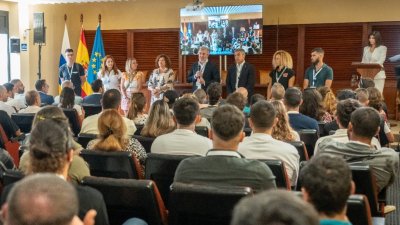
The president of Canarias, Fernando Clavijo, and the Minister of Agriculture, Livestock, Fisheries and Food Sovereignty, Narvay Quintero, inaugurated this Thursday, July 23, the Agricultural Generational Renewal Meeting 2026, held at the Agricultural Training School (ECA) in Tacoronte and organized by the regional Executive through the Directorate General of Agriculture.
The event brought together young farmers and ranchers from all the islands who are beneficiaries of the 2025 and 2026 calls for aid from the Strategic Plan of the Common Agricultural Policy (PEPAC) managed by the Government of Canarias, with the aim of creating links between new professionals, sharing experiences, analyzing the evolution of their business projects, and collecting proposals for improvement for measures to support their entry and permanence in the agricultural sector.
During the opening of the event, Clavijo recalled that, between 2023 and 2026, a total of 275 young people have applied for aid amounting to 19.9 million euros, granted by the Ministry through the various calls to incentivize the creation of agricultural businesses, with the purpose of promoting generational renewal and contributing to ensuring the continuity of these activities on the islands.
The president highlighted that the Canary Islands Executive has reinforced during this legislature the measures aimed at facilitating young people's access to the primary sector by improving the regulatory bases of the calls and increasing the available credits.
“In Canarias, there is a generation with training, initiative, and great ideas that wants to dedicate itself to the primary sector. Our responsibility is to reduce barriers and offer them the necessary instruments so that they can turn their proposals into viable projects capable of generating economic activity and employment,” pointed out the member of the Executive.
In this regard, he explained that the increase in credits for this support line has allowed for an expansion of the scope of aid and has enabled support for all initiatives that met the established requirements “with the purpose of preventing any young person who meets the requirements from giving up developing their agricultural or livestock activity due to not having the necessary financial support.”
Likewise, he indicated that the meeting responds to the need to maintain a direct dialogue with those who are starting their professional careers. “Listening to their experiences allows us to know what is working, detect the persistent obstacles, and better guide public policies aimed at facilitating the start of their activity and the consolidation of their projects,” he added.
“This meeting gives us the opportunity to recognize the effort, initiative, and entrepreneurial capacity of a new generation that is already contributing to modernizing the primary sector, generating new opportunities in rural areas, and ensuring the continuity of agricultural and livestock activity in the Canary Islands,” he concluded.
For his part, Narvay Quintero stressed that the economic support for this measure is complemented by continuous technical support for the beneficiaries. This advice begins with the definition of the business idea and the development of the business plan, continues during the launch of the activity, and is maintained during the first years of the initiative’s development, a decisive stage to guarantee its viability and consolidation.
Quintero pointed out that this support must go hand in hand with specialized training closely linked to the real needs of the sector. In this regard, he highlighted the value of the 2026 Agrarian Generational Change Meeting being held at the Tacoronte Agrarian Training School, one of the three agrarian training schools in the Canary Islands and one of the five agrarian and maritime-fisheries training centers managed by the Ministry.
The event was also attended by the Vice-Minister of the Primary Sector, Eduardo García; the Director General of Agriculture, Juan Ramón Marín; the Director General of Livestock, Andrés Díaz Matoso; the CEO of Rural Environment Management of the Canary Islands, Juan Antonio Alonso; representatives of the Agrarian Training Service, the ECA of Tacoronte, and the Agrarian Professional Organizations, and the mayor of the municipality, Sandra Izquierdo.
Seven business experiences
During the day, participants were able to enjoy an audiovisual piece that captures the experiences of seven young people from each of the islands who have developed their agricultural and livestock projects with the support of PEPAC aid.
The documentary reviews the careers of Jésica Jurado Rodríguez, from El Hierro; Sheila Rodríguez de León, from Tenerife; Iraultza Izquierdo Darias, from La Gomera; José Alberto Arencibia Ramos, from Gran Canaria; Claudia Rodríguez Pérez, from La Palma; Juan Daniel Ramírez Gutiérrez, from Lanzarote; Héctor Luis Cabrera González, from Fuerteventura; and Karliana José Aguilera Mudarra, from Lanzarote.
Through their testimonies, the protagonists explained the process of setting up their businesses, the contribution of the aid received, and the main challenges they have faced in developing their activity. After the screening, a round table was held where they delved into their business initiatives and shared their experiences with the other attendees.
Subsequently, five technical round tables were held for beneficiaries of the grants and specialized technical staff. These working sessions focused on analyzing the evolution of the projects, understanding the main needs and concerns of the participants, and, above all, gathering proposals aimed at facilitating the incorporation and retention of young people in the agricultural sector, which were shared at the end of the meeting.
Among the highlighted issues were the difficulty of access to land and water, the need for simplification of administrative procedures and technical requirements of the calls, as well as inexperience in the sector.
Quintero stated that these results will guide the department's next actions. “Access to basic resources such as land and water, deregulation, and legislative flexibility will continue to be part of our roadmap to facilitate the incorporation of new professionals and contribute to the consolidation of their projects,” he commented.
Narvay Quintero closed the event, after which attendees were offered a cocktail made with local products within the framework of the agricultural and agritourism initiative of the young farmer Sheila Rodríguez de León. This proposal highlights the quality and diversity of the islands' local productions and brings together the offerings of about thirty young producers from the archipelago's agricultural and agri-food sector. Among other things, fruits and vegetables, artisanal sweets and breads, cheeses, coffees, wines, and beers from the Canary Islands are offered as a result of a firm commitment to the younger generations of professionals in the primary sector.
Aid for the incorporation of young farmers is part of the Strategic Plan for the Common Agricultural Policy (PEPAC) and is co-financed by the European Agricultural Fund for Rural Development, the Autonomous Community of the Canary Islands, and the Ministry of Agriculture, Fisheries and Food.


Add La Voz de Lanzarote as a preferred Google source.
Stay informed with the latest current news.