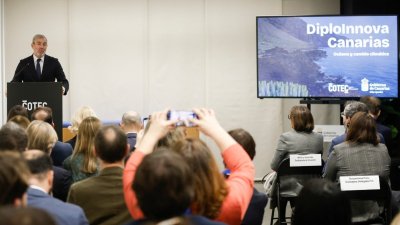
The Government of Canarias Canarias is laying the groundwork for scientific diplomacy, a strategy for science to become a driver of economic and social development through the establishment of relationships with other countries based on innovation and research.
The objective is for these contacts to be solid and lasting, enabling technological entrepreneurship and talent attraction. As a result of this line of work, launched for the first time in Canarias and driven by the President of the Government, Fernando Clavijo, and the Ministry of Universities, Science, Innovation and Culture, led by Migdalia Machín, communication channels have already been opened with nearly 40 embassies to showcase the archipelago's innovation capacity and, at the same time, attract international projects through strategic and institutional alliances.
To this end, the archipelago seeks to connect the various players in the research and innovation ecosystem of Canarias with embassies and global organizations for innovation, development, and research, with the aim of solving common challenges and attracting strategic projects, using its geographical position as a geopolitical and technological bridge between Europe and Africa. In this way, it aims to boost key sectors for the islands such as the blue economy, renewable energies, water management, or aspects related to astrophysics.
Canarias has facilities and infrastructures that have become international benchmarks, such as the Canary Islands Technology Institute (ITC), the Canary Islands Oceanic Platform (Plocan), or the Canary Agency for Research, Innovation and Information Society (ACIISI), with the permanent support of the University of Las Palmas de Gran Canaria (ULPGC) and the University of La Laguna (ULL).
The Vice-Minister of the President's Cabinet, Octavio Caraballo, emphasized that scientific diplomacy opens a new era in the external projection of Canarias, linked not only to knowledge but also to innovation and talent, "so that the islands actively participate in providing solutions to the great global challenges of our time".
Caraballo highlighted that, in recent years, the Canary Islands have initiated a determined transition towards an economy based on knowledge, innovation, and the responsible use of their natural resources, a transformation that relies on collaboration between administration, science, business, and society to generate added value, diversify the economy, and offer solutions to challenges that manifest in island territories.
Particularly relevant in this regard is the Canary Islands Africa Strategy launched by the Government of the Canary Islands, which has scientific diplomacy as one of its fundamental pillars.
This line of work has already materialized in agreements such as the joint work with the Mohammed VI Polytechnic University (UM6P) of Morocco. Likewise, in this context of knowledge transfer and scientific diplomacy, the Government of the Canary Islands has opened avenues for collaboration with the Souss Massa region through the agreement signed between the Technological Institute of the Canary Islands (ITC) and the Ibn Zohr University during an institutional visit by the Moroccan delegation to the archipelago.
Also during the visit that President Fernando Clavijo made to Uruguay last June, a memorandum of understanding was sealed to update the historical cooperation between both territories in matters of innovation, talent, sustainability, and scientific transfer.
DiploInnova Canarias
With the objective of turning the islands into an international bridge to project their innovation potential and facilitate the installation of international projects on the islands, the Islas Responsables team has developed two editions of DiploInnova Canarias to date.
In the first meeting, held in La Palma in September 2025, the focus was on Astrophysics and Space, areas in which the islands have consolidated themselves as a global benchmark. It was attended by around a hundred representatives from embassies, the Ministry of Science, Innovation and Universities, and national and international organizations and entities in the R&D&I field, with the aim of generating alliances that materialize into projects with real impact.
In the second edition, which took place in Madrid, DiploInnova focused its work on the Ocean and Climate Change with the presence of 17 embassies, to which the ecological richness of the islands was presented, their location in the Atlantic, and their natural conditions that make them an exceptional laboratory for advancing solutions to climate change, biodiversity loss, and the sustainable management of marine ecosystems. At the same time, these conditions make the archipelago a strategic partner of great value.
Projects working on desalination with wave energy; clean energy and water from waves; floating dual-turbine offshore wind in deep water; very low-cost direct CO2 capture; or specialized research in floating marine photovoltaic systems are potential areas of work being developed on the islands.
As a result of these contacts established during the second edition of DiploInnova Canarias, the autonomous community has opened a channel of collaboration with the Ecuadorian archipelago of Galápagos and will soon sign a collaboration protocol to address issues of interest to both territories in innovation and sustainability and to exchange knowledge in this regard.
Next October, the third edition of DiploInnova will take place in Brussels.
Collaboration with Asia
In this regard, the Canary Islands participated in the Osaka 2025 World Expo with the aim of sharing initiatives to advance sustainable development in island territories. Learning about successful experiences in low-impact tourism or agricultural practices on islands that promote food sovereignty were some issues of interest for the autonomous community that were addressed in this forum.
The Canarian delegation was led by the head of Universities, Science, Innovation and Culture, Migdalia Machín; the Minister of Agriculture, Narvay Quintero; and the Vice-Minister of the President's Cabinet, Octavio Caraballo. During these days, advances in the sustainable development of the island of Okinawa were explored through visits to research and technology centers in which Islas Responsables participated.
In this context, agreements were explored with the Canary Islands universities on mobility, training, and joint projects in key areas such as marine biotechnology, climate change, or island biodiversity. The experience of Spanish researchers at the Okinawa Institute of Science and Technology (OIST) was also learned about, while facilitating the participation of Canary Islands talent (postdocs, internships, joint supervision...) was proposed.
Likewise, Islas Responsables participated alongside coastal and island territories in a debate held within the framework of the World Urban Forum in Baku on the accelerated risks these territories face due to climate change. In this space, the Canary Islands emphasized that it is building a systemic climate resilience agenda while consolidating itself as an Atlantic resilience laboratory, capable of transforming structural vulnerabilities - such as water scarcity, energy isolation, coastal pressure, urban heat, or environmental degradation - into opportunities for innovation, institutional cooperation, productive diversification, and climate justice.
Add La Voz de Lanzarote as a preferred Google source.
Stay informed with the latest current news.