The Government of the Canary Islands hopes that the three laws created to provide a legal framework for the reconstruction of the island of La Palma, after the eruption of the Cumbre Vieja volcano in 2021, can be extended throughout Spain when natural disasters occur.
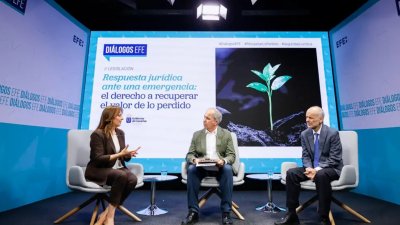
The consejera of the Presidency, Public Administrations, Justice and Security of the Government of the Canary Islands, Nieves Lady Barreto, and the professor of Administrative Law at the University of La Laguna, Francisco Villar, who advised the Executive, participated in the EFE Legislation Dialogues ‘Legal response to an emergency: The right to recover what was lost’, held at the headquarters of the EFE Agency in Madrid.
After the eruption, on September 19, 2021, the Government of the Canary Islands, given that there was no right to recover the value of what was lost, approved a first decree aimed at the reconstruction of homes, which allowed relocation outside the lava flow, and with which territorial and urban planning regulations were flexibilized.
More than 1 billion in damages
Nieves Lady Barreto, consejera of the Presidency, Public Administrations, Justice and Security of the Government of the Canary Islands. EFE/David Fernández
With the arrival of the new Canarian Executive, after the 2023 elections, three laws were drafted that provided a legal framework for reconstruction in urban planning, agricultural, and protected housing matters, respectively.
The consejera, who has put the valuation of damages at 1.1 billion euros, explained that the reconstruction “could not be faced” with the state civil protection law, since the aid for loss of housing of up to 15,000 euros was not enough to renovate a house if it had significant damage, and, furthermore, agricultural estates of up to one hectare, which could generate thousands of euros in production, were lost.
Thus, for Barreto, this framework is “a model that transcends La Palma, that transcends the Canary Islands and that we believe is fair that it can reach all citizens when they experience a terrible situation like that”.
She also highlighted that the aid delivery system has “traceability” and “all possible controls” and, after distributing them for primary residences and agricultural estates, in this third year, aid for second homes is being delivered, and new estates are already being built with the money from the paid aid.
The right to be compensated
“People are starting to have a life, to rebuild it, and furthermore, a fair response is given,” she valued.
The call by Barreto “right to be compensated in the face of a major natural catastrophe” is “new”, and, in his opinion, this legislative model is no longer from La Palma and “not even” from the archipelago: “It is a model that must be for any citizen; that in the face of such a situation, be it a dana, be it major fires, they can recover the value of what they lost and therefore live their lives in a real and fair way”.
Professor Villar has summarized the model in two basic ideas: “People have the right to recover what they had” (and if it is not possible for safety reasons, “the administrations must facilitate your recovery in other places”) and “an economic compensation that makes it real that you can materialize your rights”.
“That is characteristic of a social State that says here there are people who have suffered damage from a natural catastrophe and we are going to put them in the best conditions” to recover their previous life, he concluded, and stressed that “the obstacle will be the temperature, the uncertainty about whether there is a volcanic tube or gas emissions, but they will have the economic and legal conditions to resettle elsewhere on the island”.
Finally, Barreto also proposed creating a state fund financed by “small annual contributions” from the autonomous communities that would respond to this right when any region is affected. EFE

Add La Voz de Lanzarote as a preferred Google source.
Stay informed with the latest current news.