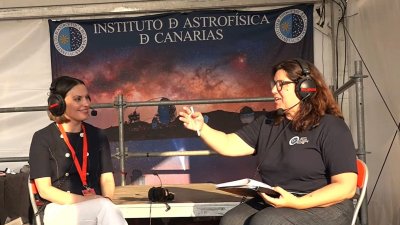
The Minister of Universities, Science and Innovation and Culture, Migdalia Machín, attended from Palencia along with the Instituto de Astrofísica de Canarias (IAC), the total solar eclipse, following first-hand the observation, research, and dissemination actions linked to the so-called Eclipse Trio, which can be observed between 2026 and 2028.
"Experiencing an eclipse like this August 12th from a scientific perspective allows us to understand all the knowledge that exists behind a phenomenon that awakens the interest of millions of people," stated Migdalia Machín, who highlighted the participation of the IAC in the NATE project (North African Telescope Eclipse), an international initiative that she leads together with Mohammed VI Polytechnic University of Morocco and the National Solar Observatory of the United States, with the support of the Government of the Canary Islands, through the Canary Agency for Research, Innovation and Information Society (ACIISI).
The activities developed during the 2026 eclipse are part of the preparation for the international campaign that will take place during the total solar eclipse of August 2, 2027 in Morocco. The NATE project will combine research, training, and citizen participation through a coordinated network of telescopes that will allow for advanced observations of the solar corona along the eclipse's path.
Researchers, faculty, students, and volunteers are participating in this process, in actions that will serve to train the scientific and technical teams that will take part in the 2027 campaign and, at the same time, aim to bring science closer to citizens and foster scientific vocations among young people.
The participation of the Canary Islands is part of the coordination promoted by the Ministry of Science, Innovation and Universities together with the autonomous communities to prepare for the eclipses visible from Spain in the coming years. A collaboration that reinforces astronomical dissemination and scientific culture and internationally projects the Canary Islands' capacity in astrophysical research.
"The research being carried out today will continue in Morocco during the total eclipse of August 2, 2027. It is a demonstration of the science we do from the Canary Islands and of our ability to take that knowledge beyond the islands," affirmed the minister.


Add La Voz de Lanzarote as a preferred Google source.
Stay informed with the latest current news.