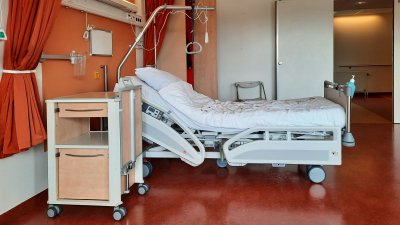
The young Miguel Planas, 33 years old, has spent six months admitted to the Insular Hospital of Gran Canaria after becoming tetraplegic, and not for medical reasons, but due to a bureaucratic jam that prevented him from accessing adapted housing and which he managed to confront thanks to his insistence and the mobilization of citizens and entities.
Last June 1st was the second turning point in the life of the Gran Canarian: he left the hospital to move into his new home. The first occurred on March 7, 2020, when, after a fall in the gym, he suffered a severe spinal cord injury that caused him tetraplegia and a situation of dependency for which he requires a respirator to live.
"The options I was given were not viable for a person in my condition. I need security to stay alive, and the options I was given did not allow for that," he tells EFE in an interview in his new adapted home, stating that he felt "a bit helpless."
"If six years have passed for me to be here and I've done it on my own, it means things weren't done; there was no intention, it wasn't of interest," he laments.
Unassumable Requirements
Planas explains that his family did not have financial resources and that, to obtain a grant from the Government of the Canary Islands, they asked him for requirements that the house had to meet: "When I read all that, I realized that if I didn't find a way myself, I was going to be in the hospital for a long time."
His story is not exceptional. Hundreds of people in situations of dependency are occupying beds in Canary Islands hospitals due to the lack of external resources to cover the care they require.
This is the case of his friend Said Lamrabet, a Moroccan who arrived in 2020 by boat and who, after diving badly into a natural pool, became tetraplegic in a country where he did not yet understand the language nor had a support network of family or friends. He has been in the hospital since 2021 without knowing when he will leave, and both will attend the event for the visit of Leo XIV in the cathedral of Las Palmas de Gran Canaria next June 11 to bring this reality to the pontiff.
Although he acknowledges that the situation of people in his condition is a bit more complex, Planas believes that behind the entire bureaucratic labyrinth and the absence of a solution for his case there is a lack of empathy, but also that, being a minority, there is no interest in solving his problem.
Social Media and Patronage
"Obviously, I wasn't planning on staying in the hospital for the rest of my life," he remarks. Therefore, when he felt his stay was being prolonged at the hospital "once his health was already stable," and after "many, many meetings, calls, emails to try to find a solution," he turned to social media to make a public appeal, which led to a crowdfunding campaign and a charity concert, among other things.
"The response from people was amazing. Especially here in the Canary Islands, when someone needs help, you see a lot of solidarity from people," he states, assuring that it was thanks to all that mobilization, both from citizens and entities, that he managed to buy a simple, old, and cheap house and renovate it almost from scratch to adapt the property to his medical needs.
"Now I can invite people to my house and not to the hospital," he says, explaining that his favorite area is where the sofa for guests is located and pointing out that, finally, he can feel "a sense of tranquility, comfort, regain privacy, sleep without noise, wake up whenever I want; it's freedom."
Miguel Planas recounts that the privacy and comfort of a home were the elements he missed most during his hospital stay and, although he describes the healthcare staff at the Spinal Cord Injury Unit of the Hospital Insular as "very good" and "always very effective," a clinical environment can never replace that of a true home.
Artistic and Sports Projects
During these six years, the young man from Gran Canaria has experienced difficult moments, including depression, anxiety, and stress, but he has also learned to worry less about things he used to consider very important, to enjoy the little things, and to have a lot of resilience and a very positive attitude.
Now, he says with conviction, "a stage of great excitement is coming" to continue with the goals he already has, such as theater, which he has been doing for two years; painting, which he has been doing for three years by holding the brush in his mouth; or boccia, a Paralympic sport in which he is federated; and to start with new objectives, such as the creation of a center for people with physical disabilities.
During the interview, Planas recalls a day when she performed at the Teatro Guiniguada. She was there, on stage, in a wheelchair, with a respirator. She remembers that, seeing herself doing something she would never have imagined and under those conditions, she thought: "I am capable of doing whatever I set my mind to." And, she assures, "limitations are in the head."

Add La Voz de Lanzarote as a preferred Google source.
Stay informed with the latest current news.