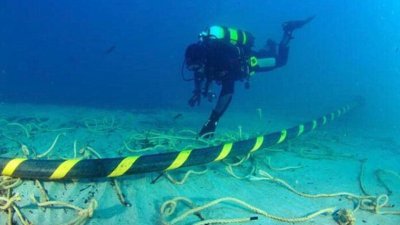
And what if we could hear what the ocean has to say to us using the submarine fiber optic cables that connect the entire planet? That is the idea behind Distributed Acoustic Sensing (DAS), a specialist of which is Professor John R. Potter, and which seeks answers for the future of the globe.
Potter is currently in Gran Canaria on sabbatical from the Norwegian University of Science and Technology (NTNU), where he has come to the island to work hand in hand with researchers from the Oceanic Platform of the Canary Islands (Plocan) and the University of Las Palmas de Gran Canaria precisely on the development of this novel technology.
In an interview with EFE, Potter states that this technology "completely changes the way we can listen to the ocean." With only specialized equipment called an interrogator, connected at one end of the cable, all these telecommunications connections can be turned into "a gigantic listening network."
Using the fiber optic cables already laid for decades on the seabed and, with that interrogator, it is possible to detect earthquakes and take temperature and pressure measurements, with "extremely promising" results so far, but it also has potential for much more:
"We are still in the process of discovering everything this system is capable of doing."
A medium that works through sound
But why is it so important to listen to what the ocean has to say and to use DAS for it? Potter summarizes it by saying that "it is a medium that works through sound." Unlike air, through which radio waves travel and visual information is abundant, in a saltwater environment, light barely penetrates a few meters and waves attenuate.
"Therefore, practically all marine life relies on sound to communicate and perceive its environment," he summarizes. And until now, the necessary resources to deeply listen to everything the ocean offers, which is also quite unknown to humans, were not available.
It is estimated that only 10 percent of the species that inhabit the ocean are currently known.
So much so that the expert himself states that the surface of Mars is more mapped than the seabed of our planet: "It is the most unexplored, least understood, and worst-sampled part of the Earth, despite being fundamental for the life support of all living beings."
In this regard, he recalls that the oceans generate half of the oxygen that humans breathe and a large part of the food they consume, which demonstrates the crucial importance of understanding how it works in order to "manage it responsibly" and combat climate change. Because, he assures, if there is a "collapse of the marine ecosystem," humans will not be able to survive.
Communication of Marine Fauna
The DAS system can also contribute to deepening the knowledge of how marine species communicate with each other, eminently acoustic animals that can have a capacity, understanding, and acoustic nuances much more developed than those of humans, who are primarily visual.
Potter points out that the communication of marine mammals "very probably holds a much greater wealth of information and nuances than we have ever attributed to them."
And being able to delve into it could "radically" transform the way humans view the rest of the environment and species, because, according to Potter, "part of the difficulty in collectively assuming" the challenge of climate change "lies in humanity's lack of rootedness in nature."
Canary Islands as a Benchmark
Finally, Potter has no doubt that the Canary Islands can play a fundamental role in these advances that DAS can drive: "It is an absolutely strategic enclave."
"The Canary Islands occupy an exceptional position: they have a very rich ecosystem, they are in the middle of the ocean, they have clean waters teeming with life, but at the same time they concentrate significant maritime traffic, high-speed ferries, technological infrastructure, and a large presence of cetaceans," explains the university professor.
The archipelago, therefore, brings together "all the elements that define current challenges" with which humans must learn to coexist, especially thanks to the work of institutions such as Plocan, which has led the development of ocean observation systems to better understand their needs and by forging international alliances.
Therefore, there could not be a better "testing ground" than the Canary Islands to turn the DAS technology "into an essential marine conservation tool". Because, Potter concludes, "the Canary Islands have proven key to clarifying what measures we should take and where we should direct our efforts to move forward".


Add La Voz de Lanzarote as a preferred Google source.
Stay informed with the latest current news.