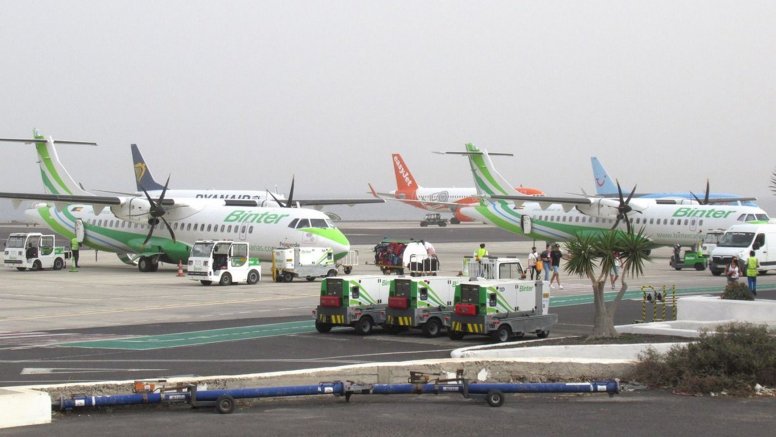
Lanzarote is the third Canary Island in terms of population and also the third that receives the most tourists at its airport. While these two realities coexist, it is very difficult for Canarians to get a last-minute flight between islands.
When the "fully booked" sign is hung up by the only two airlines operating between Lanzarote and Tenerife, it becomes impossible to fly between the two islands if an unforeseen event or a last-minute situation arises. Despite air connectivity being a crucial service in the archipelago, a seat is not always guaranteed.
For this July, Binter, the main airline for inter-island flights, offers just over 13,600 seats weekly to connect Tenerife and Lanzarote throughout July, as well as 17,426 seats to Gran Canaria. In total, 190 flights per week between Tenerife and Lanzarote and 232 between Gran Canaria and the island of volcanoes. For the summer, with Tenerife, there has been "a 35% growth" in seat availability compared to an average week in June and a 2% growth compared to Gran Canaria, according to data provided by the company itself.
Despite this, there are days when it is impossible to get a plane ticket. This situation is even more complicated for flights to non-capital islands, as most connections go through Tenerife or Gran Canaria.
This very Friday, July 17, for example, there are no tickets available to fly from Lanzarote to Tenerife. The same happens with Canaryfly, the second Canary airline that flies between islands.
The geographical reality of the Canary Islands makes flying the only alternative. Several passengers have stated in declarations to La Voz, the frustration of not being able to access a last-minute flight in a region marked by its ultra-peripheral status and its geographical situation as an archipelago.
Added to this reality is the fact that a flight on a flexible fare from the main airline in the Canary Islands costs 248 round trip between Lanzarote and Tenerife North (68.5 euros if the 75% residency subsidy is applied). The cost of tickets also becomes an added handicap for the most impoverished people and students who must travel to the capital islands to pursue most university degrees.
Add La Voz de Lanzarote as a preferred Google source.
Stay informed with the latest current news.