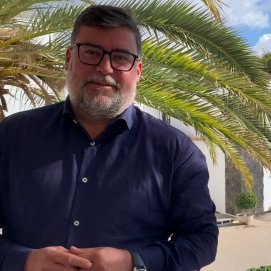
“Island identity, being Canarians, does not belong to a party or an ideological current. It acts as a common space where all sensibilities fit.”
The Canarian poet Pedro García Cabrera wrote in Líquenes that “the sea is a permanent heartbeat.” That image dismantles any attempt to reduce the Canary Islands to a postcard, to a still photo like those soullessly sold in souvenir shops. Inhabiting these islands means living with a living territory, full of nuances, contradictions, and aspirations that do not fit on a tourist postcard.
Canariedad—that mix of memory, character, and Atlantic sensibility—functions as a way of looking at and relating to the world. It pushes us to take care of what we have close by and to project ourselves outward without losing our roots. Our identity, so celebrated, cannot serve as a refuge to avoid the challenges that mark our daily lives.
The emotion evoked by an isa, our ‘ustedes’ or ‘mi niña’, the aroma of the sea breeze or the warmth of the accent are part of our culture, yes, but the real experience of living here is truly marked by other factors, such as an economy that depends 35% on tourism and that falters in the face of any global crisis; a climate that conditions agriculture, health, and even how we relate to each other; an insularity, eight realities, that face the cost of mobility and access to essential services; a history that has forced us to rebuild ourselves after eruptions, migratory crises, storms, and natural disasters. Canarian identity is embodied in the everyday, in the opportunities that open up and those that close.
At this point, it is worth remembering María Rosa Alonso, one of the great Canarian intellectuals of the 20th century. She analyzed how territory shapes culture and ways of thinking, even stating that “insularity is not a limit, but a perspective.” She was not talking about geography, but about lucidity, because territory sharpens the gaze, forces one to interpret reality with greater precision and to act with greater responsibility.
We live in a privileged place, a circumstance that has become a gift and whose enjoyment requires collective commitment.
The data forces us to act. Tourist pressure and the scarcity of public housing strain the market; the lack of generational replacement in the primary sector or the thousands of people waiting for surgery in the Canary Islands remind us that this is also our front-page image every time we read and watch the news.
These challenges in the 21st century do not contradict who we are: they complete us. The way we resolve what hurts defines us as much or more than what we celebrate.
That is why, to congratulate ourselves on this May 30th, the Canary Islands must first address the problems from all areas and administrations.
Island identity, being Canarian men and women, does not belong to a party or an ideological current. It acts as a common space where all sensitivities fit because, after all, it is part of our sense of belonging to a place, to a territory.
From a progressive perspective, which is where I position myself, and which places people at the center of decisions, Canarian identity implies responsibility to guarantee decent housing, strengthen public services, protect the territory without turning it into a commodity, diversify the economy, and ensure that no one is left behind. No one.
This land, rocked by the Atlantic, deserves more than to survive; it deserves to prosper, and this requires making brave decisions and raising citizens' awareness so that they do not confuse identity with complacency.
The Canary Islands do not fit on a postcard but they do fit into a common project where justice and dignity prevail.