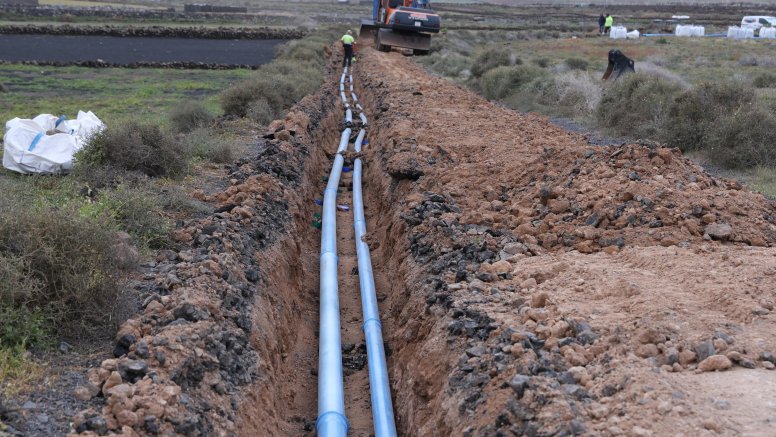
Liberación Canaria has denounced the supply situation on the island after two breakdowns occurred at the Díaz Rijo and Janubio desalination plants, which "have left 17 towns without supply while tourist centers have not suffered consequences." The organization considers that these events highlight "the deterioration of essential infrastructure, the insufficiency of strategic reserves, and the inability to guarantee continuity of supply in the face of technical incidents."
For the party, "it is intolerable that an island that generates so much wealth through tourism and other economic activities cannot guarantee something as basic as water supply to its population." In this regard, they point out that the records for the 2025 fiscal year reflect that "of the 31.83 million cubic meters of water produced, 55.4% was not billed, a difference of 17.63 million cubic meters which includes losses and other unregistered volumes."
Likewise, they point out that "about 60,000 cubic meters of storage capacity have been out of service since 2014, while their recovery remains pending," warning that, twelve years later, the island "continues to pay the consequences of poor planning and years of deterioration of its hydraulic system." Faced with this scenario, they emphasize that "the termination of the contract with Canal Gestión and the recovery of public management in June 2026 must represent an effective change," assigning to the Cabildo, the Water Consortium, and the Government of the Canary Islands the responsibility to "guarantee results, execute investments, and be accountable."
Set of eight urgent measures
Faced with this situation, the party demands a package of interventions structured in eight points:
Immediate supply: "Activate extraordinary resources for the affected towns, prioritizing vulnerable households, health and educational centers, and essential activities."
Independent technical audit: "Evaluate the condition of desalination plants, reservoirs, distribution networks, and electrical installations, identifying responsibilities, deficiencies, and pending investments."
Recovery of strategic reserves: "Urgently rehabilitate the 60,000 cubic meters of storage out of service and execute the planned reservoir in Zonzamas, establishing sufficient reserves to cope with prolonged interruptions."
Loss reduction: "Implement an extraordinary program for pipeline renewal, leak detection, and distribution modernization, with verifiable loss reduction targets."
Energy security: "Equip desalination plants and pumping stations with electrical backup systems, greater energy autonomy, and operational continuity protocols."
Treatment and reuse: "Safely utilize reclaimed water for agricultural uses and other compatible activities, reducing pressure on drinking water production."
Growth limits: "No significant tourist or urban expansion should be authorized without demonstrating water availability and sufficient sanitation and treatment capacity."
Financing and transparency: "Approve a multi-year investment plan, with guaranteed financing, execution deadlines, identified responsible parties, and public monitoring of results."
Request for institutional appearance
Liberación Canaria has requested "the president of the Cabildo and the Water Consortium, Oswaldo Betancort, and the Government of the Canary Islands for a joint public appearance to explain the real state of the hydraulic system, the investments made, and the concrete commitments to overcome this situation." They maintain that "the water emergency cannot become the 'permanent excuse to justify the lack of structural solutions'."
Finally, they conclude that Lanzarote requires a model linked to "territorial carrying capacity" that reinvests part of the economic return in essential services, insisting that "we cannot continue to increase tourist, urban, and demographic pressure on infrastructure that already shows difficulties in meeting existing needs" and emphasizing that "water is a right" and that "guaranteeing its supply is a public obligation."
Add La Voz de Lanzarote as a preferred Google source.
Stay informed with the latest current news.