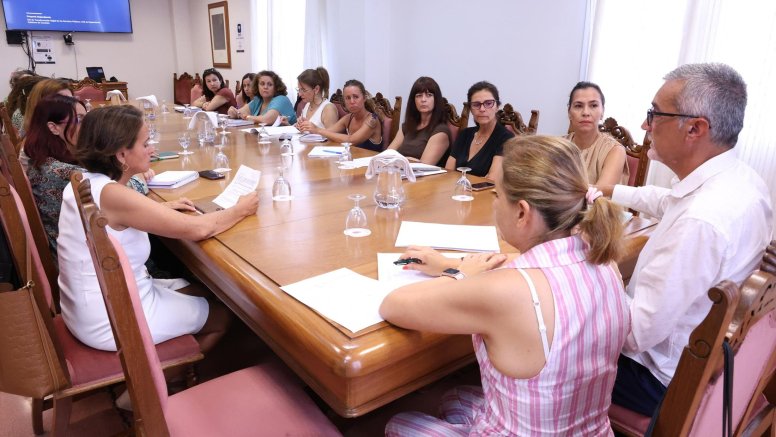
The Cabildo of Lanzarote and La Graciosa held the Insular Table of Social Action and Seniors this Wednesday, a working meeting with the island's town councils to analyze the situation of dependency, disability, and the new bases for social emergency and technical assistance.
The meeting, convened by the Department of Social Welfare and Inclusion, was attended by the Councilor for the Area, Marci Acuña; and the Director General of Dependency of the Government of the Canary Islands, Concepción Ramírez Cuélliga, who traveled to Lanzarote to discuss with the municipalities the state of implementation of the Dependency Law.
During the Table, three main issues were addressed: the balance of dependency in Lanzarote and La Graciosa, with special attention to advanced telecare and the Home Help Service; the situation of the Assessment and Orientation Teams linked to disability; and the modifications to the bases for social emergency and technical assistance.
The president of the Cabildo, Oswaldo Betancort, highlighted that "coordination between administrations is key for resources to reach the people who need them sooner and better." "We are talking about dependency, disability, accessibility, technical assistance, and social emergency, areas that directly affect the daily lives of many families in Lanzarote and La Graciosa," he pointed out.
Lanzarote reduces waiting times in dependency and disability
The Director General of Dependency of the Government of the Canary Islands, Concepción Ramírez Cuélliga, thanked the Cabildo for the invitation and indicated that Lanzarote "was the island that had the greatest delay in resolving dependency files." Ramírez pointed out that currently there are 128 people awaiting assessment and announced that the forecast is that "between next week and the following one" the island will be up to date in this matter.
The Director General also highlighted the evolution of new public services linked to dependency. In this regard, she reported that the Home Help Service, launched as a public benefit in May, already has 50 people registered. Likewise, advanced telecare has gone from 126 initial users to 508 people with the service installed.
"We have to keep moving forward because there are still people on the waiting list for telecare and for the Home Help Service, but we are working on it," stated Ramírez.
For his part, the Minister of Social Welfare and Inclusion, Marci Acuña, assured that the current situation "has nothing to do with the one that existed at the beginning of the term." "The news then was the delay and almost an attitude of resignation due to the waiting times for both obtaining dependency recognition and disability assessments. Three years later, we have turned that situation around thanks to active policies aimed at changing this reality," he said.
Acuña highlighted that the new services must be coordinated with the town councils "so that they are provided in the most effective way possible" and also focused on the evolution of disability assessments. "We have gone from waiting times of two years and two and a half years in 2023 to times below six months, which is what the law dictates," he insisted.
New criteria for social aid
During the meeting, the Cabildo presented the modifications to the social emergency and technical aid bases to the town councils. At this point, it was clarified that social emergency aid maintains its economic limit of up to 3,000 euros, while technical emergency aid may be valued up to 95% of the total cost when linked to accessibility, personal autonomy, and inclusion of people with disabilities.
In the case of social emergency aid, the economic limit of up to 3,000 euros is maintained. The main novelty is incorporated in technical emergency aid, which may be valued up to 95% of the total cost when linked to accredited needs for accessibility, personal autonomy, and inclusion of people with disabilities.
"We are adapting the bases to the reality that many families live. There are needs that cannot be resolved with standard aid, because we are talking about accessibility, personal autonomy, support products, adaptations, or specialized treatments," explained Acuña.
According to the data analyzed in the Table, Lanzarote has 6,896 people with a recognized disability rating equal to or greater than 33%. Furthermore, only 7 applications exceed the 180-day threshold, while another 308 are within the deadline as they correspond to recent dates.
Add La Voz de Lanzarote as a preferred Google source.
Stay informed with the latest current news.