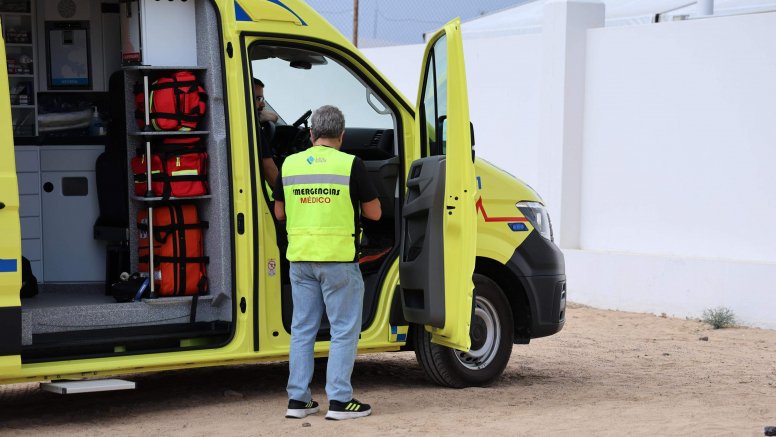
The Federation of Health and Social Health Sectors of Comisiones Obreras (CCOO) of Lanzarote, through its union representation, has conveyed to the Canarian public health administration and the parties responsible for the provision of urgent health transport its concern about the thermal conditions that ambulances destined for urgent health care in Lanzarote may endure, especially the medicalized units.
CCOO denounces that certain ambulances remain parked outdoors for prolonged periods and are directly exposed to solar radiation, among other locations, in the vicinity of the Doctor José Molina Orosa University Hospital and the Playa Blanca Local Health Center.
The union organization considers this situation particularly worrying during episodes of high temperatures and summer months, as prolonged exposure to solar radiation can cause a very significant increase in the temperature inside the vehicles.
We are not just talking about comfort: we are talking about safety
For CCOO, this situation cannot be addressed exclusively from the perspective of the comfort of the professionals.
A medicalized ambulance is a health resource intended to provide advanced life support. "It cannot be treated as a conventional vehicle that remains exposed to the sun for hours and is only air-conditioned when the crew arrives to start a service," points out Nicolás Cabrera Acosta, representative of CCOO Health and Social Health Sectors of Lanzarote.
The union considers it necessary to jointly analyze three related but distinct issues: the exposure of professionals to high temperatures, the conditions for the preservation of medicines, and the conditions for the preservation and operability of those health products and equipment that are subject to specific requirements.
The AEMPS warns that temperatures can exceed 40 degrees in emergency vehicles
CCOO recalls that the Spanish Agency for Medicines and Health Products (AEMPS) has specific information on the proper use and conservation of medicines in emergency vehicles.
The AEMPS expressly warns that during the storage, conservation, transport, and use of medicines in these vehicles, the temperature can exceed 40 degrees.
The Agency also points out that uncontrolled exposure to high temperatures can affect certain medications, especially those whose preservation requires specific conditions, which can lead to alterations in their stability, loss of activity or, in certain cases, the formation of degradation products.
Among the precautionary measures contemplated by the AEMPS are the adoption of optimized storage conditions and, when these cannot be guaranteed, measures such as thermal insulation or periodic replacement of exposed products.
"If the AEMPS itself warns that temperatures can exceed 40 degrees in emergency medical vehicles and points out the risks that uncontrolled exposure to high temperatures can cause to certain medications, we understand that this problem cannot be ignored when an ambulance remains for hours directly exposed to the sun," CCOO maintains.
A medicalized ambulance is not a conventional vehicle
CCOO recalls that vehicles intended for health transport are subject to specific technical and health requirements.
Royal Decree 836/2012, which regulates the technical characteristics, health equipment, and staffing of road health transport vehicles, contemplates class C care ambulances, intended for advanced life support, and establishes the corresponding references to the technical regulations applicable to these vehicles.
Likewise, in the Canary Islands, Decree 154/2002, of October 24, in its current wording, regulates land health transport and contemplates care ambulances intended for on-route technical-health assistance, including basic life support and advanced life support units.
Therefore, CCOO considers it necessary to verify that the actual operating, parking, and preservation conditions of the vehicles and the health products they transport are compatible with the applicable technical-health requirements.
Occupational risk: CCOO demands a specific assessment
The trade union organization recalls that the exposure of professionals to high temperatures during their activity must be addressed within the general framework of protection established by Law 31/1995, on the Prevention of Occupational Risks.
Article 14 of this regulation recognizes the right of workers to effective protection in matters of safety and health, while Article 16 establishes the obligation to carry out an assessment of the risks to the safety and health of workers arising from working conditions and to update it when relevant changes occur.
Likewise, Royal Decree 39/1997, which approves the Regulation of Prevention Services, establishes the criteria for risk assessment and contemplates the carrying out of measurements, analyses, or tests when they are necessary to determine the magnitude of the risks and the preventive measures that must be adopted.
CCOO considers, therefore, that the thermal exposure of professionals who carry out their activity in medicalized ambulances must be specifically contemplated and evaluated, taking into account the real conditions of parking, solar exposure, indoor temperature, duration of exposure, activity developed, and job characteristics.
"We are not proposing a subjective assessment of whether it is hotter or colder. We are demanding that the risk be identified, measured, technically evaluated, and, if appropriate, the necessary preventive measures be adopted," the union points out.
Preventive regulations require action against risks arising from extreme temperatures
CCOO recalls that labor risk prevention regulations include specific measures against certain cases of adverse weather phenomena and extreme temperatures, introduced by Royal Decree-Law 4/2023, including the obligation to adopt preventive measures and adapt working conditions in legally provided cases.
However, the union considers that, in the case of ambulances, the preventive analysis must be carried out taking into account the specific characteristics of these vehicles and the legal regime applicable to workplaces located in means of transport.
Therefore, CCOO demands that the thermal risk "be addressed fundamentally through the specific assessment of occupational risks, without limiting preventive action to the automatic application of general temperature values provided for other workplaces."
Measuring temperature: from subjective perception to objective data
One of the main proposals of CCOO is the need to have adequate systems for measuring and recording the indoor temperature of ambulances.
The union considers it especially important to have objective records that allow us to know what temperatures are actually reached during periods of parking and sun exposure.
"If an ambulance has been in the sun for several hours, knowing the temperature at the time the crew arrives does not allow us to know what temperatures were reached during the previous hours," explains CCOO.
For this reason, the trade union organization calls for continuous measurement and recording systems, especially in the care compartment and in areas where medicines or products subject to specific conservation conditions are stored.
CCOO also considers that the preventive evaluation should be carried out using recognized technical criteria and methodologies to assess heat exposure and thermal stress, taking into account the real conditions in which the work is carried out.
"Turning on the air conditioning upon arrival does not solve what happened during the previous hours"
CCOO considers any response that is limited to turning on the air conditioning when the crew enters the vehicle to be insufficient.
"The air conditioning can reduce the temperature of the cabin when the service begins, but it does not allow us to know or guarantee the thermal conditions that the medicines, products, or equipment that have remained stored inside the ambulance have previously endured," points out Nicolás Cabrera.
Therefore, the union considers it necessary to differentiate between the air conditioning of the cabin during the provision of the service and the guarantee of conservation conditions during the previous parking periods.
CCOO calls for immediate measures
Given this situation, CCOO has proposed to the responsible administrations, the contracting company, and the prevention services, each within the scope of their respective competencies and obligations, the adoption of effective preventive measures.
Among them, the union demands:
-
Avoid, whenever operational conditions permit, prolonged parking of medically equipped ambulances in direct sunlight, prioritizing garages, covered areas, or spaces adequately protected from solar radiation.
-
Establish effective provisional measures until permanent infrastructure is in place that allows for adequate vehicle protection.
-
Install adequate systems for continuous measurement and recording of the interior temperature of ambulances, especially during parking periods.
-
Conduct a specific thermal risk assessment for professionals working in these vehicles.
-
Identify medications and healthcare products subject to specific storage conditions that are stored in the units.
-
Establish a documented procedure for action in case of deviations from storage conditions, including, where appropriate, technical assessment, immobilization, replacement, or withdrawal of affected products.
-
Ensure that healthcare equipment and products subject to specific operating or storage conditions are maintained within the parameters established by their manufacturers and applicable regulations.
-
Provide worker representatives and prevention delegates, under the terms established by occupational risk prevention regulations, with the necessary information and documentation for the exercise of their functions, including risk assessments, existing protocols, and relevant temperature records.
-
Ensure that no worker is held responsible for reporting or warning of a situation that may affect occupational safety and health or the storage conditions of medications and healthcare products.
CCOO: "It is a matter of care safety"
The union insists that this claim "should not be interpreted solely as a labor demand."
"We are talking about professionals who work inside these vehicles, but also about patients who receive urgent assistance and about medications and healthcare products that must be kept under established conditions. Ensuring controlled and verifiable thermal conditions in a medically equipped ambulance is also a matter of care safety," points out Nicolás Cabrera Acosta.
CCOO considers it especially necessary to address this issue in Lanzarote due to the high solar radiation and temperature conditions that can occur during the summer months, and calls on the administrations and the contracting company to adopt preventive measures before an incident occurs that could affect workers, patients, medications, or healthcare equipment.
"We do not want to wait for a problem with a medication, a patient, or a worker to appear before acting. Prevention consists precisely of identifying the risk, measuring it, and adopting the necessary measures before the damage occurs," the union concludes.
Add La Voz de Lanzarote as a preferred Google source.
Stay informed with the latest current news.