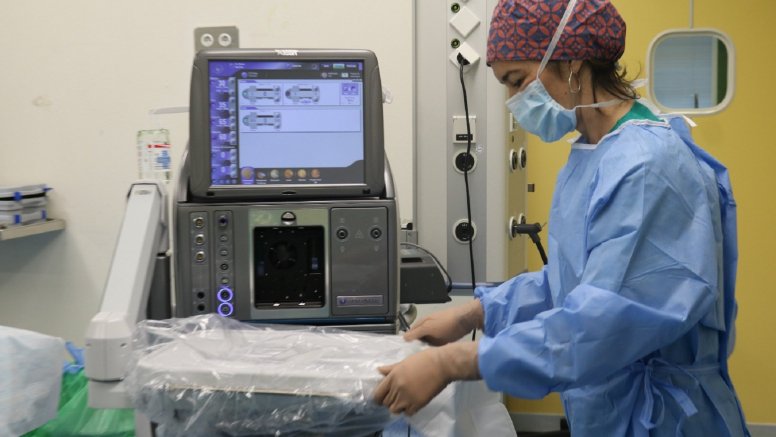
The professionals of the Doctor José Molina Orosa University Hospital, a center attached to the Ministry of Health of the Government of the Canary Islands, implement strategies to strengthen patient safety, improve care and prevent risks. This is an effort that materializes in the daily work of all workers to ensure that users receive safe and quality comprehensive care.
On the occasion of World Patient Safety Day, the Molina Orosa recalls the various strategies, action protocols and projects that the center has been adopting to reinforce patient safety, always from scientific evidence and comprehensively, trying to involve professionals, patients and their families with the ultimate goal of minimizing and preventing any risk derived from healthcare. These include the hand hygiene program and an innovative system for controlling and dispensing high-risk medications.
This new medication administration model is carried out by means of optical readers and a portable electronic device that allows identifying the traceability of cytostatic or high-risk treatments from the beginning of the process to administration to the patient. To do this, a QR code of the mixtures prepared in the pharmacy and the barcode of the patients' identification bracelets are scanned.
Another significant measure in the field of safety and focused on specific processes has been the creation of a specialized vascular access team for the placement of venous catheters, in order to prevent and reduce infections derived from the improper use of these devices.
Safety in services
The Hematology service also develops a transfusion safety program that guarantees traceability from the moment the sample is taken until the transfusion, unifying the patient, the request and the blood bag with a single number. In addition, the service has activated a hemovigilance system that supervises the transfusion process with safety guarantees for the donor and the recipient (patient), with the aim of avoiding and identifying any adverse reaction and making optimal use of blood and its components.
For its part, the Intensive Care Unit (ICU) of the Molina Orosa, has been distinguished with quality certificates for its involvement in the Bacteriemia Zero and Resistance Zero projects. These recognitions guarantee compliance with the recommendations and good practices to reduce the incidence of infections in critical patients and improve the quality of care and safety of patients in the Intensive Care units.
The role of Preventive Medicine
The Preventive Medicine service, responsible for the Patient Safety Strategy at the Molina Orosa, points out the importance of continuous training of professionals to update knowledge and apply the best safety practices.
Throughout the year, this service organizes campaigns and courses aimed at professionals and students in practice, with special attention to hand hygiene, one of the most effective measures to prevent infections related to healthcare.
Likewise, it highlights the need to involve patients in promoting their safety, favoring clear and understandable communication with them and their families.
The importance of reducing risks
Among the basic safety procedures, the unequivocal identification of patients through the use of identification bracelets in emergencies and admissions stands out, which allow verifying the identity with the patient's full name and the clinical history number.
Another strategic line of work is the Program for Optimizing the Use of Antibiotics (PROA), developed by a medical team to improve clinical outcomes in patients with infections, minimize the adverse effects of antibiotics and prevent antimicrobial resistance.
Fall prevention is another of the key projects. It focuses on detecting the risk in time and anticipating a possible fall of patients, which would lead them to prolong their hospitalization and negatively affect their quality of life. To this end, training activities and safe mobilization and transfer workshops are given to staff on a regular basis.
Finally, it should be noted that the Molina Orosa laundry has incorporated this year the antimicrobial textile protection with NOB166 technology, thus reinforcing the prevention of nosocomial infections, one of the great challenges of patient safety.
Add La Voz de Lanzarote as a preferred Google source.
Stay informed with the latest current news.