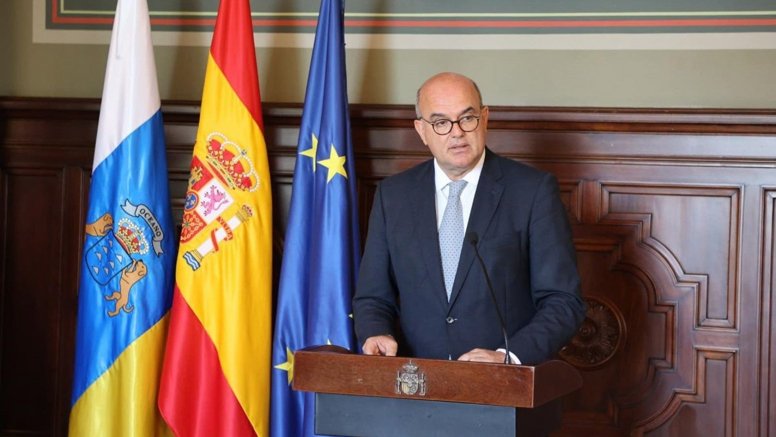
The Government Delegation in the Canary Islands has reproached the Canarian Executive this Wednesday for requesting that a young Moroccan man who had said he was 20 years old be transferred to the peninsula through the 'express' procedure intended for minors who have recently arrived on the islands.
"We do not understand why the Government of the Canary Islands sent us that file when it states that the young man stated upon arrival that he was of legal age. And it is not the first time it has happened because there have been eight files that the autonomous community has sent us of people who were already of legal age," says the delegate, Anselmo Pestana, in statements provided by his department.
Pestana himself had signed the transfer of the young man to Extremadura earlier in the week, without objections from the Prosecutor's Office, which was using 2008 as the boy's year of birth, which he had said on several occasions to the Police, which implied that he was 17.
However, sources from the Prosecutor's Office have explained to EFE that the Junta de Extremadura pointed out this Tuesday that the file contains an interview with the minor where he says he was born in 2005, a fact that he alleged to oppose hosting him, since it meant that he was 20 years old.
A forensic bone test performed urgently at the last minute determined last night that he is "over 19 years old".
In his statements, Pestana also responds to the president of the Canary Islands, Fernando Clavijo, who has complained that what happened with this boy who arrived on September 10 in a fishing boat to Lanzarote is an example of the "negligence" that, in his opinion, the Government of Spain is demonstrating with this type of transfers.
"The president of the Canary Islands, Fernando Clavijo, is mistaken about the adversary, the enemy, in this whole process," replies the delegate, "because what both the Government of Spain and, I understand, that of the Canary Islands intend is that minors who exceed the capacity of the care service on the islands be transferred to other autonomous communities and that these assume their guardianship."
Pestana emphasizes that "that is why the Immigration Law was reformed", which he describes as "a milestone", and decrees were approved to articulate the mechanism that is being launched these weeks.
According to his version, the first of those affecting the Canary Islands (another one in Ceuta was completed earlier), "has finally failed because the Prosecutor's Office, which has the powers, has declared that he is of legal age."
"These things are going to happen in the thousands of files that we are going to have to process in this Government Delegation, but I want the president of the Canary Islands to know that he has an ally here, in the Delegation, to move these files forward," he insisted.
Anselmo Pestana appreciates "a certain hysteria" in the criticisms that President Clavijo is making, because he considers that "he knows that he has that commitment" from the Government of Spain.
"Where he has the adversaries is in the Popular Party. He has them sitting on his Governing Council because it is the PP that presents allegations to each transfer file in the autonomous communities in which it governs," he points out.
Pestana specifies that "we can all make mistakes", but insists that he does not understand why the Government of the Canary Islands sent him the file of that young Moroccan man when "it states that the young man stated in the interview that he was of legal age".
The Government delegate also alludes to "the more than 900 files" that, according to his data, "never received a response from the autonomous Executive to be able to document minors who had arrived in the Canary Islands".
"Many of these people will have reached the age of majority and are now on the street without documentation, condemning them to poverty without the documents that would allow them to obtain a residence and work permit in our country," he adds.
Add La Voz de Lanzarote as a preferred Google source.
Stay informed with the latest current news.