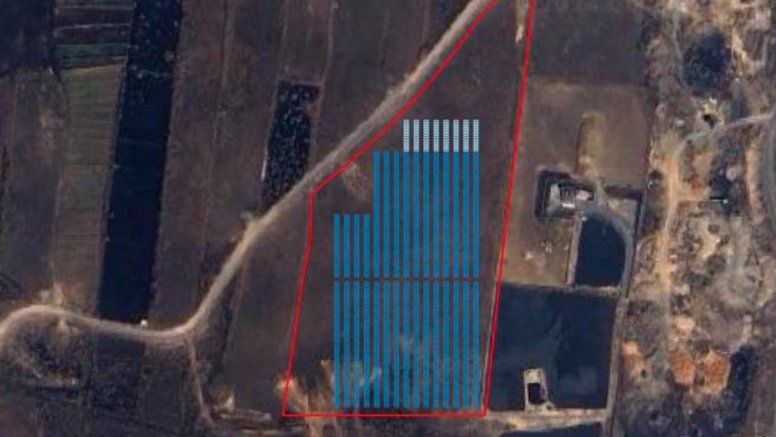
The Cabildo of Lanzarote has reported this Wednesday morning that it has already issued a unfavorable report against the declaration of general interest of a project to install a photovoltaic plant in Mácher. The island's first institution thus joins the Tías City Council, which two weeks ago already showed its "total opposition and express disagreement" against this initiative that plans to install 1,680 solar panels on rural land for agricultural protection.
To date, the Cabildo of Lanzarote had publicly denied that article 6 bis had been applied. However, it had already announced that it would oppose the administrative procedure to give the green light to this installation. The presentation of this unfavorable report was announced this Wednesday by the president of the Cabildo and Lanzarote's parliamentarian, Oswaldo Betancort (CC), during an intervention in the Plenary Session of the Parliament of the Canary Islands.
Betancort recalled that the island institution has maintained "from the first moment" its opposition to this installation, considering that "it does not fit the territorial and energy model it defends for Lanzarote," based on "landscape protection, preservation of agricultural land, and the implementation of renewables in previously transformed spaces."
“As we had announced, the Cabildo has issued an unfavorable report because we understand that this project does not fit into the model of renewable implementation that we defend for Lanzarote,” Betancort stated.
For his part, the Minister of Territorial Policy, Jesús Machín, lamented "the attitude maintained by the PSOE in recent weeks." "They have tried to generate an artificial controversy and sow doubts among the citizens when they knew perfectly well that the procedure was in the consultation phase and that the Cabildo was going to report against it. They have preferred to use fear and disinformation rather than defend the interests of Lanzarote," he affirmed.
So far, the Canary Islands Vice-Minister of Ecological Transition, Julieta Schallenberg insisted last week that the project "has not yet been declared" of insular interest, but rather its processing has begun, and assured that Mariano H. Zapata's order is not valid until it is ratified in the Governing Council. Furthermore, she assured that its paralysis is in the hands of the Government of the Canary Islands, which could not occur "if there is no objective cause."
In this extraordinary procedure, the reports from the Cabildo de Lanzarote and the Tías City Council are not binding, but rather the paralysis or continuation will depend on the criterion of the Government of the Canary Islands.
“The Cabildo has defended a clear and coherent position from the outset. We are committed to renewable energies, but also to orderly planning that is compatible with the conservation of Lanzarote's territorial and landscape values,” Machín indicated.
Last week, Schallenberg insisted to the media that it will be the Canary Islands government that "will decide in due course" whether or not to "leave on the table" this private initiative that plans to install 1,680 solar panels on rural land protected for agricultural use. "Given the opposition, it is likely to happen," added Schallenberg, who refused to make definitive statements about the project.
A procedure processed through an exceptional route
The Minister of Ecological Transition of the Canary Islands government, Mariano H. Zapata (PP), signed on May 15 the order to declare this project of general interest by applying article 6 bis of the Law regulating the Electrical Sector of the Canary Islands, an exceptional procedure, which allows the promoter to be exempted from municipal licenses and island authorizations. This law allows, in "justified reasons of urgency or exceptional interest," projects to be subjected to "a special authorization regime," which exempts them from urban planning licenses or "any other municipal or island preventive control act."
In contrast, the Tías City Council highlighted in its objections that the application of article 6 bis "cannot serve to arbitrarily legalize prohibited land uses" that Canary Islands laws protect for their significant value to the primary sector. Relying on a technical report from a municipal architect, the council also recalled that the General Urban Planning Plan of Tías "expressly prohibits energy use" in this category of land.
This photovoltaic project would occupy 24,117 square meters out of a total area of 28,721.
Add La Voz de Lanzarote as a preferred Google source.
Stay informed with the latest current news.