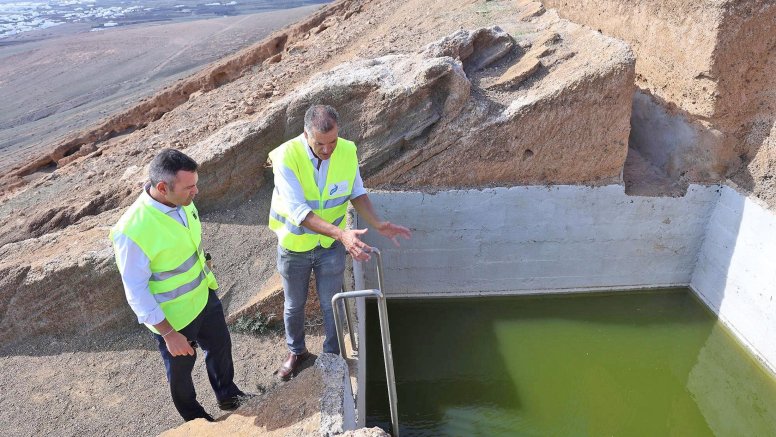
The Insular Water Council of Lanzarote received last week the works for the recovery of the exterior channels of the Maretas of Montaña Blanca, in the municipality of Tías. The action restores the function of an infrastructure that is part of Lanzarote's water culture and whose origins date back to the 1940s.
According to historical references collected in the publication Historia de Tías, in 1945 the Cabildo concluded the construction of two maretas on the southern slope of Montaña Blanca, intended to take advantage of rainwater runoff. This hydraulic system, made up of collection channels and storage tanks, is a testament to the effort made by previous generations to ensure the use of water on an island historically marked by its scarcity.
Before desalination transformed the island's supply, taking advantage of rain required a good knowledge of the terrain and how to channel water to where it could be stored. In Montaña Blanca, the channels excavated in the hillside collected the water and led it to some drains whose function was to decant the water before it entered the cistern. From there, the water continued its journey to two reservoirs located inside the mountain.
"The Maretas tell how Lanzarote learned to take advantage of rain on an island where every drop counted. Recovering its channels is preserving that memory and restoring its function," highlighted Oswaldo Betancort, president of the Cabildo and the Insular Water Council of Lanzarote.
Over the years, mud, stones, and vegetation carried by the rains ended up clogging the exterior channels. The water then flowed down the hillside without a defined course, eroding the slopes and potentially flooding land located in the lower areas. The cleaning and repair of the channeling allows the runoff to follow its course again.
The works, financed with own funds from the Insular Water Council and carried out by Transportes y Excavaciones Sccatmeca, S. L., included the removal of sediments, the repair of breaks in the exterior wall, and the waterproofing of the channels. Most of the work was done by hand to preserve the surrounding terrain. The access path was also conditioned and the sumps and the interior channel were cleaned.
The Minister of Water of the Cabildo of Lanzarote and La Graciosa, Domingo Cejas, pointed out that "the important thing is to highlight the work of our ancestors who carried out authentic hydraulic engineering works to recover rainwater and give it domestic and agricultural use".
"We must not forget our history and, above all, be proud of it. Lanzarote and La Graciosa have been pioneers in seeking hydraulic alternatives to supply the lack of rainwater," Cejas added.
With the recovery of the external channels, water can once again travel the path for which the Maretas were built, from the hillside to the reservoirs. An action that, in addition to improving the conduction of rainwater and avoiding damage from uncontrolled runoff, contributes to conserving an essential part of Lanzarote's hydraulic heritage and historical memory.
Add La Voz de Lanzarote as a preferred Google source.
Stay informed with the latest current news.