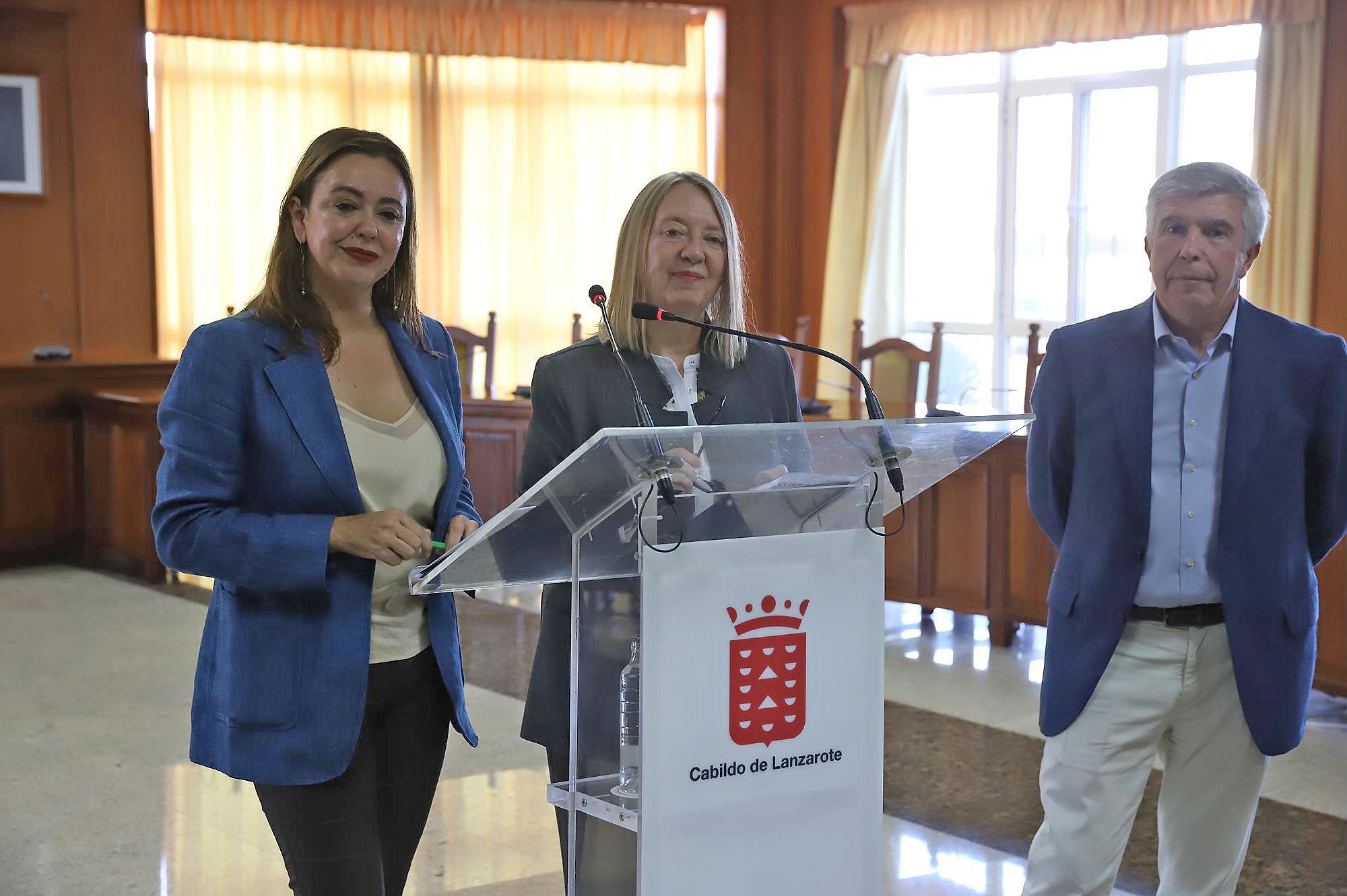
The president of the Cabildo and the Lanzarote Water Consortium, María Dolores Corujo, held a meeting with the general director of ACUAES, María Rosa Cobo, this Tuesday, in which both institutions reaffirmed ACUAES' commitment to invest 37.5 million euros in the improvement of the island's sanitation network.
The actions framed in this project contemplate the expansion of the Arrecife treatment plant, whose execution is scheduled to begin in early 2023, and the Wastewater Treatment Plant (WWTP) of Tías, as well as the construction of a new sanitation network and a regenerated water pipeline in the Yaiza and Uga area.
Dolores Corujo thanked María Rosa Cobo and ACUAES for their commitment to execute one of Lanzarote's largest investments in sanitation, benefiting more than 100,000 people among the three municipalities where the improvements will be carried out.
“With this commitment, we are undertaking an enormously ambitious project to update our wastewater facilities with the objectives of having the capacity to attend to all wastewater and improve its quality once treated, responding to 80% of the needs of our population”, the president highlighted.
Likewise, Corujo pointed out that the European and Spanish authorities are increasingly demanding with the control of discharges into the sea and the Canary Islands, historically, has been one of the communities with the highest number of incidents. “Acting on these two outfalls will mean a very important improvement with respect to that pending issue”, the president acknowledged.
For her part, the general director of ACUAES, María Rosa Cobo, stated the importance of the agreement with the Cabildo and of these actions for the island of Lanzarote and detailed that “the works of the Arrecife treatment plant will begin shortly and will benefit 90,000 inhabitant-equivalents, with a term of 24 months, 18 for the execution of the works and six for the commissioning of the installation”.
The work to be carried out in the treatment plant will allow expanding the current treatment capacity of the installation to 12,000 m3/day compared to the current 8,000 m3/day, as well as incorporating a tertiary treatment with a production capacity of regenerated water of up to 6,000 m3/day for its reuse in agricultural uses and garden irrigation.
To this work will be added an action in the Arrecife outfall, increasing the diameter of the land section and conditioning a part of the submarine section that is in poor condition, so that the treated flows can be evacuated in the expanded treatment plant, all of which represents an investment of 16.5 million euros.
Tías Treatment Plant
In relation to the Tías treatment plant, the capacity of the current installation will be expanded to 12,000 m3/day, achieving the necessary treatment capacity to cover all needs, since the future incorporation of new population centers to this system, Yaiza, Uga and Puerto Calero, as well as the scattered population centers of the municipality of Tías (La Asomada, Mácher, Conil, etc.) is planned. The planned investment amounts to 21 million euros.
The project also includes a new sanitation network that will collect and transport the discharges from the towns of Yaiza, Uga and Puerto Calero to the Tías WWTP, and a regenerated water pipeline will be executed that will allow the use of this resource in the Yaiza and Uga area.
Once each of the works covered by the agreement has been completed, and the period of operation and commissioning tests has been completed, the Consortium will carry out the management of their operation, consisting of carrying out the material tasks of operation, conservation and maintenance. All the works will be co-financed by the European Regional Development Fund ERDF.
Add La Voz de Lanzarote as a preferred Google source.
Stay informed with the latest current news.