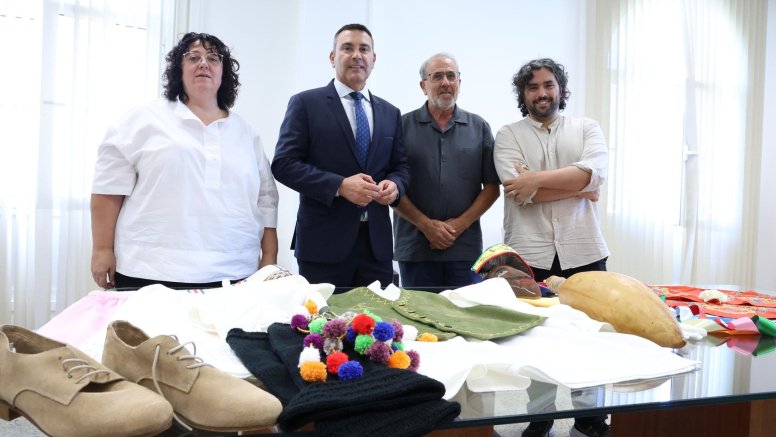
The seafaring tradition of Los Buches de Arrecife will now have a prominent space in the El Álamo Museum, in San Antonio, Texas (United States). The president of the Cabildo of Lanzarote and La Graciosa, Oswaldo Betancort, recently received from the hands of representatives of the Parranda Marinera de Los Buches Association a replica of the traditional attire of this emblematic cultural manifestation, which will be incorporated into the museum space dedicated to Canarian heritage in the North American city.
The attire, made by artisan Tania Nicolova, under the supervision of professor and specialist in traditional Lanzarotean clothing Ricardo Reguera, faithfully reproduces the 19th-century canon. The set consists of openwork trousers or drawers, openwork shirt, velvet waistcoat, gaiters, leather shoes, scarves, and a montera hat.
The piece is completed with the characteristic net mask, made by artisan Marcial Viñoli and painted by David Machado, in addition to the traditional buche, made by Factum Arte. The latter is the most representative element of Los Buches as it is made from the tanned and inflated stomach skin of a cartilaginous fish from the Canary Islands coasts and is used in carnivals to symbolically and festively strike neighbors and visitors, within the atmosphere of humor and lightheartedness typical of the Entrudo.
The incorporation of this attire into the El Álamo Museum will allow for an expanded representation of Lanzarote's cultural heritage in the space dedicated to the Canarian presence in San Antonio, a city founded in 1731 by families from the Archipelago. The initiative is part of the institutional collaboration that Lanzarote and San Antonio maintain with a view to the commemoration, in 2031, of the tricentennial of the founding of the Texan city.
During the meeting, the president of the Cabildo, Oswaldo Betancort, highlighted the importance of projecting traditions that are part of the Lanzarotean identity outside the Islands.
"After the incorporation of Los Diabletes de Teguise, Los Buches represent a new opportunity to show the world another of the great expressions of Lanzarote's cultural identity. They are an Entrudo tradition from Arrecife, deeply linked to the seafaring history of the capital and our popular roots, and their presence in the El Álamo Museum will contribute to disseminating a heritage that is part of our way of being," he stated.
For their part, the president of Parranda Marinera Los Buches, Juan Antonio Machado Santana, and the artistic director of the group, David Machado, thanked the Cabildo de Lanzarote for its support of an initiative that will allow for international projection of one of the most unique manifestations of the Carnival of Lanzarote and bring the popular culture of Arrecife closer to the thousands of people who visit this emblematic American museum each year.
The artisanal legacy of Lanzarote will also cross the Atlantic
Along with the costumes of Los Diabletes de Teguise and Los Buches de Arrecife, the El Álamo Museum will also incorporate a representative sample of traditional Lanzarote craftsmanship, offering a broader view of the island's ethnographic and cultural richness.
Among the pieces that will travel to San Antonio, Texas, are 18th-century men's and women's attire, as well as examples of traditional Lanzarote ceramics and pottery, hand-molded with clay extracted from volcanic soil and made using techniques inherited from the island's ancient aborigines. The collection will also include basketry work, as well as delicate samples of rosettes and cutwork, textile manifestations that keep the traditional work of Lanzarote craftswomen alive.
Likewise, the space dedicated to Canarian heritage will exhibit a reproduction of Los Novios del Mojón, the most famous and unique expression of traditional Lanzarote pottery. These schematic figures of baked clay, historically conceived as a symbol of fertility, love, and marital commitment, were close to disappearing with the decline of traditional earthenware.
Their recovery was made possible thanks to the work of master potter Dorotea Armas Curbelo (1899-1997), a native of Muñique, who rescued the old molds of these pieces in the mid-20th century and restored Los Novios del Mojón to the place they occupy today as one of the great emblems of Lanzarote's craftsmanship and cultural identity.
Add La Voz de Lanzarote as a preferred Google source.
Stay informed with the latest current news.