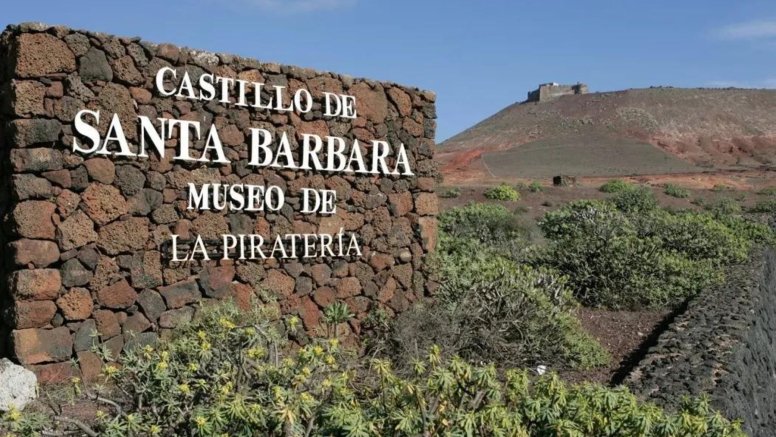
The group Primero Teguise has focused on the situation of the Castillo de Santa Bárbara, one of the most important heritage sites in Lanzarote and declared an Asset of Cultural Interest. The formation denounces that, more than a year after the Teguise City Council announced its reopening and its transformation into the future Museum of History of Teguise, the building remains completely empty, with problems in the electrical installations, security deficiencies, and evident exterior deterioration.
"One expects to find a museum and what one finds is an empty building accompanied by the constant noise of a gasoline engine," they point out from the formation.
Primero Teguise considers that the situation of the Castle reflects the same lack of planning and maintenance that it has been denouncing in other municipal services, with the aggravating factor that it is the main historical and heritage reference of the municipality.
"They told us that the Castle was undergoing transformation. A year and a half later, the only visible transformation is that we have gone from having a museum to having an empty building powered by a gasoline engine," laments Jonás Álvarez, councilor and spokesperson for the formation.
The party recalls that in February 2025 the City Council publicly announced that the Castle would leave behind the old Museum of Piracy to become the future Museum of History of Teguise. However, it assures that this transformation never materialized. Currently, the building remains empty, while the website of the old Museum of Piracy remains active and the signage leading to the monument continues to announce a museum that no longer exists.
"Many visitors go up to Guanapay expecting to visit the Museum of Piracy and all they find are empty walls. All that remains of the old museum is the sign on the road. Inside there are no longer pirates, nor history, nor content," criticizes Álvarez.
The formation also expresses its concern about the state of the facilities. During a visit to the castle, it claims to have verified that the electrical supply depends on a gasoline generator installed next to the building, which runs continuously and generates a loud noise. Furthermore, it denounces the existence of visible wiring and electrical connections, as well as several junction boxes without protective covers, especially at the top of the enclosure, a situation that, in its opinion, requires immediate action for safety reasons.
"This generator has been running for a year and a half. Plenty of time for electrical planning and to have a proper installation. If there are indeed problems in executing the definitive connection, the City Council should be demanding a solution from the electric company daily. What it cannot do is get used to living provisionally, although should we continue to call something provisional that has been working that way for almost two years?", asks the spokesperson.
Primero Teguise also denounces the external deterioration of the monument. As explained, the facades show numerous inscriptions made by visitors who have scratched the coating with stones, marks that have been visible for years without restoration or maintenance work being carried out.
"It gives the impression that historical heritage only matters on the day of the reopening photo. Then silence, abandonment, and improvisation return. It is difficult to understand how the City Council keeps the website of the old Museum of Piracy active and continues to advertise it when the building has been completely empty for years. How is it possible that the municipality's main historical monument has a worse image than many daily-use municipal buildings?", adds Álvarez.
The municipalist formation also expresses its concern about the occasional closures of the castle without prior notice when organizational or personnel incidents occur, a situation it considers unacceptable in the municipality's main heritage resource and which harms both residents and visitors.
From Primero Teguise they insist that the solution involves addressing a comprehensive recovery of the Castillo de Santa Bárbara. Among the measures they propose are the definitive execution of a secure electrical connection, the elimination of risks derived from provisional installations, a restoration and cleaning plan for the facades, the implementation of a museological project for the building, and the guarantee of a stable opening.
"Absolutely everything in our municipality needs management, investment, and respect. Our monuments tell the story of who we were. What is worrying is that today the Castillo de Santa Bárbara is also telling how we are managing our heritage. If we talk about our Castle, what we want is to feel pride when any neighbor or visitor goes up to Santa Bárbara. Because today, unfortunately, the first thing they find is not the history of Teguise, it is an example of how our heritage should not be cared for," concludes Jonás Álvarez.