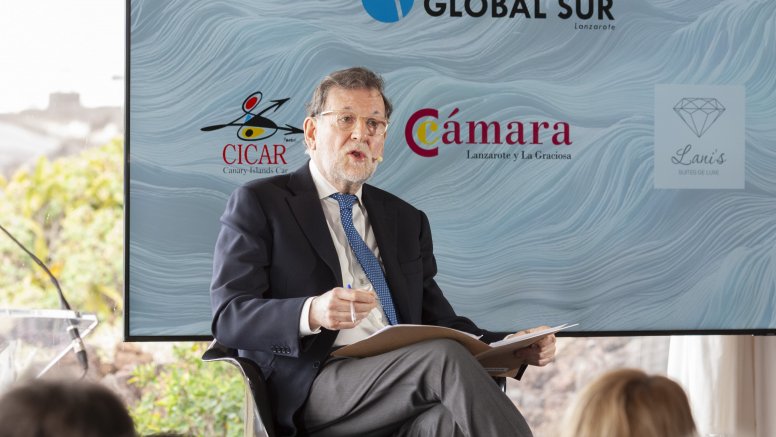
The former President of the Government of Spain between 2011 and 2018, Mariano Rajoy (Popular Party), has intervened this Friday morning in the Dialogues of the Global South Forum 2026. In addition to Spanish president, Rajoy also served as first vice-president of the Spanish Executive (2000-2003), was spokesperson for the Spanish Executive and minister of different portfolios during José María Aznar's presidencies at the head of the Spanish Government.
During a dialogue moderated by journalist Alberto Acosta, the former Spanish president has shown his viewpoints on the international panorama, focusing his speech on the value of the world's democracies, the role of Europe, Spanish relations with the United States and the challenges facing the planet with the different open conflicts in Ukraine, Venezuela or Iran.
Highlighting the value of democracies against wars
On the one hand, Rajoy has highlighted the value of democracies against armed conflicts, linking the defense of democracy with the strategic alliance with Western powers and the need to be firm before dictatorial regimes.
"I will always continue to bet on democracies and if you bet on democracies you have to be with the United States, which was never anything other than a democracy, with Europe, with Australia, with Japan... That is the bet that I believe the vast majority of Europeans make," he assured.
Likewise, he has also commented on the role of the United States in the conflict between Ukraine and Russia, pointing out that "if the United States allows Russia to annex Ukraine, that will be a stain on 250 years of history in defense of democracies because it will have accepted that a dictatorial regime takes part of a country by force."
Furthermore, regarding the principles of the European Union, the former president has stated that "nobody can be in the European Union if it is not a democracy and this can say to some country: 'Listen, you have to respect the principles of democracies'... that is important".
Role of Europe in the world
During the forum, the former president has described Europe as a model of internal success based on peace and well-being, but with serious shortcomings and dependencies in the current geopolitical scenario. In this regard, he has remarked that the Old Continent "has three very important dependencies that it has to take seriously. First, technological dependence, we depend on China and the United States. The second, energy and the third, foreign security and defense policy".
Along these lines, Mariano Rajoy has emphasized the need for a union in Europe. "Only if Europe speaks with a single voice and combines its defense instruments, will it be able to make a mark in the world... if Germany, Italy, Spain, and France come together to create a common foreign and defense policy, we will make a mark, and if not, we will make no mark at all."
Regarding the war in Iran, he/she/it has pointed out that "we have had nothing to say because in the case of Venezuela, it was the United States that made the decisions... when Biden left Afghanistan, Europe painted in that decision the same as those of us who are here. Neither more nor less".
Role of Spain in the world
As for Spain, it has highlighted the importance of reliability and the fulfillment of commitments. On the one hand, it has spoken about the relationship between the United States and Spain regarding the opposing discourses on the Iran war. "The United States has generated concrete problems with some countries, especially with ours," it has said.
Regarding this, he has stated that "people cannot be taken for fools" referring to Spain's refusal to deny the US the use of its bases in Spanish territory for its participation in the war with Iran. He has pointed out that one cannot be in NATO, "wanting them to defend us, but not putting in a penny". "And now we are going to state that we are going to increase defense spending, but then Spain comes along and says: 'But I am not going to comply with it'", he continued.
Thus, he has stressed that foreign policy "requires a left hand, to be fair and get along well with people... that in foreign policy and in life itself".
Add La Voz de Lanzarote as a preferred Google source.
Stay informed with the latest current news.