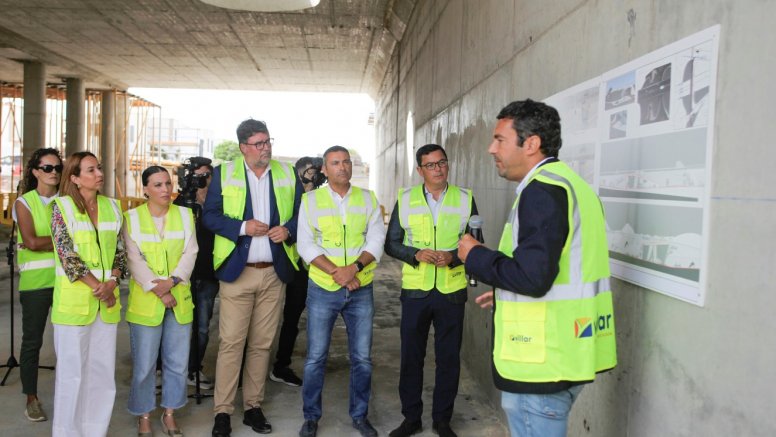
The Councilor for Public Works, Housing and Mobility, Pablo Rodríguez, supervised this Tuesday the works that the Executive is developing, through the General Directorate of Road Infrastructure, for the construction of the underpass of the LZ-2 in the town of Playa Honda, in the municipality of San Bartolomé.
Pablo Rodríguez pointed out during the visit, in which he was accompanied by the General Director of Road Infrastructure, Rosana Melián; the president of the Cabildo of Lanzarote, Oswaldo Betancort, as well as the mayor of San Bartolomé, Isidro Pérez, that this action "represents a milestone for the island as it will improve the road connectivity of Playa Honda, uniting the residential and commercial area, and creating a safe connection for cyclists and pedestrians."
The project is based on the execution of an underpass to the LZ-2 for road traffic, pedestrians and cyclists, consisting of two reinforced concrete frames, their corresponding mouths and the urbanization of the environment.e
In this sense, the councilor has highlighted the uniqueness of the project, in which "an innovative method of pushing central drawers under the LZ-2 has been applied, never before used in the Canary Islands, and which has required the participation of specialized international companies."
The construction process consists of the execution of the two central drawers on the margins of the road, taking them to their final position, under the LZ-2, by means of a pushing operation. The same is done by a battery of hydraulic jacks that, slowly, at a speed of 1-2 m/h, are moving the structure to its final position. On the other hand, the mouths of the underpass are executed "in situ" on the margins of the road, once the drawers have been taken to their final position.
Rodríguez stressed that this infrastructure "will not only improve the flow of traffic and reduce congestion in the roundabouts accessing Playa Honda, but will also promote pedestrian mobility through a new axis that connects Avenida del Mayor with the commercial area, regenerating spaces that are currently very congested."
On the other hand, the president of the Cabildo of Lanzarote, Oswaldo Betancort, pointed out that "this project is a clear example of the commitment we have acquired, both from the Cabildo and from the Government of the Canary Islands, to improve the connectivity of our towns, streamline traffic and facilitate the daily life of our citizens, in terms of mobility."
Betancort added that the importance of this infrastructure lies not only in its capacity to connect the residential area of Playa Honda with the industrial and commercial area more efficiently, "but also in its contribution to the decongestion of traffic on one of the main roads of our island, a problem that has affected us for years."
For his part, the mayor of San Bartolomé, Isidro Pérez, said that "Playa Honda has been demanding this underpass for years, a work that has required a great effort to carry out and that, finally, is underway to improve the quality of life of all the residents."
Last Thursday, the 22nd, the Ministry, once the first phase of the works was completed, began the execution of the works for the restitution of the two lanes in each direction of the LZ-2 road, returning the highway to its previous capacity.
New underpass on the LZ-2
The new underpass, awarded to the company Señalizaciones Villar SA for a value of 3,813,768.38 euros.
This project includes the creation of an underground passage parallel to the current one, designed to facilitate both road and pedestrian and cyclist traffic. Once completed, it is estimated that it will free the roundabouts accessing Playa Honda from approximately 9,000 vehicles per day, reducing the retentions that also affect the LZ-2.
To maintain traffic on the LZ-2 during the works, circulation was reduced to one lane in each direction, implementing road diversions and using a screen of micropiles in the median.
The underpass will have natural lighting provided by six skylights on the roof, improving it in the interior space. In addition, sufficient space has been provided for the coexistence between pedestrians, cyclists and drivers, including a pedestrian sidewalk of 5.50 meters, a segregated bike lane of 3.50 meters, a green strip of 1.90 meters and a traffic lane of 5.50 meters.
This project will not only improve mobility and road safety in the area, but will also contribute to the reduction of pollution, aligning with the sustainable development objectives of the Government of the Canary Islands.
Add La Voz de Lanzarote as a preferred Google source.
Stay informed with the latest current news.