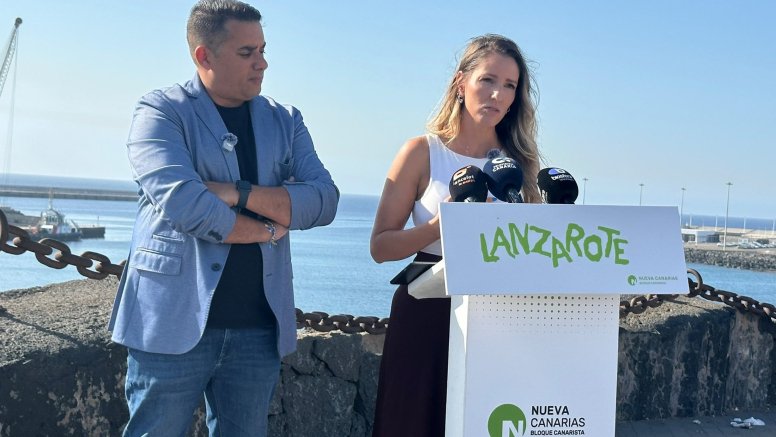
The candidate of Nueva Canarias-Bloque Canarista (NC-BC) for the Presidency of the Cabildo of Lanzarote, Yoné Caraballo, has proposed this Monday in a press conference that the next insular corporation arising from the May 2027 elections promote the creation of an Insular Tourist Tax that allows a part of the resources generated by tourist activity to revert directly to Lanzarote society and contribute to financing the needs that the island bears as a consequence of tourist pressure.
The proposal contemplates that the next Insular Cabildo of Lanzarote build a sufficient political and institutional majority to submit to the Parliament of the Canary Islands a Legislative Initiative aimed at establishing a tax on tourist overnight stays on the island.
Caraballo proposes that this process have the maximum possible political and institutional support in Lanzarote, so that the implementation of the tax is the result of an Island agreement and not solely of a partisan initiative. The new Law of Cabildos allows these institutions to exercise legislative initiative before the Parliament of the Canary Islands through the presentation of bills.
That tourist wealth reverts to Lanzarote
For Yoné Caraballo, there is a contradiction that must be addressed, which is that "Lanzarote is one of the main tourist powerhouses in the Canary Islands, but it lacks a specific instrument that allows a part of that wealth to revert directly to the needs of the population", furthermore, the candidate states, "the majority of Lanzaroteans are in favor of this instrument".
"Lanzarote cannot limit itself to absorbing tourist pressure. If we have more visitors, more occupation of our territory, and more demand for water, roads, transport, cleaning, public services, and housing, we must also obtain more resources to meet those needs," he points out.
The collection of the future Insular Tourist Tax should have a clear social and territorial purpose, being allocated, among other things, to public housing, transport, cleaning, environmental protection, public services, water management, and policies aimed at the young population.
A tax on cruise passengers to finance public housing in Arrecife
This insular proposal is complemented by the initiative defended by the spokesperson for NC-BC in Arrecife, Sheila Guillén, to establish a specific tax on cruise passengers arriving in the capital.
The proposal contemplates two rates depending on the ship's stay time. Five euros per passenger on cruises with a stay of less than 12 hours. And 2.5 euros per passenger on cruises with a stay of more than 12 hours.
With the cruise traffic forecasts handled by the Arrecife City Council, around 700,000 cruise passengers annually for this 2026, revenue could reach up to 3.5 million euros, depending on the distribution of passengers between both tiers. With a figure of 900,000 cruise passengers expected to be reached in 20230, the maximum revenue would reach 4.5 million euros annually.
Sheila Guillén proposes that these resources be allocated entirely to create a Municipal Youth Emancipation Fund, with the objective of promoting a genuine public housing stock owned by the municipality.
The proposal contemplates the construction of between 108 and 120 municipal public housing units during the first four years and reaching approximately 240 housing units in eight years, depending on the effective revenue and the municipal execution and financing capacity.
“We want the resources generated by tourist pressure on Arrecife to become opportunities for our young people to emancipate themselves and stay to live in our city,” defends Guillén.
NC-BC recalls that today the Youth Emancipation Index of the Canary Islands is at 14.1%, meaning that 86% of young people between 18 and 30 years old still live in their parents' homes. It is the lowest emancipation rate in the European Union. Furthermore, they point out that 36% of young Canary Islanders with jobs are at risk of poverty.
“We cannot absorb all the tourist pressure without receiving resources”
For NC-BC, both proposals are part of the same vision, “to make Lanzarote's tourism success have a greater social return for the population.”
Caraballo considers it an anomaly that an island like Lanzarote, an international tourist benchmark, does not have its own instrument of this kind, while other tourist territories have developed mechanisms for part of the income associated with tourist activity to contribute to financing public policies.
The same reflection extends to Arrecife, a port city that receives hundreds of thousands of cruise passengers each year and that, according to Guillén, “must be able to obtain specific resources from that activity to meet its needs. Port and tourist cities like Barcelona or Venice have tourist instruments linked to their visitors and cruises.
“Arrecife and Lanzarote cannot simply absorb the tourist pressure. We cannot assume the impact on our roads, our public spaces, our housing, our services, and our territory without also collecting resources that benefit society,” argues Yoné Caraballo.
Add La Voz de Lanzarote as a preferred Google source.
Stay informed with the latest current news.