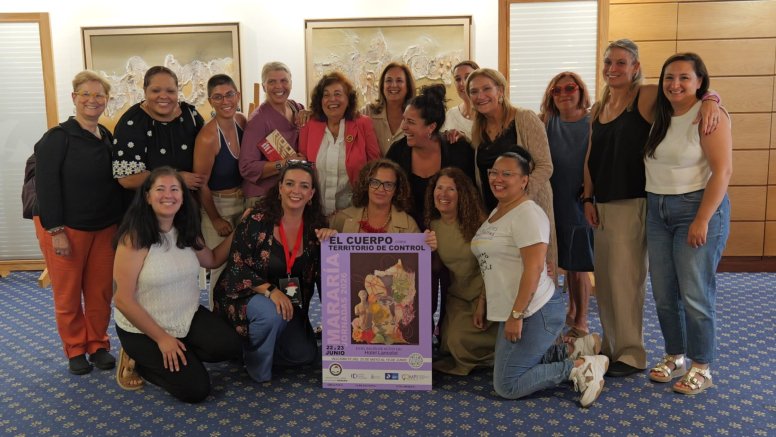
The center of the fourth wave of feminism, also called feminism 4.0, is occupied by the denunciation and the fight against sexual, physical, and digital violence, which includes the practices of trafficking, a true source for prostitution, and pornography, a pedagogical tool of the misogynistic culture of desire.
This was made clear at the annual conferences of the Mararía social and cultural association for women, dedicated to debating and delving into the female body as a territory of control. The conferences concluded with the denunciation of the current patriarchal rearmament and the need to maintain pressure in the streets, at a time of very worrying demobilization, because progress has historically been achieved through demands.
Two hundred people attended in person and online this meeting of feminist reflection and debate, whose sessions on June 22 and 23 are recorded and available on the entity's YouTube channel. Participating in the inaugural event, along with President Nieves Rosa Hernández, were the Minister of Social Welfare of the Cabildo, Marci Acuña, and his counterpart in the Arrecife City Council, Maite Corujo.
In her speech, the president of the International Academic Network for Studies on Prostitution and Pornography (RAIEPP), Rosa Cobo, defined the conceptions of patriarchal, capitalist, and sexual libertarian consent, which deny female desire, turn women's bodies into an economic resource and social ladder, or substitute will for desire for them, within the framework of a revolution that sacralizes a sexuality hijacked by men.
“Faced with these discourses, feminist consent demands desire, will, and minimal structures of equality. And although in most of the world it is not possible, and although it never happens one hundred percent, there is an opportunity for women because history is not written,” she pointed out.
The doctor in Sociology from the ULL and expert in sexual violence, pornography, and prostitution, Esther Torrado, denounced patriarchal ideology and politics, “a gentlemen's agreement that sustains, normalizes, and minimizes violence.” “Despite the fact that we increasingly have more science, more accounts, more complaints, and more legislation with a gender perspective, politics and research continue to fail to give women their place, they continue to consolidate male privilege.”
She agreed in her speech with the journalist and director of Feminicidio.net, Graciela Atencio, on the efforts of cancellation, censorship, and violence against women scientists, academics, and activists. "There is an attempt to erase women, to expel them from public life," she said. She advocated for the construction of a feminist artificial intelligence, developed by women, to counteract gender biases, and for having programmers "who provide us with tools to fight and not just to resist." The writer addressed the difficulty of penalizing digital practices such as deep-fakes, and the uselessness of national legislation against the globality of crimes.
The conferences, followed by discussions with attendees, were completed with a round table on associations working with victims of gender violence, the screening of the music videos "Poderosas" and "Stop Tratas," made by members of the Association Action against Trafficking, and the presentation of the book "Spain, the European Thailand. The Sewers of Prostitution," by Kamila Ferreira with contributions from Merlín Vargas, both survivors of trafficking.
The staging of the performance Manicomia Poética, by women poets from Fuerteventura, under the artistic direction of Anna Villacampa, was the cultural contribution of this annual edition of the Mararía Conferences.