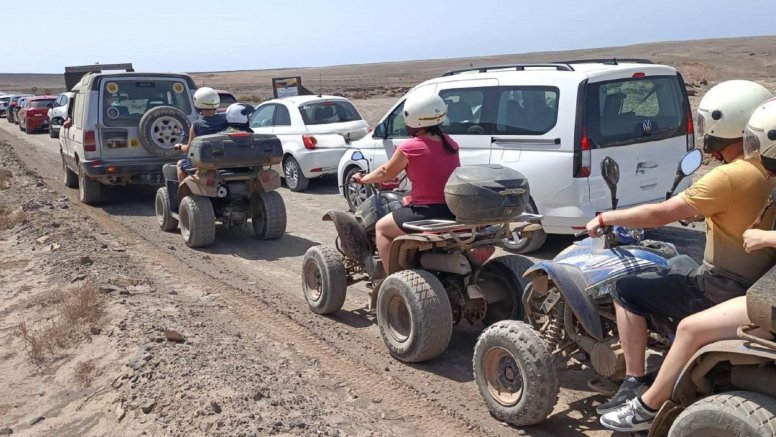
The Territorial Policy of the Cabildo of Lanzarote informs that it continues with the administrative procedures to agree on the precautionary suspension of tourist excursions organized in buggies, quads, and safari vehicles on rural land on the island, while progress is made in regulating this activity and defining the conditions for its possible development in a way compatible with the protection of the territory.
This action follows up on the procedure initiated by the island Corporation at the beginning of October, when it opened a prior public consultation to gather the opinions of citizens, town councils, owners of rural land, environmental organizations, sports clubs, and affected professional sectors on the regulation of motorized vehicle traffic in natural environments. The initiative aimed to study the necessary legal tools to establish common criteria for the entire island and limit the impacts derived from these practices. The consultation has registered high participation, and numerous objections have been received, the vast majority against these practices.
After this first step, the Cabildo states that it is now moving forward with the procedures to adopt drastic measures based on the technical and environmental reports obtained by the Institution, as well as on the requests made by various administrations and competent bodies. This documentation warns of the impacts that these activities generate on the landscape, ecosystems, traditional paths, and certain elements of Lanzarote's cultural heritage.
The president of the Cabildo, Oswaldo Betancort, emphasizes the island Corporation's responsibility to act to protect the island's natural and heritage values. “Lanzarote has a limited and particularly fragile territory, and we must act when there are reports warning of impacts that could compromise its conservation. Our obligation is to protect the island's natural and cultural heritage and ensure that the activities carried out on it comply with regulations and are compatible with our environmental values,” states Betancort.
The president highlights that the objective is to move towards a regulation that provides legal certainty and allows this problem to be addressed with homogeneous criteria throughout the island.
“We are working to provide a responsible response, based on technical and legal criteria, to a situation that requires regulating these activities. The protection of Lanzarote must be a priority, and we must have effective tools to guarantee it,” he adds.
For his part, the Minister of Territorial Policy and Territorial Planning, Jesús Machín Tavío, explains that “we have reports from various technical areas and competent bodies that agree in pointing out the effects that these activities can cause on the territory. As the Administration responsible for land management and protection, we must act with prudence and responsibility to prevent these impacts from continuing to occur,” states Machín.
Technical reports warn of effects on soil, landscape, and biodiversity
Among the impacts identified in the technical documentation are soil compaction and erosion, loss of fertile land, dust generation, effects on crops and native vegetation, disturbance to fauna, noise pollution, the appearance of new tracks, and deterioration of rural roads and infrastructure. Possible impacts on elements of archaeological and ethnographic heritage are also warned against.
The absence of an island network of specifically authorized routes for these activities has favored the circulation of excursions along agricultural roads, traditional tracks, and areas of environmental value, causing disturbances to residents and farmers, in addition to impacts on the environment.
Consequently, the Institution is considering adopting drastic measures while the regulatory framework that allows for the regulation of this activity continues to be developed. Among the alternatives studied by the Cabildo is the drafting of a Provisional Insular Ordinance, provided for in Law 4/2017, on Land and Protected Natural Areas of the Canary Islands, with the aim of establishing homogeneous criteria for rural land while the processing of the new Insular Planning Plan continues. Likewise, the possibility of establishing an official network of motor routes subject to specific restrictions has been considered.
Add La Voz de Lanzarote as a preferred Google source.
Stay informed with the latest current news.