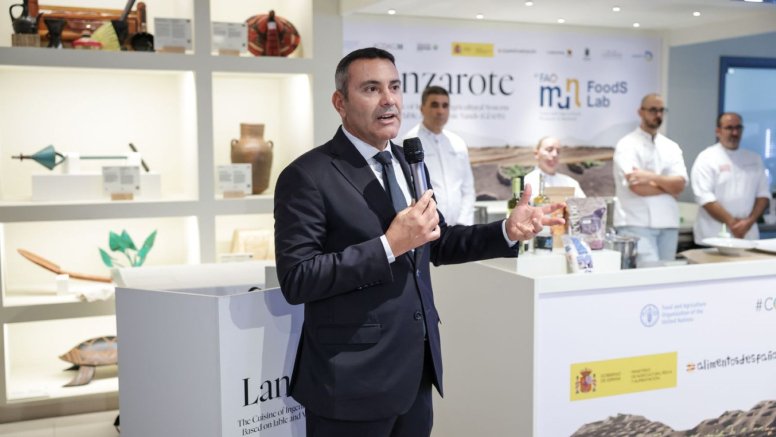
Lanzarote presented this Thursday at the headquarters of the Food and Agriculture Organization of the United Nations (FAO), in Rome, its unique agricultural, landscape, and gastronomic heritage through the event 'Lanzarote, the cuisine of ingenuity: the agricultural systems of jable and volcanic sands (SIPAM)', an action coordinated by the Economic Promotion Area of the Cabildo, through the Saborea Lanzarote brand, SPEL-Turismo Lanzarote, and the Area of Environment and Food Sovereignty, responsible for the development and monitoring of SIPAM Lanzarote.
The initiative, promoted by Turespaña through the Spanish Tourism Office in Rome, coincided with the celebration of the 30th session of the Committee on Agriculture (COAG), the main technical body of the FAO in agri-food matters, which brings together institutional representatives and international experts from July 20 to 24 in the Italian capital to address the main global agricultural challenges and strategies. The event, held in the FAO MuNe–Foods Lab space, brought together nearly a hundred attendees, including COAG participants and representatives and professionals from the Italian tourism sector invited by Turespaña.
The presentation allowed to show how the particular natural conditions of Lanzarote gave rise to unique cultivation systems, capable of transforming the scarcity of water, wind, jable, and volcanic sands into landscape, food, culture, and identity.
In 2025, Lanzarote was recognized by the FAO as a Globally Important Agricultural Heritage System for its agricultural systems in jable and volcanic sands. This designation incorporates the Island into an international network comprising more than a hundred agricultural systems and recognizes cultivation methods based on knowledge accumulated over generations and the adaptation of agriculture to particularly complex environmental conditions.
The president of the Cabildo de Lanzarote, Oswaldo Betancort, thanked the FAO for this international recognition and highlighted that “SIPAM is not only a distinction for Lanzarote, but also a commitment to the generations of farmers who have managed to turn the difficulties of the territory into knowledge, creativity, and opportunities”. Betancort pointed out that “the strategy developed by the Cabildo aims to strengthen the primary sector and protect our identity through an alliance between agriculture, gastronomy, and tourism”.
“This combination is contributing to preserving our landscape, fostering generational change, generating local economic activity, and ensuring that a larger portion of tourism revenue remains and is distributed on the Island itself,” he added.
A Living and Resilient Agricultural System
The Deputy Director of the FAO’s Office of Climate Change, Biodiversity and Environment, Piedad Martín, highlighted Lanzarote’s incorporation into the global network of Globally Important Agricultural Heritage Systems.
Martín emphasized that “GIAHS are not landscapes frozen in time, but living, dynamic, and resilient systems, where food production, biodiversity, traditional knowledge, and cultural identity are deeply interconnected.”
“Lanzarote is an extraordinary example of adaptation to the territory. Its farmers have developed solutions over generations capable of conserving moisture, protecting crops from the wind, and producing food under conditions of great aridity,” he stated.
For his part, Spain’s Permanent Representative to the FAO, Fernando Miranda Sotillo, highlighted that Lanzarote’s designation “allows for the international projection of an agricultural system that combines tradition, innovation capacity, and extraordinarily efficient management of limited natural resources.”
He also considered that “the protection of these models must be accompanied by measures that guarantee their economic and social continuity, supporting farmers, facilitating generational change, and promoting knowledge exchange among the territories that are part of the GIAHS network.”
Representing Lanzarote, through the Department of Environment and Food Sovereignty of the Cabildo, Samuel Martín, underlined that the recognition “values much more than unique agricultural techniques, because it recognizes a culture built around the land, knowledge transmitted between generations, and a way of producing fully adapted to available resources.” Martín explained that “cultivation in jable and volcanic sands constitute systems that we must conserve, but also strengthen so that they continue to be productive and have a future.”
In this regard, he highlighted the need to “support those who work the land, protect agricultural biodiversity, recover local varieties, and ensure that new generations find real opportunities for professional and economic development in the primary sector”.
“The designation by the FAO implies a collective responsibility. It is not just about conserving a landscape, but about keeping alive a system that produces food, preserves knowledge, sustains our identity, and reinforces the food sovereignty of Lanzarote and La Graciosa,” he added.
Gastronomy as a tool for dissemination
The Head of Dissemination and Promotion of the FAO Communication Office, Clara Vélez Fraga, valued the format chosen to bring Lanzarote's agricultural heritage closer to attendees. Vélez Fraga highlighted that “gastronomy allows agricultural and environmental knowledge to be conveyed through an accessible, understandable experience capable of connecting with very diverse audiences”.
“Each product and each preparation tells a story about the landscape, biodiversity, the work of communities, and their ability to find solutions to environmental difficulties,” she pointed out.
She also indicated that “one of the main challenges of dissemination is to ensure that the value of these agricultural systems reaches beyond technical and specialized fields.” In her opinion, “the presentation of Lanzarote demonstrates how communication, culture, and gastronomy can contribute to raising awareness about the importance of conserving world agricultural heritage.”
Three chefs from the Island developed a gastronomic presentation and a show cooking using products linked to the SIPAM Lanzarote and the island's culinary tradition, with the collaboration of producers, restaurateurs, and professionals from Lanzarote's gastronomic sector.
The reception began with "papas arrugadas" (wrinkled potatoes) accompanied by green and red "mojos" (sauces), crispy sweet potato from the sand, and a selection of Lanzarote goat cheeses with artisanal jams. Under the concept of "the cuisine of ingenuity," the menu included horse mackerel marinated with pickled sand carrot; Tinajo tomato with La Santa scarlet shrimp and herb essence; Canarian "sancocho" with "mojos" and kneaded "gofio"; "gofio" stew with fish broth from the Marine Reserve; and corn broth.
The sweet table featured frangollo, kneaded gofio, sweet potato trout from the jable, gofio shortbread, and bonbons made with smoked goat cheese from Quesería El Faro and salt from Janubio.
The offering was accompanied by wines from the El Grifo and La Geria wineries, Primo de Lanzarote vermouth, and a selection of craft beers from Malpeis, Nao, Vulcan Aloe Pale Ale, and 2 Cabras.
As the Minister of Economic Promotion of the Cabildo of Lanzarote and La Graciosa, Nori Machín, highlighted that this presentation "has allowed us to show the capacity of Lanzarotean products to compete and differentiate themselves on a first-class international stage, not only for their quality, but also for the history, landscape, and effort of the producers behind each creation."
Machín explained that "Saborea Lanzarote works to connect the primary sector with restaurants, the agri-food industry, and markets, generating new commercialization opportunities and increasing the added value of our products."
"Bringing our chefs, producers, wines, cheeses, craft beers, and traditional dishes to Rome contributes to opening new avenues for promotion and strengthening a local economic fabric in which agriculture, livestock, fishing, restaurants, and tourism advance in a coordinated manner," she stated.
The minister also emphasized that "the value of local products does not end with their production, but grows when we are able to transform them, incorporate them into restaurants, promote them, and ensure they reach new markets."
A destination connected to its identity
Finally, the CEO of SPEL-Turismo Lanzarote, Héctor Fernández, valued the opportunity to present the Island to a specialized international audience and assured that "gastronomy is not a complementary element of the tourist experience, but a direct expression of the territory, the landscape, and the culture of Lanzarote."
Fernández pointed out that "the cuisine of ingenuity represents the tourism model we are promoting: a tourism of higher added value, sustainable, connected with local producers, and capable of generating benefits that reach the entire Lanzarotean society."
He also highlighted that "bringing this narrative to the FAO headquarters reinforces Lanzarote's international positioning as a unique destination, where agriculture, landscape, heritage, and gastronomy are part of the same experience."
For his part, the Tourism Counselor of the Embassy of Spain in Italy, Turespaña-Ministry of Industry and Tourism, Gonzalo Ceballos Watling, highlighted that “gastronomy constitutes one of the great assets of Spain's international tourism promotion, because it allows us to present our destinations through their products, the people who make them, and the culture linked to each territory”.
Ceballos explained that the presentation of Lanzarote “is part of the international promotion actions for Spanish gastronomy developed by Turespaña in coordination with the Ministry of Agriculture, Fisheries and Food”.
“This collaboration seeks to integrate the tourism offer with the quality and diversity of Spanish food and beverages, reinforcing Spain's positioning as a benchmark gastronomic destination,” he added.
In this context, he pointed out that “Lanzarote particularly clearly represents the complementarity between tourism and agri-food promotion, because its gastronomy allows us to understand its landscape, its agricultural heritage, and the capacity of its population to adapt to the environment”.
Ceballos also valued the presence at the event of representatives and professionals from the Italian market, considering that “these actions bring Spanish destinations closer to prescribers, travel agents, and specialized actors, and contribute to positioning gastronomy as a cultural experience and as a tool for economic promotion”.
The collaboration between Turespaña and the Ministry of Agriculture, Fisheries and Food is developed through campaigns and events in international markets, professional conferences, gastronomic presentations, trade fairs, and communication actions in which chefs, producers, and professionals from the tourism and food sectors participate.
Add La Voz de Lanzarote as a preferred Google source.
Stay informed with the latest current news.