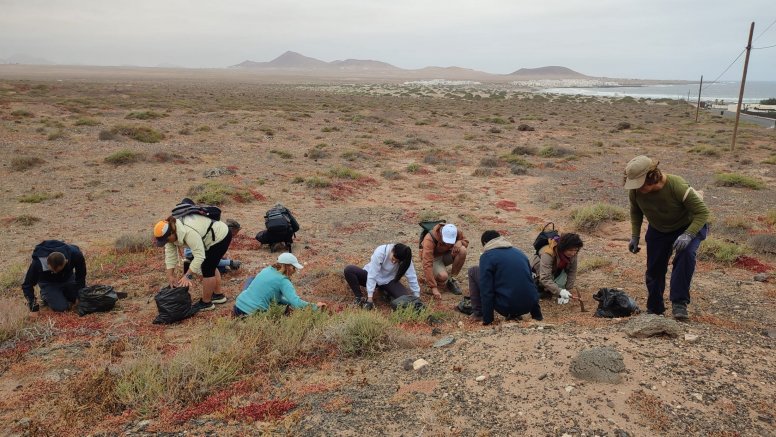
The early warning network RedEXOS, promoted by the Directorate General of Natural Spaces and Biodiversity of the Government of the Canary Islands, held a participatory activity last Sunday in Caleta de Famara for the identification and control of invasive plants. The route was organized by the La Palma Biosphere Reserve and the Cabildo de La Palma, with the assistance of numerous entities committed to nature conservation, with participants from Arrecife Natura, DesertWatch, the Association for the Conservation of Canary Biodiversity (ACBC), WWF, the Custodia del Territorio Papacría association, Horibonte, Permaterra, Ecologistas en Acción, and Trib-Arte.
The initiative, framed within the Alien CSI Bioblitz program and the awareness and conservation actions integrated into the Week on Invasive Species Portugal & Spain, seeks to bring citizens closer to the problem that Invasive Alien Species (IAS) represent for island biodiversity, encouraging active participation in their early detection, monitoring, and control. In this context, RedEXOS reinforces its role as a surveillance and alert network aimed at preventing the introduction and establishment of invasive species in the Canary ecosystems.
During the morning, participants received practical training to recognize invasive species present in the environment, such as the "sun daisy" (Malephora crocea), an ornamental plant native to South Africa that has spread in various coastal ecosystems and can displace native flora.
The counselor of the Biosphere Reserve, Samuel Martín, thanked the participants for their interest and highlighted the importance of citizen collaboration "to detect new invasive species early and act before they become established or spread and to minimize their impacts on biodiversity, natural resources, and socioeconomic activities associated with the territory."
RedEXOS is the early warning network of the Directorate General of Natural Spaces and Biodiversity of the Government of the Canary Islands. Its mission is to improve early detection, surveillance, and rapid response to invasive alien species, by promoting coordination between administrations, scientific entities, social organizations, and citizens to protect the unique biodiversity of the Canary archipelago.
Add La Voz de Lanzarote as a preferred Google source.
Stay informed with the latest current news.