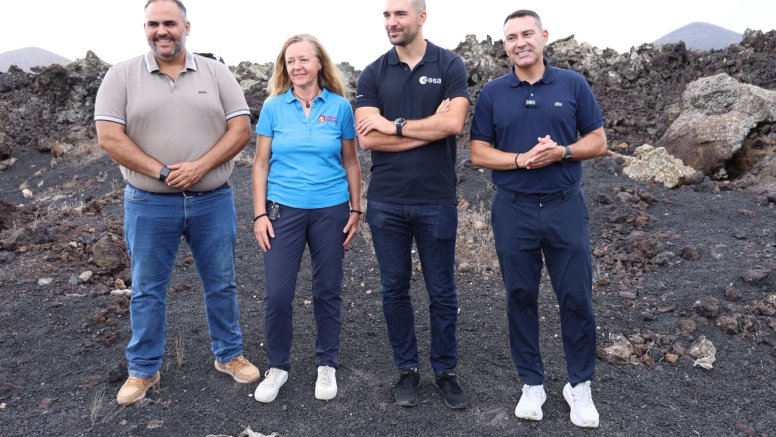
The president of the Cabildo of Lanzarote and La Graciosa, Oswaldo Betancort, has highlighted this Saturday the relevance of the UNESCO Global Geopark of Lanzarote and Chinijo Archipelago as a territory dedicated to the preservation of geology, the protection of natural heritage, and the development of scientific initiatives with international projection, during the meeting held in Tinguatón with the astronaut of the European Space Agency (ESA) Pablo Álvarez.
The event is part of the Spanish astronaut's participation in PANGAEA (Planetary ANalogue Geological & Astrobiological Exercise for Astronauts), the ESA training program that prepares astronauts to carry out scientific and geological fieldwork in future exploration missions to the Moon and Mars.
During the meeting, both the president of the Cabildo, the Geopark counselor, Samuel Martín; the head of the ESA's PANGAEA project, Loredana Bessone, and the astronaut Pablo Álvarez, shared the objectives of this initiative and the importance of collaboration between scientific institutions and territories of high geological value.
The choice of Lanzarote as the setting for this training responds to the exceptional characteristics of its volcanic landscape, which offers an environment of great interest for the study of planetary geology and allows astronauts to familiarize themselves with basaltic terrains and geological processes relevant to space exploration.
Oswaldo Betancort highlighted that "it is a pride that Lanzarote is once again the setting for a training program of the European Space Agency and that our volcanic landscapes serve to prepare astronauts who will participate in future exploration missions."
"This collaboration," he added, "allows us to show the world that Lanzarote not only possesses an extraordinary natural heritage, but is also a territory of knowledge, research, and innovation. The protection of our geology is a responsibility to future generations and, at the same time, an opportunity to contribute to scientific projects that expand the frontiers of human knowledge."
Betancort also underlined the Cabildo's commitment to the conservation and dissemination of the natural values of Lanzarote and La Graciosa, as well as to the promotion of collaborations with international scientific and technological organizations.
Geopark, a territory where geology is preserved
For his part, the Geopark advisor, Samuel Martín, explained that “a Geopark is not simply a space where we find volcanoes or unique landscapes. It is a territory where geology is preserved, the heritage that explains our planet is protected, and its knowledge is promoted through research, education, and dissemination”.
“That the ESA chooses Lanzarote to train its astronauts demonstrates the scientific value of our territory. Here we can study volcanic processes, analyze the relationship between volcanism and water, and better understand phenomena that have also been important in the evolution of other planetary bodies, such as Mars,” he added.
Lanzarote, a natural laboratory for planetary geology
Astronaut Pablo Álvarez emphasized that “Lanzarote is the best place in the world to learn to be the eyes and hands of scientists on the Moon and Mars”. The astronaut from León explained that the island offers the ideal terrain for training in planetary geological exploration.
In this regard, the head of the ESA's PANGAEA project, Loredana Bessone, greatly valued “the high level of conservation and protection that the island of Lanzarote has” and stressed that the training on the island helps to better interpret the terrain, carry out geological surveys, identify and collect samples of scientific interest, and work in coordination with scientific teams on the ground during future exploration missions.
The training developed in Lanzarote is part of a multi-week itinerary that includes different locations of geological interest in Europe. The island's volcanic landscape, its extensive basaltic terrains, and the diversity of geological structures make Lanzarote a privileged environment for training in planetary geology.
Add La Voz de Lanzarote as a preferred Google source.
Stay informed with the latest current news.