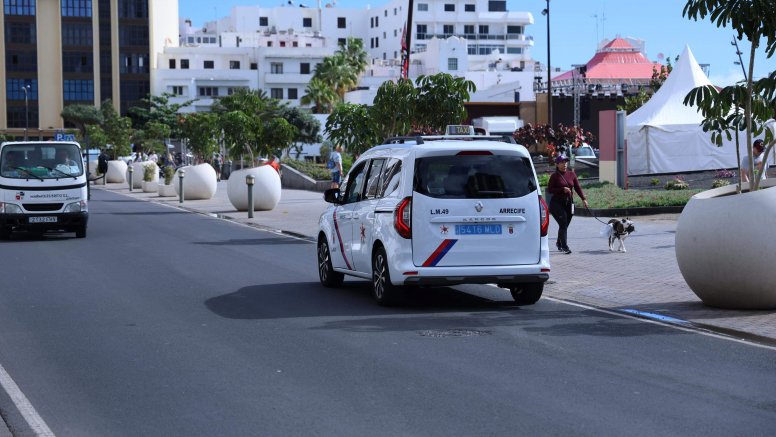
The Cabildo of Lanzarote and La Graciosa has taken a decisive step in improving island mobility with the plenary approval and subsequent publication in the Official Bulletin of the Province of the Regulation of Sensitive Areas of Lanzarote, a tool that will allow for the organization and strengthening of the public taxi service in those strategic areas of the island that concentrate a high demand for transport.
The new regulation comes after more than two decades without specific regulation in this matter and is born as a response to a historic demand from the taxi sector, public administrations, and citizens. Its objective is to guarantee a more efficient, coordinated, and adapted service to the current reality of Lanzarote.
The president of the Cabildo, Oswaldo Betancort, emphasized that the Regulation represents “a fundamental step forward to continue modernizing mobility on the island and to offer effective responses to the needs of residents and visitors.”
“Lanzarote has experienced a significant transformation in recent years and our transport infrastructures are recording historic user numbers. It was necessary to provide ourselves with a tool that would allow us to act with planning, coordination, and legal certainty to guarantee an efficient taxi service at times of maximum demand,” said Betancort.
For his part, the Councillor for Transport and Mobility, Miguel Ángel Jiménez, explained that the regulation responds to a real need of the island. “It is about regulating those spaces where there is a large concentration of people who need adequate transport and a quick response from the public taxi service. It is a long-demanded measure that is born from consensus and dialogue.”
Jiménez also highlighted that the drafting of the Regulation has been supported by a socioeconomic study and by the mobility data recorded on the island. “The Lanzarote Airport received more than 8.7 million passengers during 2024, while the Port of Arrecife exceeded 600,000 travelers. These figures justify the need to have tools that allow for strengthening the service when circumstances require it.”
He also thanked the collaboration of the three taxi cooperatives of Lanzarote and the municipalities of San Bartolomé and Arrecife, “whose involvement has been fundamental to build a regulation that is agreed upon and adjusted to the real needs of the island.”
Airport and Port of Arrecife, first Sensitive Areas
The Regulation establishes the legal framework for the declaration and regulation of Sensitive Areas in ports, airports, stations, and transport interchanges, taking into account their status as strategic infrastructures of public interest and the high volume of users they concentrate.
As a first measure, the following are declared Sensitive Areas: César Manrique-Lanzarote Airport and Arrecife-Los Mármoles Port. The decision is based on 2024 mobility data and technical reports that confirm the need to reinforce the service at certain times of high demand.
More coordination, technology, and guarantees for the service
The regulations will allow, in an exceptional and temporary manner, the activation of mechanisms to reinforce the service through the participation of taxis from other municipalities when circumstances require it, always under technical criteria and by motivated resolution of the Cabildo.
It also incorporates systems of organization, management, and control to guarantee an efficient and transparent service, including the use of technological tools, the mandatory application of the official rates approved by the Government of the Canary Islands, and the creation of a Monitoring Commission made up of institutional, professional, and citizen representatives.
During the drafting of the Regulation, hearings were given to the affected municipalities, the representative associations of the taxi sector, and the organizations of users, in compliance with the current regional regulations. With this initiative, the Cabildo provides Lanzarote with a key tool to respond to the current challenges of mobility and improve the quality of the public taxi service on the island.
Add La Voz de Lanzarote as a preferred Google source.
Stay informed with the latest current news.