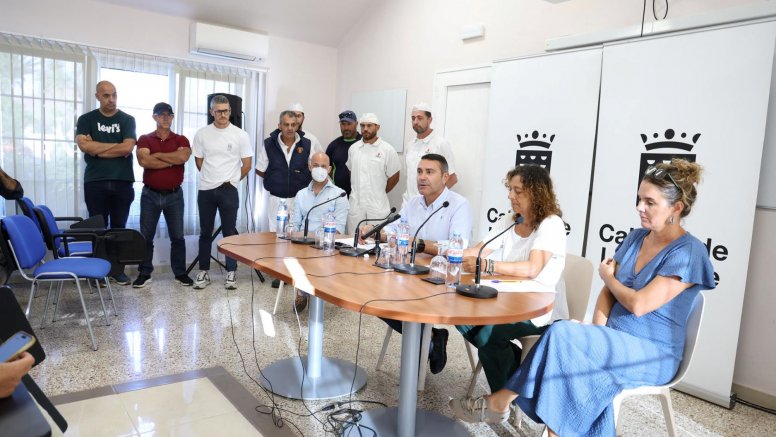
The president of the Cabildo of Lanzarote and Minister of Agriculture and Livestock, Oswaldo Betancort, offered this Thursday a press conference at the Experimental Agricultural Farm - accompanied by a large group of workers - to report on the error committed in the 2025 campaign of distribution of local variety seeds.
During the appearance, Betancort explained that, "due to a human error, some packages of castor bean seeds were distributed instead of pinto bean seeds, due to the physical similarity between both varieties." The president stated that "the Island Agricultural Service has always maintained the traceability of the seeds and that there is total control over the affected batches: of the 77 packages distributed, 69 have been collected, and the remaining recipients have signed a declaration of responsibility committing to their return."
The Cabildo has opened an information file that, predictably, will confirm that it was a human error. It will also adjust the existing protocol to avoid similar cases. Betancort reiterated the professionalism of the workers of the Experimental Agricultural Farm, and clarified that "there was never a risk to public health since the Farm distributes seeds only for sowing and not for direct consumption."
The president detailed that, "on September 22, an applicant reported having received incorrect seeds. Immediately, an action protocol was activated that included, first, sending SMS to all applicants for pinto beans informing of the error and requesting the urgent return of the seeds. Then, telephone calls were made to all those involved to explain the situation and coordinate the delivery. And finally, the seeds were collected at the farmers' homes in case of impossibility of displacement."
Total transparency
The technical report prepared by the Island Agricultural Service details that "the error occurred when an operator, not finding enough seeds in a container, opened a new bag without checking the label, guided only by the appearance of the seeds."
Ricinus communis, known as castor bean, is a plant that grows wild on the island and is used for ornamental and industrial purposes. Its seeds are not suitable for direct human consumption, as they contain a toxic protein, although oil with medicinal, cosmetic and industrial applications is obtained from the plant.
The local variety seed campaign, which the Cabildo has been carrying out for more than 20 years, includes the distribution of traditional legumes and cereals from Lanzarote, such as onions, peas, chickpeas, broad beans, beans, white beans, butter beans, black beans, pinto beans, millet, wheat, oats and rye. The distribution is carried out respecting the order of entry of applications and ensuring the traceability of each delivery.
Betancort concluded the press conference emphasizing "the responsibility and transparency of the Cabildo and the professionalism of the teams of the Experimental Agricultural Farm, reiterating that the situation has already been resolved and that security and confidence in the management of local variety seeds are maintained."
Add La Voz de Lanzarote as a preferred Google source.
Stay informed with the latest current news.