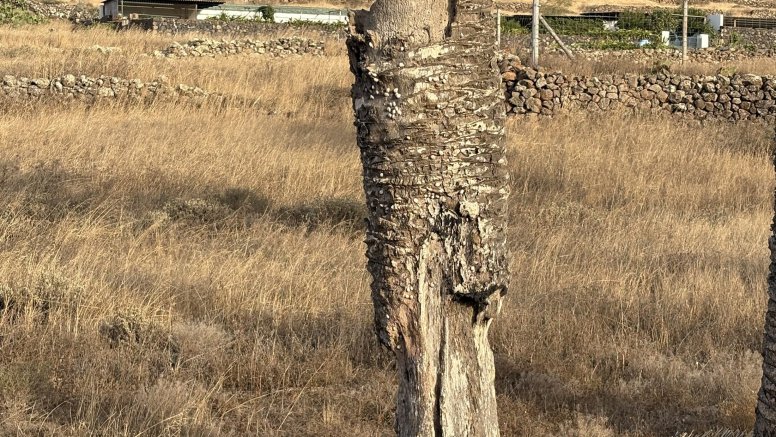
Liberación Canaria has expressed in a press release its "concern" about the situation of the palm grove in the municipality of Haría, one of the most recognized natural and identity symbols of Lanzarote and an essential part
of the landscape that has given fame to the municipality as the Valley of a Thousand Palms.
In recent years, residents of the municipality have expressed their concern about the presence of dead palm trees, diseased specimens, disappearance of palm trees in certain areas and a growing perception of progressive loss of this unique landscape. This concern deserves, they argue, "a public, clear, and documented response from the competent administrations."
"The palm trees of Haría are not a mere ornamental element. They are part of the history, the landscape, the collective memory, and the natural heritage of the municipality. Their conservation requires planning, technical monitoring, institutional coordination, and a sustained commitment over time," they state.
Liberación Canaria considers it necessary for the Haría City Council to publicly inform about the current state of the palm grove, the results of the health study announced in 2023, the actions taken since then, the treatments applied, the areas intervened, the number of affected specimens, and the measures planned to prevent further losses.
The existence of island plans for control against *Diocalandra frumenti* and phytosanitary actions in Lanzarote "confirms that the problem of the palm grove cannot be treated as a minor issue."
Precisely for this reason, they point out that "Haría needs transparent information, updated technical evaluation, and a specific roadmap to protect one of its greatest natural and cultural assets."
Liberación Canaria requests the Haría City Council and the Cabildo de Lanzarote to "clarify the role of the Haría palm grove within the island conservation actions, what resources are being allocated to the municipality, and what concrete plan exists to recover the lost specimens, treat the affected ones, and guarantee future maintenance."
Likewise, they propose the implementation of a Recovery and Conservation Plan for the Haría Palm Grove, which includes, at least, several points:
- The progressive replacement of Canary Island date palms in places where specimens have been lost.
- Periodic technical monitoring of the palm grove's health status.
- The publication of updated data on affected, treated, removed, and replaced specimens.
- Coordination between the City Council, Cabildo, Government of the Canary Islands, private owners, and specialized technical personnel.
- Prevention and control measures against pests.
- A landscape conservation strategy that allows for the recovery and protection of Haría's historical image as the Valley of a Thousand Palms.
"It is not about making a simple complaint, but about demanding responsibility, transparency, and planning. If actions are already underway, citizens have the right to know their scope, their results, and
their next steps. If they are insufficient, they must be reinforced," they point out.
"Caring for Haría's palm grove is protecting the history, identity, landscape, and natural heritage of a municipality that cannot afford to lose one of its most recognizable symbols," they conclude.
Add La Voz de Lanzarote as a preferred Google source.
Stay informed with the latest current news.