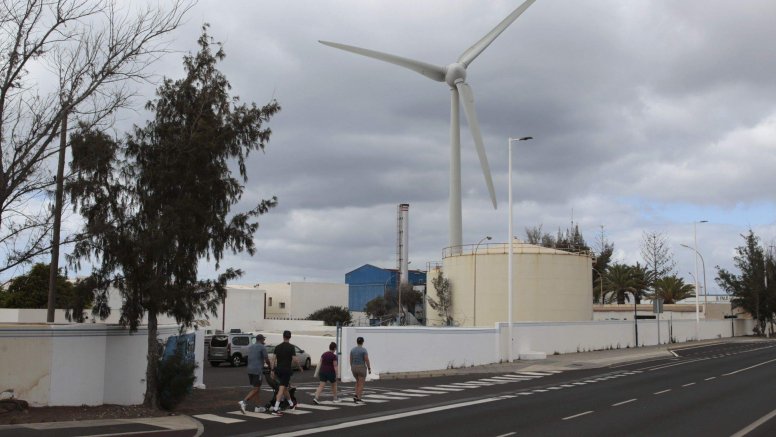
The Minister of Territorial Policy, Territorial Cohesion and Water of the Government of the Canary Islands, Manuel Miranda, has called on the State this Friday for a specific hydraulic works agreement that allows to address the "very serious needs" that Lanzarote has in terms of desalination and purification, whose financing, he has warned, cannot be assumed solely by the autonomous community and island institutions.
"The structural problems it has in terms of desalination and purification are very, very serious," the minister stressed in the Parliament of the Canary Islands, warning that it will be "impossible" to resolve them economically with exclusively regional and island financing.
Therefore, he has called on the central government to materialize the initiatives proposed from the Canary Islands so that large desalination and purification plants are considered works of general interest and can be financed with state funds.
Miranda has particularly called for a new hydraulic works agreement that goes beyond a contribution of 20 million euros and allows for addressing the island's structural needs, which, as he pointed out, are already affecting the quality of life of its inhabitants due to the "continuous water cuts" that occur "practically daily".
In his opinion, the situation of Lanzarote's hydraulic infrastructures was "critical" when the current regional government began its term in 2023 and acknowledged that, despite the actions developed since then, the island continues in a water emergency.
Likewise, the minister recalled that one of the first decisions adopted by the regional Executive was to transfer to Lanzarote the portable water production plants that had been used during the crisis caused by the La Palma volcano, a measure that, although it took time to become operational, "helped alleviate the island's water stress situation".
Among the problems detected at the beginning of the term, he cited difficulties in system management, lack of hydrological planning, and the need for significant investments due to the deterioration and obsolescence of infrastructures.
In this regard, he recalled that the Government had to promote the approval of the Lanzarote Hydrological Plan, which was approved in the early months of 2025 and allowed the island's planning to be adapted to European requirements.
Miranda also highlighted the investments aimed at recovering water production capacity and cited the work on the racks of the Lanzarote 3 and Lanzarote 4 facilities, one of them with a capacity of approximately 10,000 cubic meters.
The minister explained that the situation also affects sanitation and purification infrastructures. In La Graciosa, he indicated that the works to guarantee the water supply will begin soon, after they have been awarded for just over three million euros.
In terms of sanitation, he expressed confidence that during the first quarter of 2027, the execution of works in Caleta de Sebo can begin, along with the installation of a new purification plant. He also pointed out the need to renew the Playa Blanca purification plant, a project that is being finalized and will have state financing. The planned investment is between 12 and 14 million euros, as indicated.
Miranda insisted that Lanzarote must remain in a state of emergency to expedite the necessary actions, after Fuerteventura and Tenerife have been able to exit that declaration.
Add La Voz de Lanzarote as a preferred Google source.
Stay informed with the latest current news.