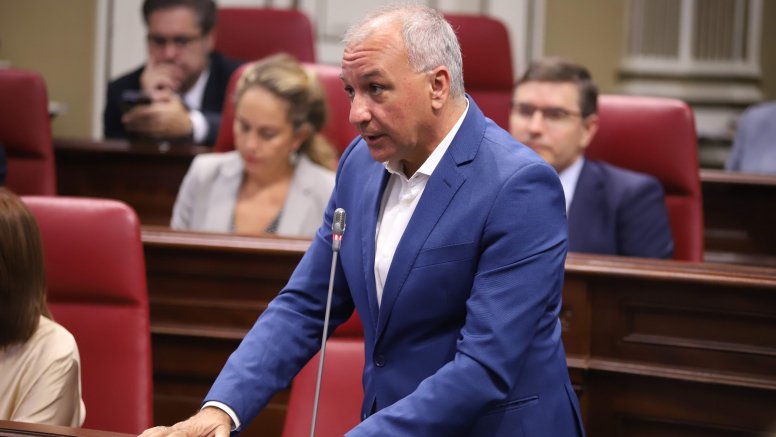
The candidate of Unidad del Pueblo Canario (UPC) for Congress for Las Palmas, Luis Campos, believes that the general elections of November 29 transcend a mere political change, as a victory that brings the PP and Vox to power will mean "losing all the rights conquered in the last 70 years".
In an interview with EFE, the lead candidate of the Canary Islands left-wing coalition - made up of Nueva Canarias, Podemos, Izquierda Unida, and Sumar, and also supported by organizations such as Los Verdes, Recortes Cero, municipalist forces, unions, and social groups - details the pillars of the electoral program, already 90% complete, with a special focus on intervention in the real estate market, changing the tourism model, and a comprehensive review of immigration policy.
A year of conversations in the Canary Islands left
Regarding the unity of the left, which has not been achieved at the national level, Campos points out that it is the result of more than a year of work, the "generosity" to set aside party labels, and the citizen mandate in the streets against "the threat of democratic regression".
Faced with unfavorable opinion polls, the leader of NC recalls international precedents such as Brazil to emphasize that "when the left unites, mobilizes, and goes to the polls with a firm voice in defense of the social majority, forecasts are reversed".
On the social front, Campos describes housing as the archipelago's main problem, affecting family finances, mental health, and young people's expectations.
Although he attributes direct management competence to the regional government of Fernando Clavijo (CC), he proposes that Congress can promote a constitutional reform to enshrine housing as a fundamental and enforceable right, authorize municipalities to cap prices and declare stressed areas, transfer funds for a permanent public housing stock, and implement sanctioning measures or compulsory transfer against speculation by large holders and financial entities.
He also insists on the advisability of restricting the acquisition of properties by foreigners or non-residents in the islands for rental purposes, and warns that the European Union will only support exceptions if the Canary Islands have previously exhausted their powers through moratoriums, declassification of land, or the implementation of a tourist tax.
Furthermore, he considered it necessary to curb the growth of that sector and tackle vacation rentals: "In the Canary Islands today, there is no room for even one more vacation home in urban residential areas or popular neighborhoods," he states.
On immigration matters, the UPC candidate flatly rejects the claims of PP and Vox to suspend transfers or return unaccompanied minors and accuses them of seeking to turn the islands "into an open-air prison."
In contrast, he calls for legal asylum channels at the source, raising the state budget for cooperation to 0.7%, a solidarity-based and binding distribution within the EU, and immediate contingency protocols to avoid saturations like the one El Hierro is currently experiencing.
In electoral terms, Campos places the expectations of this confluence in fighting for two seats in Las Palmas, achieving representation in Santa Cruz de Tenerife, and obtaining senators, relying on the more than 150,000 votes that their parent forces (NC and Sumar) garnered in the previous elections.
Luis Campos guarantees that UPC will "never" facilitate an agreement that allows the right and far-right into the Spanish government.
At the same time, he censures Coalición Canaria for agreeing with Vox in local island corporations, such as Teguise, Arona, or Granadilla, and showing a willingness to negotiate: "If it depends on Coalición Canaria, they will open the door to the right and far-right in Spain, just as they have already done in the Canary Islands institutions," he emphasizes.
Add La Voz de Lanzarote as a preferred Google source.
Stay informed with the latest current news.