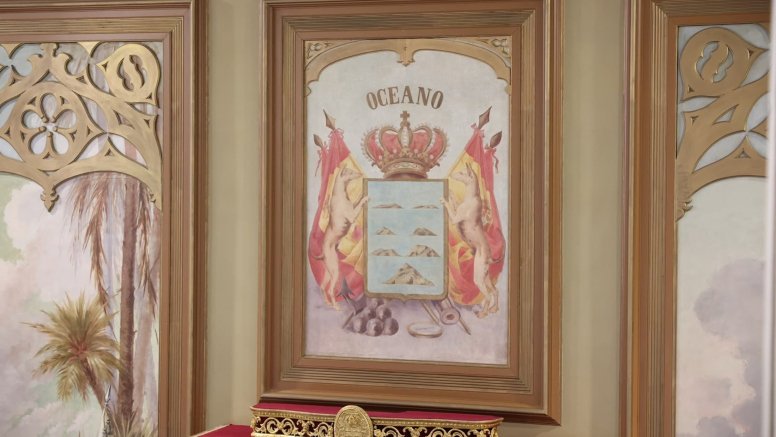
The president of the Parliament of the Canary Islands, Astrid Pérez, presented this Wednesday the restoration of the historical oil painting located at the top of the back wall of the Plenary Hall, a work attributed to the La Palma painter Manuel González Méndez and initially dated in 1906, which had remained hidden for more than four decades under different layers of decorative paint.
The recovery of the canvas allows the hemicycle to regain an essential element of its original artistic conception and complete the pictorial ensemble conceived at the beginning of the 20th century for the building that would later become the seat of the Parliament of the Canary Islands.
“Today is an important day in the history of our Parliament of the Canary Islands, but it is even more so for the historical heritage of the Canary Islands,” said Astrid Pérez during the presentation. The president recalled that the oil painting, which represents the coat of arms of the Provincial Deputation of the Canary Islands, had remained hidden since the remodeling of the Plenary Hall carried out in the eighties.
The president explained that, at the beginning of the 20th century, when the building was being prepared to become the seat of the Provincial Deputation, three large paintings were commissioned to decorate its main hall. Two of them represent episodes related to the conquest of the islands, The Foundation of the city of Santa Cruz and The Surrender of the aboriginal princess, while the third element was the coat of arms of the Provincial Deputation that has now been recovered. “We are not simply recovering a painting; we are returning a part of its original artistic conception to the hemicycle,” the president emphasized.
Astrid Pérez also announced that the other two works will also be restored, and pointed out that the Parliament has already initiated the contracting procedure for the company that will carry out this work.
The restorer Agustina Torino, responsible for the intervention, explained during the presentation the complexity of the oil painting recovery process, which required working on the different layers that had hidden the original painting. “It has been a very precise job. There were four layers of paint and we had to discover what was underneath without knowing exactly what we were going to find,” explained the restorer.
To reach the original painting, it was necessary to carry out an extremely meticulous intervention, using a scalpel to remove the different superimposed layers in a controlled manner. “It has been like discovering the work little by little, with a scalpel, millimeter by millimeter, until reaching the original painting,” said Torino.
The work has been carried out by the company Cúrcuma, represented during the presentation by Julio del Rosario Fuentes, together with the restorer Agustina Torino.
The president of the Parliament highlighted the work carried out to recover a piece that remained practically forgotten and that, once restored, is visually integrated again into the artistic ensemble of the Plenary Hall.
Astrid Pérez also emphasized that the protection of the Chamber's heritage constitutes an institutional responsibility and assured that the Parliament will continue working to identify, study, conserve, and enhance its artistic and historical assets.
Add La Voz de Lanzarote as a preferred Google source.
Stay informed with the latest current news.