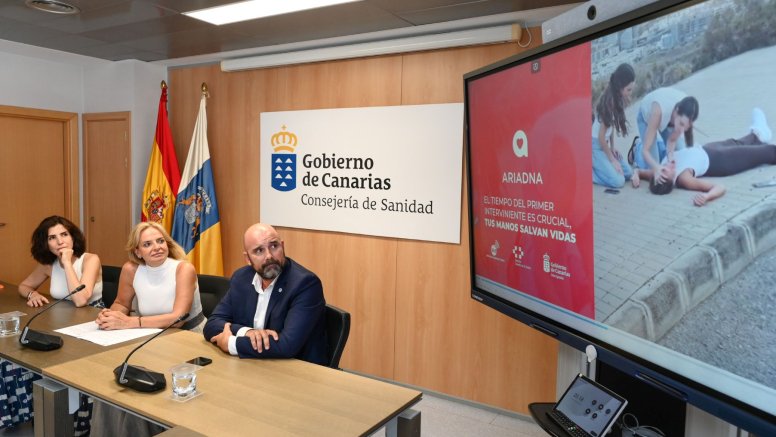
The Ministry of Health of the Government of the Canary Islands today presented the Ariadna app, an application developed for mobile phones, which helps reduce response times to a cardiac arrest. This application will be managed by the health coordinators -doctors and nurses- of the Canary Emergency Service (SUC) from the emergency room and is designed to offer a rapid response, locating the volunteer with knowledge in cardiopulmonary resuscitation and the use of semi-automatic defibrillators (DESA) close to the place where the arrest occurs.
This resource was presented this morning at a press conference by the Minister of Health, Esther Monzón, the director of the SUC, Noemí González, and the coordinator of Healthcare Quality Projects of the Spanish Society of Cardiology and president of the Canary Society of Cardiology, Pablo Jorge Pérez.
Minister Esther Monzón explained that "with this initiative, the Canary Islands becomes the second autonomous community, after Galicia, to integrate the Ariadna application into its health emergency system, developed by the Spanish Society of Cardiology (SEC), the Spanish Heart Foundation (FEC) and the Red Cross, which raises the level of cardioprotection in the islands and marks a fundamental milestone in the fight against out-of-hospital cardiac arrest."
The Ariadna app, according to the president of the Canary Society of Cardiology, functions as a collaborative map and allows anyone who has it installed on their mobile phone to react in time to a cardiac arrest. In addition, along with the emergency call, the application locates the nearest DESA on the mobile, both in public and private spaces. Pablo Jorge highlighted the value of this tool, which already has experience in Galicia, because "it offers a coordinated, equitable and evidence-based strategy to reduce the impact of sudden death and improve survival in Spain."
A tool that adds up
According to the director of the Canary Emergency Service, "the health coordinators of the SUC daily attend numerous emergency calls for cardiac arrests that occur outside the hospital environment, in which the response time and the involvement of the first responders is essential to minimize sequelae and increase the survival of those affected, while health resources are dispatched to the scene of the incident."
With the launch of Ariadna, SUC professionals, in addition to activating the advanced life support resources of the Canary Islands Health Service's healthcare network, will be able to send alerts to users of this application so that they can act if a cardiac arrest occurs in their surroundings, until the arrival of professional health response.
In the Canary Islands, unlike other autonomous communities in the country, anyone can perform cardiopulmonary resuscitation and use a semi-automatic defibrillator, as long as they have the remote assistance of a SUC health coordinator from the emergency room, through the 1-1-2 emergency number, which increases the potential number of users of this application.
Ariadna can be downloaded through Google Play and the App Store, and the user must choose to register as a tracker to register new defibrillators or as a collaborator if they are a qualified user to attend emergencies.
Collaborators trained in cardiopulmonary resuscitation (CPR) will be geolocated and alerted by SUC professionals to go to the emergency site, and through remote assistance, they will be instructed on how to act until the arrival of health resources, which will have been activated from the outset.
Chain of survival
In the event of cardiac arrest, SUC professionals emphasize the importance of activating the chain of survival as soon as possible, which consists of the following steps:
Check if the person is conscious and breathing.
If not breathing, call the emergency number and put it on speakerphone.
Perform CPR maneuvers (100-120 compressions per minute on the center of the chest).
Ask a third person to locate the nearest defibrillator.
Follow the defibrillator's instructions to apply shocks.
Continue with CPR maneuvers until the ambulance arrives.
CPR training
In addition, the Minister of Health added that another of the objectives of the Ministry of Health is to continue promoting Cardiopulmonary Resuscitation training in order to reduce response times in the event of cardiac arrest, since anyone can become a first responder at any given moment, while health resources arrive.
In the Canary Islands in 2025, more than 11,100 people participated in health promotion workshops related to CPR and first aid, taught by professionals from Primary Care, Hospital Care, and the Canary Emergency Services.
Furthermore, the Canary Islands School of Health and Social Services offered formal training in CPR in 2025 to 2,887 people from various fields. In this regard, Monzón highlighted that at the end of last year, ESSSCAN was officially included in the Spanish Council of Cardiopulmonary Resuscitation (CERCP), which represents national recognition for the training work of health and social professionals, consolidating its role as a benchmark in emergency and critical care training.
Add La Voz de Lanzarote as a preferred Google source.
Stay informed with the latest current news.