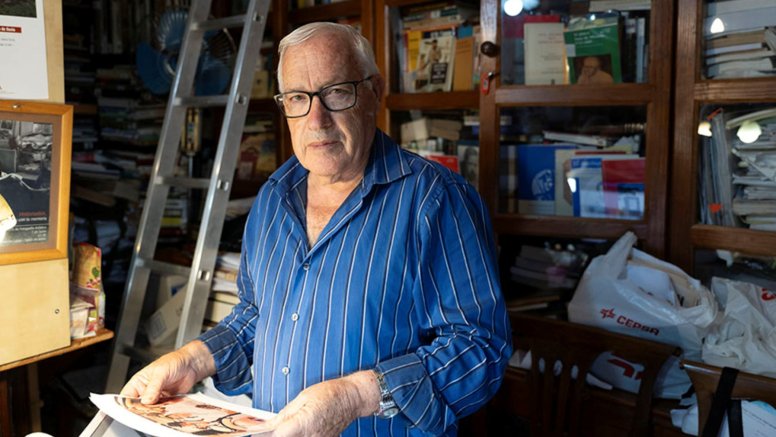
There are stories that remain dormant for generations within the pages of a book, in an ancient parish register, in a deed, or in a document that, with the passage of time, seems condemned to silence. And yet, a patient search, an expert eye, and the knowledge of someone who knows how to interpret these vestiges of the past are enough for a story to come back to life.
That is precisely what the work carried out by Francisco Hernández Delgado, Official Chronicler of La Villa de Teguise, from the Historical Archive of Teguise represents, a task that transcends mere documentary consultation to become a true exercise in the recovery of collective memory.
On this occasion, his work has once again built a bridge between two shores separated by the Atlantic: Lanzarote and Uruguay.
On the occasion of the commemoration of the 300th anniversary of the arrival of the first Canary Island families in Montevideo, many of them from Lanzarote, the search for family origins has once again turned the gaze towards the archives of Teguise. Behind each name, each surname, and each date lies a story of emigration, hope, and farewell; but also a story of permanence, because those who left took with them a part of the land that saw them born.
In this journey towards roots, the work of Francisco Hernández Delgado has been fundamental. His dedication, his meticulousness, and his knowledge of historical records have made it possible to locate family documentation and recover data that, for many people on the other side of the ocean, constitute something much more valuable than a simple documentary reference: they are the possibility of reconnecting with their ancestors and knowing where their Canary Island roots come from.
Gratitude for this work arrived from Uruguay in the form of an emotional letter sent by Inmaculada Cedrés Padrón, president of the Sociedad Islas Canarias - Montevideo - Uruguay, who wished to make her recognition public.
"With affection from the Sociedad Islas Canarias - Uruguay, and within the framework of the commemoration of the 300th anniversary of the arrival of the first Canary Island families in Montevideo, many of them from Lanzarote, we wish to express our deepest recognition and gratitude."
The words of the president of the Sociedad Islas Canarias highlight the human scope of a task that, at times, may seem confined to documents and archives.
"Your invaluable and selfless collaboration in the search for our family archives has been the key to reconstructing history, rescuing from oblivion roots that emigration once distanced.
And perhaps it is precisely that image, the key that opens the door of memory, that best defines the work of a chronicler. Because safeguarding documents does not mean only preserving old papers: it means preserving the traces of those who preceded us and keeping the doors open so that future generations can know their history.
The letter concludes with words that summarize with special beauty the recognition received:
"Thank you for your thoroughness, for safeguarding our memory, and for helping us always remember where we come from"
From Teguise, memory thus travels again towards Uruguay. It does so through names, surnames, and documents that were once left behind when those men and women undertook the journey to other lands.
Three centuries later, their descendants are once again looking towards Lanzarote in search of answers.
And there, among the documentary collections of the Historical Archive of Teguise, someone works patiently so that those answers can be found.
Because an archive is not just a place where the past is preserved.
It is also a place from which the past can find us again.
The work of Francisco Hernández Delgado demonstrates that history acquires its true meaning when it serves to unite people with their roots. And on this occasion, his work has managed to make the distance between Lanzarote and Uruguay, at least for an instant, much shorter.
Once again, memory has found its way back.
Add La Voz de Lanzarote as a preferred Google source.
Stay informed with the latest current news.