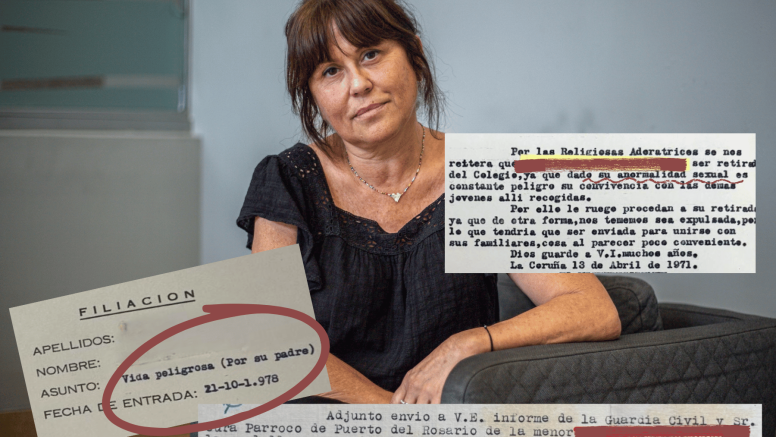
From the darkest period in Spain's history, there is a part that remained in the shadows for years of democracy, the part that led thousands of young women to centers where they were mistreated, sexually assaulted, where they suffered the theft of their children, spaces where they worked tirelessly and where they were instilled with the values of "a good woman" in the eyes of the regime, inspired by National Catholicism.
One of the pillars of the Franco dictatorship was its fight against women, whom it considered minors. This reality was legislatively evident in initiatives such as the marital license. Women needed the permission of their husbands, their fathers or male siblings for any transaction, to be able to work, to control their assets, to mortgage themselves, even to file a complaint. They had the obligation to care for their children, but custody and, therefore, decisions belonged to their husbands.
This control over women was exercised in different ways through the regime's institutions. The Women's Protection Patronage was one of the mechanisms to coerce and control girls, adolescents, and young women. This institution was presided over honorarily by the dictator's wife, Francisco Franco, Carmen Polo, and depended on the Ministry of Justice.
A criminal organization to repress women
The Women's Patronage wove its influence throughout the State through Provincial Boards (also in the Canary Islands), becoming one of the executive arms of the Franco Regime. "It was a criminal organization," explains Belén López Cillero, researcher and historian of the Women's Protection Patronage, who traveled to Lanzarote to break down how this structure operated at an event organized by Arrecife en Vivo.
For a woman to end up in one of these centers, the dictatorship relied on different reports that could be issued by anyone, from the guardians of morality -who were responsible for observing women's public behavior- to priests, neighbors loyal to the regime, or family members. Even in the years of the Spanish Transition, young women who were survivors of rapes, sometimes committed by their own fathers, continued to be admitted to these spaces.
Being considered a rebellious woman, being a single mother, having been raped, going out partying, having maintained "indecorous attitudes", having an ideology contrary to the regime or the suspicion of being a lesbian was sufficient reason for a young woman to end up confined in one of these Provincial Boards. Anything that attacked the regime's concept of morality could be a reason to be admitted to one of these centers.
In the Canary Islands, the researcher explains, these guardians of the regime focused on the beaches and how the women who went to them were dressed. "They described what kind of swimsuits they had to wear," she highlights.
These Provincial Boards, dependent on the Patronato, served as a steamroller for dissent and helped impose a single way of being and behaving. "They had no right to a trial, of course, nor the right to reply, and they remained incommunicado in there," highlights the writer, who adds that the nuns hid letters from their partners or family members from them.
The role of the Patronato de la Mujer was "to adapt women to the idea that national Catholicism had for them, which was to be in their homes, attending to their husbands, unable to have any outside activity, to be quiet, to raise children, and to have no personal aspirations," continues Belen López. The researcher estimates that throughout the country, around 800,000 girls, adolescents, and young women passed through the Patronato centers, suffering all kinds of abuse.
López points out that the Franco regime delegated the control of these Sección Femeninas to religious congregations. In total, about thirty congregations participated in these initiatives for more than forty years. "It was the pedagogy of mistreatment, of abuse, and what they did was clean, because they spent their days cleaning, praying, and working," explains the researcher and author of the book *Why did nobody talk about them?*, which deals with the repression carried out by the Patronato de la Mujer in the Galician city of A Coruña.
In these spaces, the inmates received beatings, abuse, and were victims of sexual assault. They also suffered different forms of harassment. For example, if they urinated in bed, "they would rub nettles on their vulvas," place the urinated sheet over them as if it were a ghost, and force them to walk around like that among their companions, or hang the piece of clothing outside and make their companions walk in front of the sheet.
In these centers, there was also a punishment cell. "They locked them up for days and they lost track of time," she highlights. During her research work, she also came across the testimony of a survivor's daughter, who recounted that her mother was forgotten in one of the punishment cells and, upon arrival, had lost consciousness.
One of the methods they used to decide which type of institution to send arrested women to were "deflowering" techniques, where regime employees performed tests on women to determine if they had had sexual relations or not and if their attitude was reversible or not.
Lesbian women, sent to psychiatric hospitals
Women suspected of being lesbians were sent to psychiatric centers, some of them controlled by the Patronato de Protección de la Mujer. "They were completely over-medicated and the treatments were atrocious," highlights Belén López, who points out that these women were subjected to different electroshock therapies, insulin comas, where they increased the sugar dose until they fell into a coma, or where they were forcibly given turpentine injections.
The most rebellious women were also sent to these psychiatric hospitals, where they were subjected to therapies with the idea of "eliminating the red gene". The Francoist psychiatrist Antonio Vallejo-Nájera, who until July 2026 was awarded the Gran Cruz de la Orden Civil de Sanidad, claimed, drawing from Nazism, that republican people were intellectually inferior simply for being left-wing.
All this pseudoscientific theory led to decades of human rights violations against republicans and justified the removal of at least 30,900 minors from republican families to be given to families aligned with the regime, according to an investigation by the University of Jaén. In addition, between 1936 and the end of the 20th century, more than 300,000 irregular adoptions were registered.
Add La Voz de Lanzarote as a preferred Google source.
Stay informed with the latest current news.