When a woman suffers sexual assault, something fails in society and something breaks within her. Her self-perception changes, her self-esteem is damaged, and she faces a moment when the system's support becomes fundamental. To preserve her safety, accompany her in the process, and guide her, a network of five centers has been launched in the Canary Islands, available 24 hours a day. One of them opened its doors exactly one year ago in Arrecife, the capital of Lanzarote.
"We are going to dismantle myths; you can find the aggressor in your dining room, in your bedroom, you have them close, they are a known person, from your circle," explains the coordinator of the five comprehensive assistance centers in the Canary Islands, Araceli Sánchez Gutiérrez, during a conversation with La Voz.
Since its opening in May 2025, this Lanzarote resource has assisted 160 women in just over a year. To date, the identified aggressors were mostly acquaintances (37%), family members (18%), or had or had had a romantic relationship with the victim (18%). In contrast, a smaller percentage were strangers (24%) or the victim did not respond (1%).
This space has two activation pathways: through emergency services (112, 016, and 012) or by direct contact with the space (647 755 021).
Once the survivor arrives at the center, the space has three areas of attention designed for survivors of sexual violence: psychological, social, and legal. However, filing a report is not a mandatory requirement to access these free resources. "We try to ensure the victim always goes through the legal area, whether she wants to report it or not, because we are going to inform her of her rights," indicates the coordinator Araceli Sánchez, who adds that the victim "may not want to report it now, but perhaps in two months."
The center also includes the care of foreign women, regardless of their administrative status in Spain, and has an interpreter service for individuals whose native language is not Spanish. Furthermore, it maintains coordination plans with other entities to act in cases of trafficking or gender-based violence.
"We don't just act in crises; we also act in the long term, we treat past violence. A victim who suffered an assault when she was an adolescent, for example," continues the coordinator. The space is also designed to work with victims' families and guide their support.
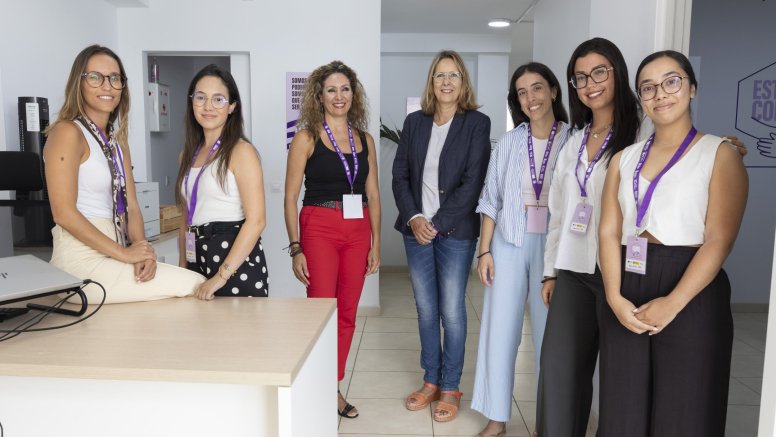
Upon accessing the resource, the first filter that women victims of sexual violence encounter is the administrative figure. At the entrance of the resource is Tania Ramón Espinosa, who is responsible for updating data, drafting reports, managing files, and attending to women, their families, and other entities by phone and in person.
"My attitude has to be very approachable, convey tranquility, a lot of empathy, not ask about the case to avoid re-victimizing her, but if she needs a little listening, carry out active listening," exemplifies the administrative assistant of the space. After receiving a notification, there is coordination by the staff to go to the place where the victim is and provide initial support. "The technicians go to the hospital and accompany the victim from the first moment, we do not abandon her until we leave her in a safe place," adds the Canary Islands coordinator, who states: "We will always be by the victim's side."
Social support, a crucial pillar
"We always talk about the physical consequences, even the psychological ones, but we forget about the social consequences," reveals Araceli Sánchez. Women victims of sexual violence may see their situation worsen with job loss, economic problems, or economic dependence on their aggressors. "The social consequences are important," adds Sánchez.
From this area, the center has social workers Ainhoa Rodríguez Medina and Laura Expósito Delgado. "We don't just focus on the history of violence," explains Laura Expósito, adding that factors such as housing, health, education, or employment are taken into account to "detect needs" among patients. "We work alongside other areas, because it makes no sense for the psychologist to work on the symptomatology if the woman lives with her aggressor in the same house, for example," she continues.
"Violence is a very thin thread, from the moment you touch something that can cause harm, the woman disappears and doesn't come. So you have to be very careful," reveals Laura Expósito.
At this point, the current housing crisis affecting Lanzarote is one of the problems they are trying to address from the social area of the resource to ensure that victims can find housing alternatives.
"Sexual violence has no class, no status, it doesn't depend on the economy. In the end, just by being a woman, you are already exposed," indicates Ainhoa Rodríguez. However, she points out that there are aggravating factors due to double discrimination, for example, among women who are victims of sexual violence and are undocumented, who in most cases lack economic and family support.
Legal advice
Another of the fundamental areas within the center is legal advice. Mayelín Correa Tavío is the lawyer responsible for explaining and judicially accompanying sexual violence survivors who come to the center. "I manage daily accompaniments to courts, from statements to forensic examination," explains the lawyer, who is also responsible for answering questions and requests for legal advice.
Throughout her judicial accompaniment, the lawyer explains that the complainants go before many specialists, from doctors, forensic experts, or judicial assistants, to their own statement in court. "There are quite a few professionals, and more than one in that chain always fails," she explains.
During this process, victims sometimes encounter questioning from the professionals who attend to them with questions such as: "And why are you reporting now?", which causes survivors to consider abandoning the legal proceedings.
Thus, Mayelín Correa points out that legal action is not always taken, sometimes because the survivor herself prefers not to, and on other occasions because the case has expired. However, she warns that it is important for women to know their rights. "If [the victim] is a minor, I automatically have to go to the Prosecutor's Office, I have to report it ex officio, but if she is of legal age, I don't," she explains.
At the same time, she points out that many proceedings end in provisional dismissal, a judicial resolution that temporarily halts a criminal proceeding and orders its archiving due to lack of evidence or because its perpetrator could not be identified. "Proving a sexual assault is complicated, because in the end it is a crime that always happens in an intimate setting," explains Correa. However, she indicates that a dismissal does not mean "that they don't believe you," but rather that "there is not enough evidence to incriminate someone."
At the same time, she emphasizes that consent "has to last throughout the entire process," meaning that if a woman begins a consensual sexual relationship and wants to stop and the man continues, it is also sexual assault. In some educational centers she has visited to raise awareness about this intervention center, students have asked her: "What if it started and then she didn't want to?", to which the lawyer responds emphatically: "Then you have to stop," as it would be considered rape.
Psychological Support
Sometimes, even with a conviction, justice does not fully repair the damage suffered by victims of sexual violence. Therefore, psychological support from the center becomes fundamental. Aridiam Curbelo is one of the psychologists at the facility, responsible for attending to victims of sexual violence, whether the assault is recent or not. "We provide support regardless of whether a report is filed or not, and regardless of when the sexual violence occurred; we guarantee that we can support the person throughout the entire process, from beginning to end," she explains.
In parallel to the judicial proceedings, or even if they do not occur because the victim decides not to report or the events are time-barred, psychological intervention is key. "I often encounter clients who experience the entire judicial process with a lot of anxiety, guilt, and shame," explains Curbelo, adding that during this process it is fundamental to "prevent the impact" of the proceedings.
Regardless of the type of sexual violence, it is common for the psychologist to encounter symptoms in therapy ranging from fear to anxiety, hypervigilance, alertness, guilt, or shame. In an assault, "a person's boundaries over their own body are violated, and this has an impact on how that person relates to themselves and to others, to the world," she explains.
To regain that confidence and self-assurance, psychological intervention becomes a crucial tool for clients. "We are available here; often, when the violence occurred a long time ago, it is difficult to ask for help, but asking for help is not reopening the wound or recounting the story; it does not imply further harm; it can be worked on in a way that is adapted to the person and achieve improvements," states Aridiam Curbelo.
"That a person regains self-confidence, the ability to make decisions about their body is something that takes time, work, and effort, it depends on the type of sexual violence, on many factors," explains the psychologist, who indicates that the existence of these types of resources, like other spaces that help women victims of sexist violence, is fundamental. "That there are resources like these, that guarantee that the rights of these people are met and that they can count on our support from beginning to end, which is a right that victims of sexual violence have," she concludes.
016 telephone line for victims of sexist violence. 647 755 021 24-hour comprehensive assistance center.
This center is a resource funded by the Canary Islands Institute for Equality, integrated into the Ministry of Social Welfare, Equality, Youth, Childhood and Families of the Government of the Canary Islands. Furthermore, the creation of this resource is financed by the European Union through Next Generation funds, by the Ministry of Equality, by the Recovery, Transformation and Resilience Plan, and by the Canary Islands Youth Foundation.
Add La Voz de Lanzarote as a preferred Google source.
Stay informed with the latest current news.