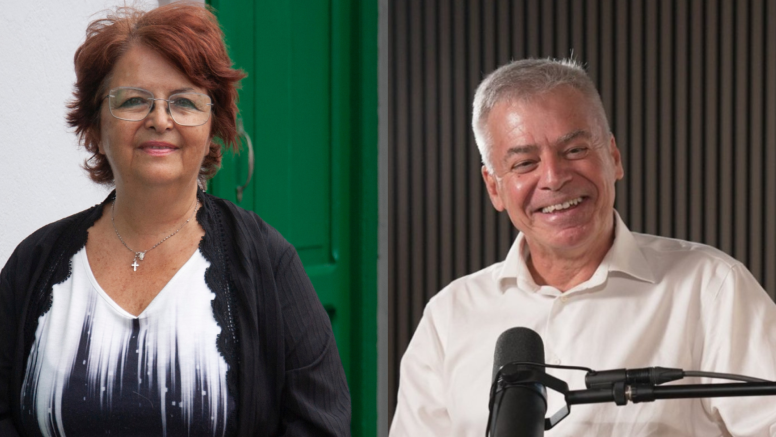
"Suicidal behavior is not a pathology, it is not an illness, it is simply a behavior that is anchored in a context where there is a lot of pain," says educational psychopedagogue Calixto Herrera, head of the Orugas y Mariposas Project, which has been bringing education on death to schools in the Canary Islands since 2013.
"Suicide is a complex, multifactorial, multidimensional, fluid behavior," Herrera continues. In the Canary Islands alone, throughout 2024, a total of 228 people took their own lives. "A suicide is an emotional devastation for families," explains Herrera, who adds that each suicide generates an intense emotional impact on approximately 135 people.
"We are going to face multiple questions that will not have answers, but the first message must be one of humility, of respect for the person, of respect for a pain that was there," he advises. "If the environment stigmatizes and labels, people will carry their pain and their desire not to live in solitude, they will hide it," he continues.
"The context we are living in, accelerated, hyperstimulated, is turning us into an inattentive society," highlights Herrera, who warns that despite being "accompanied by other bodies, the pain, despair, and blows of the world" are experienced in solitude.
This feeling of loneliness is exacerbated by the algorithms set by technological platforms through social networks, which leave minors unprotected: "Social networks lead children to streets where there is no supervision from family or adults," warns Calixto Herrera, who alerts that the myth of "using them well" is not enough because the algorithms have "an addictive component" and uncontrolled pages where suicide is encouraged.
A support group to share the pain of loss
Since Marta Ceñal's son took his own life in November 2017, a wound that runs through her from top to bottom accompanies her always. "In suicide, guilt is added, and as parents, we will always carry it," she recounts during an interview with *La Voz*.
On her own journey to learn to walk alone and cope with the pain left by her son's death, this mother created a support group for families in Lanzarote. The listening spaces, which moved online due to the pandemic, reopen their doors next week on the island in a parish space next to Plaza de Las Palmas de San Ginés, in Arrecife.
"Suicide is not thought of at a specific moment and done. It is a very long process," continues Marta Ceñal. El descanso de Pedro (Facebook), within the GAMAS Project, is an initiative with which she joins forces with families and friends of people who have taken their own lives or with survivors and is open to families who have experienced a loss by suicide.
These support groups are a space to share pain and experience with other people, but they are not guided by psychology professionals. "We are people who have suffered the same thing, what we do is listen, simply," highlights Ceñal.
"Why a support group? Because they will meet people who have experienced the same or similar things and know the pain they are going through," she adds.
What are the risk signs?
People with suicidal thoughts show risk signs that can allow family or friends to prevent suicidal behavior. These signs can be non-verbal, such as symptoms of isolation, lack of communication, poor sleep hygiene, or neglect of personal hygiene or self-care. They can also be verbal, where the person shows symptoms of hopelessness, talks continuously about death and suicide, or refers to themselves with negative comments.
How to act?
Educational psychopedagogue Calixto Herrera advises that the best way to respond to a close case of suicidal behavior is with calmness. "When a person is thinking of taking their life and has the courage, the fortitude to ask for help - sometimes with a warning sign - the environment must respond not by criticizing, not by judging, but by opening up a space."
Validating the pain, listening to it, and not trivializing that moment is fundamental for suicide prevention. For Herrera, combating suicide is a collective challenge, which must be achieved in a collegial manner. In his work in the Canary Islands educational centers, he also conveys this message to boys and girls. "We tell them: you are agents of life promotion, with a little knowledge and a little bit of skills that can be worked on, we can save the life of a classmate," he adds.
"Absenteeism is a sign," warns Calixto Herrera, so "we have to call the students who stay home, tell them 'you are important, we miss you, regardless of your academic performance, you are important'."
024 suicide prevention helpline, 112 in case of imminent life-threatening emergency
Support networks against despair
In suicide prevention, support networks are fundamental, from families to friends and the closest environment, they are crucial when accompanying a person suffering from the despair of an existential crisis, which can end in suicide. From schools, for example, a protocol is activated that mobilizes both educational activity and health centers and the family.
"On many occasions, we may find that the family, for various reasons, we are not going to blame, as families today have enough challenges with a context of precarious life, housing, economic, and labor difficulties, etc., many times we may find families that are not there," continues Calixto Herrera.
In the case of minors without support networks, Herrera also coordinates the project Migraciones y Odiseas de colores, an initiative that brings awareness about the migratory reality and the case of migrant minors who arrive at the archipelago without their families to the public schools of the Canary Islands.
"They carry in their backpacks a whole series of experiences from their place of origin, sometimes traumatic experiences, migratory grief, many absences and hopes, dreams, and a lot of courage," recounts Calixto
Herrera, who adds that upon arriving in Europe, these migrant minors "clash with a reality that hits them," with a continent that "shields itself" and they have to face these challenges far from their families and with the risk of ending up on the streets when they turn eighteen.
What resources are available?
The avenue of attention for people with suicidal behavior is through primary care, where there are trained professionals who perform an initial assessment of the risk situation.
The Canary Islands Health Service also has Mental Health Units, both for adults and for child and adolescent patients, where people who need specialized intervention are referred.
"While we are waiting for a health resource to attend to them, the school must be accompanying, the school must show its presence, the family must show its presence," emphasizes Calixto Herrera, who advocates for other minors, "well-trained," to also serve as support networks.
In life-threatening situations are the emergency services of health centers and 112. Furthermore, there is 024, the telephone enabled by the Government of Spain to assist people with suicidal thoughts, ideation, or risk of suicidal behavior, their families, and also their loved ones.
To the institutional resources is added the GAMAS project, which, led by Marta Ceñal, is a mutual aid space for families and people who have suffered the loss of a loved one.
"With your hands you can save a life, you too with your presence, with your word, with your silence, with your hug, with your kiss you can save another's life," concludes the psychopedagogue.
Add La Voz de Lanzarote as a preferred Google source.
Stay informed with the latest current news.