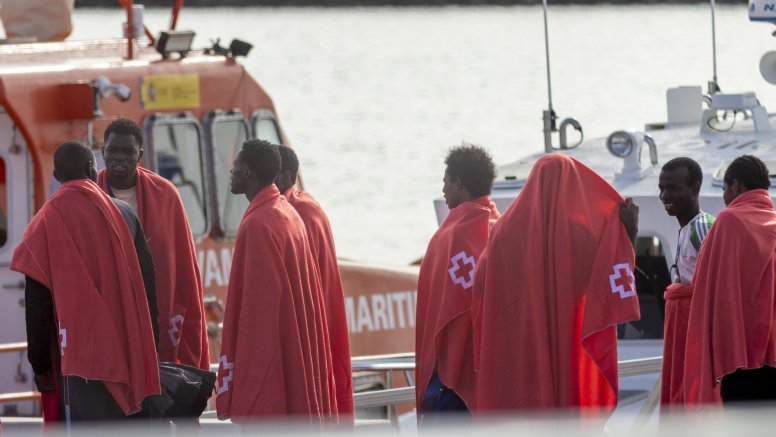
One out of every five immigrants who have arrived this year in boats or pirogues to the Canary Islands comes from Senegal, while Malian refugees, who for months were the majority, have dropped to fourth place.
The Ministry of the Interior does not publish details about the countries of origin of immigrants rescued on Spanish coasts in the arrival report it disseminates every two weeks, but it does share that information with the European Border Agency (Frontex).
In the "migration map" that this European agency disseminates openly through its website, it can be verified that as of October 31, 12,337 people had arrived in the Canary Islands by boat or pirogue (as of November 10, the actual figure is already approaching 20,000).
Of those rescued in the first ten months of the year on the Canary Route, there are 3,938 immigrants of unknown or doubtful origin.
Among those already identified, the majority nationality of those risking their lives on the Atlantic Route at this time is Senegalese, with 2,389 people (19.37%); followed by Moroccan, with 1,824 (14.78%); Gambian, with 1,358 (11.00%); and Malian, with 1,116 (9.04%).
In the case of Mali, Frontex data reflects another phenomenon: while until now refugees from that country preferably used the Canary Route to try to reach Europe, this year more Malians have arrived in Spain by boat via the Strait of Gibraltar and the Alboran Sea (1,231 versus 1,116).
In fact, in the case of the Western Mediterranean (as Frontex calls that route), Mali is already the third country of origin for immigrants crossing to Europe, after Algeria and Morocco.
The data collected by Frontex agrees with something that had already been observed since the beginning of summer at the port of La Restinga (El Hierro): the majority departure point for the pirogues declared by their occupants is no longer Gambia, Guinea, or Mauritania, but Senegal.
Last week, the Minister of the Interior, Fernando Grande Marlaska, traveled to Dakar to strengthen cooperation with the Senegalese government and ask for greater control over the departures of pirogues.
This very Tuesday, the president of the Canary Islands, Fernando Clavijo, took advantage of his trip to Madrid to attend exceptionally the Interministerial Commission on Immigration to meet with the Senegalese ambassador to Spain, Ibrahim Al Khalil Seck.
Add La Voz de Lanzarote as a preferred Google source.
Stay informed with the latest current news.