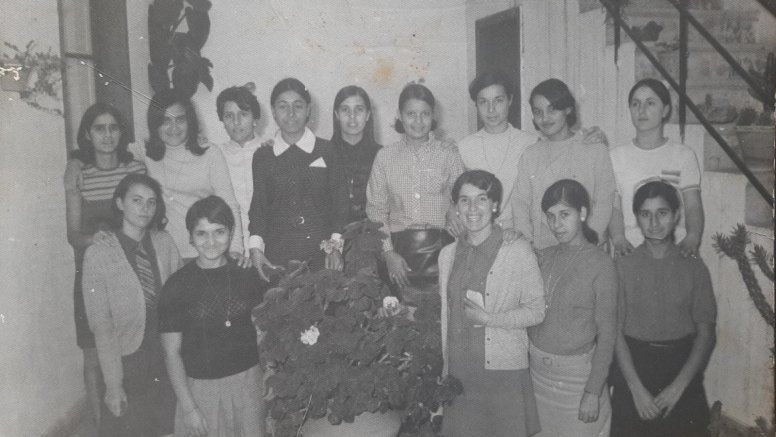
The life of Mari Luz Suárez was like that of many women of the time, a mixture of sacrifice and frustrated dreams. She was one of those canning workers from Lanzarote who brought money home thanks to cans of sardines. "They made me a mother before my time," says this 70-year-old woman from Conejera during an interview with La Voz de Lanzarote. She grew up in a dysfunctional family, her father was an alcoholic and when she was seven years old she was already taking care of her siblings.
Mari Luz was born in Yaiza, but insists that she only has birth certificates from there. Very young she moved to Arrecife, later she would begin to live in one of those official protection houses that were passed to the collective ideology as borrowed houses.
Now she lives in Gran Canaria, but she spent all her youth on the island that saw her grow up. She remembers everything from her days working in the cannery, like someone who, after the first breath of air, suddenly relives an entire era. She remembers the blue coat, the yellow apron and the boots. Those memories come to her in supermarkets, every time she sees a can of sardines.
Mari Luz is cheerful and remembers her story with sorrow and optimism. She did not know the days of celebration, nor the nights. She woke up at five in the morning just to not miss her unavoidable appointment, mass. Then she returned to Valterra, changed clothes and back to the factory, which was also in Arrecife.
"It was a good time", she recalls.
In the cannery they packaged sardines, transported wooden baskets with them and sheltered them in freezers. Some days when the work was finished, she allowed herself to play with her colleagues while she stored the fish. "It was a good time", she recalls. She never played much at home, she didn't have time for that. However, the few times she could, she fantasized about being like one of those Disney princesses.
"I remember how we made the cans, the cylinders. That machine to make them burned," she recalls. Sometimes her mother would bring a piece of fish wrapped in a cloth. Sometimes a little piece.
She didn't have time to study either. She cleaned her house. If she thought about studying, her father would remind her that she was her mother's feet and hands. "What would she be without you," he repeated to her. Mari Luz thought that was a fool's consolation and cried when she arrived home after leaving her brothers at school. She was the third of seven children.
She applied to enter the cannery and succeeded without much problem. Her mother already worked there, as did her sister. At the factory they paid her well, at least for being in that time, she received money weekly and when she reached the limits that they set, they gave her bonuses. In her case, Mari Luz did not keep the money, she left it to her mother, also her salary. She didn't buy anything for herself, she felt like a mother to the four brothers who still lived in her house.
She started when she was 16 years old, then she got married and stopped going. "I never had independence," she laments, but she decided to get married so she could take her brothers with her when things at home got difficult. When she left the factory she got married, but her husband, who was enlisted in the Navy, died shortly after. Mother of two children, she was widowed but was supported by her political family.
She could no longer return to the factory even though the salary was higher and she had to settle for the four hard coins they paid for cleaning houses. "At least there I could take my children," explains the woman from Lanzarote.
Mari Luz continues working, now she cleans houses, the job she had to choose when she was widowed and with two children to feed. She is 70 years old, but she continues "playing house", as she refers to with some resignation.
She didn't have time to learn to read or write when it was time, but she did it self-taught. She learned to read, although she is sometimes ashamed to write because of the spelling mistakes. "I'm here, I don't have time to catch a depression, when it arrives I tell it to go somewhere else," concludes this woman from Conejera.
This March 8, the canning women will be honored in Lanzarote on the occasion of International Women's Day. "Thank you for taking a moment to remember us," adds Mari Luz.
Add La Voz de Lanzarote as a preferred Google source.
Stay informed with the latest current news.