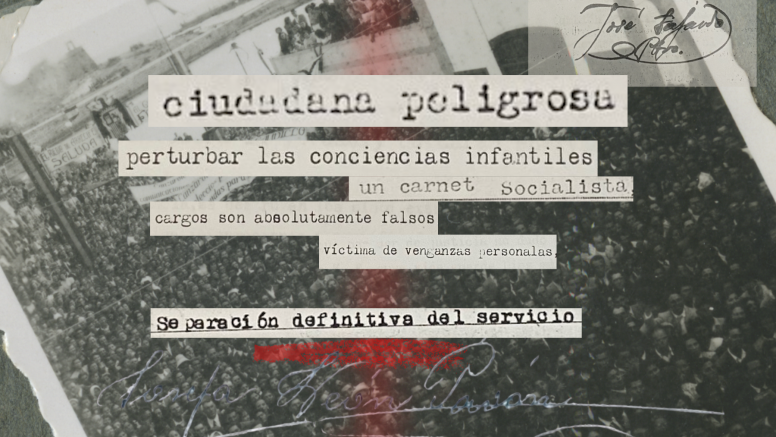
Crucifixes, red and yellow flags and portraits of the Caudillo adorned the schools of Lanzarote when Francisco Franco took control of the Canary Islands. While the Civil War (1936-1939) continued in the rest of the country after the failed coup attempt, the nascent dictatorship took less than a month to urge a plan to persecute all persons suspected of not adhering to the regime's values in the Canary Islands. Among them, it investigated all the teachers in Lanzarote who were not aligned with the principles of what was dubbed New Spain.
One month after the failed coup d'état, the Francoist side, self-proclaimed as national, began to occupy all institutions in Lanzarote. From its first steps, the Francoist Government launched a purge of left-wing teachers and all those it considered "enemies of the regime".
At least twenty-five teachers were sanctioned, transferred, or suspended in Lanzarote. However, the regime was especially inquisitorial with the head teacher of the Tahíche School, Josefa León Pavón, the only woman whom the National Commission proposed the greatest possible punishment: to expel her definitively from the Teaching Profession.
In August 1936, the Government Delegate of Lanzarote requested the "background" and "political affiliation" of the teachers working on the island, as well as reports on their involvement in "political or social propaganda" and their affiliation with "extremist parties." He also asked for details about who made up the Primary Education Board in the different municipalities.
At the same time that the purging of Republican teachers was advancing, as they received the directives of the new regime, several schools in Lanzarote asked for red-and-yellow flags and crucifixes to hang in their classrooms. This is supported by the documentation collected in the municipal archives of Teguise and Arrecife. These symbols were part of the Francoist school model, where the values of the regime were to be promoted through national-Catholicism.
"Sympathizer with socialism": the beginning of Josefa León's nightmare
When the war broke out in 1936, Josefa León was working as a teacher at the Tahíche School and was the mother of three children, who depended solely on her salary because her husband was incapacitated due to a chronic illness. At the beginning of the 1936/1937 school year, specifically on September 2nd, the Teguise City Council responded to the information requested by the Government Delegate of Lanzarote and issued a list with the names of eight female teachers and five male teachers from the municipality, accompanied by their "political backgrounds." In that list, the political leanings of each teacher were indicated, and the first reference to Josefa León Pavón was recorded: "sympathizer with socialism".
That document became the beginning of her nightmare. When the regime opened a purge file on her and expelled her from her job a few days later, Josefa León had dedicated twenty-one years to teaching, thirteen of them between Lanzarote and La Graciosa and another eight in Oviedo.
On October 8, 1936, a few days after being identified for her political ties to socialism, the Government Delegate of Lanzarote sent a report to the Civil Government of Las Palmas, identifying her among the professors suspected of being left-wing. In the document, he expanded on the charges against her, stating that the Civil Guard had searched the professor's home and found a UGT contribution card, a copy of the Republican anthem, and another of the Libertarian Anthem.
His designation was part of the regime's intention to dismantle the "worker and political movement", according to researcher Olegario Negrín Fajardo, who was the first to bring to light Josefa León's file. Despite Lanzarote not having had great social conflict, there was a "notable presence" of parties like the PSOE and of workers' union movements. The objective of the Francoist Government was to eradicate that union struggle and political divergence.
In October, the Administrative Section of Primary Education of Las Palmas ordered Josefa León to be suspended from employment and salary for being a "socialist". The president of the Local Council of Primary Education of Teguise, Domingo Robayna, signed the order for León Pavón's expulsion and notified the City Council that the position at the Tahíche school was vacant.
During the first months of Francoist repression in Lanzarote, the Provincial Purging Commission proposed the expulsion of seven of them and the National Commission reduced it to four: three men and one woman, Josefa León Pavón.
In a letter that still remains safeguarded in Teguise, on November 3, 1936, Josefa de León tried to convince the president of the Local Council of Primary Education of the municipality that she had not committed "unpatriotic" acts or acts contrary to the Francoist movement. Despite her attempts to defend herself, the Board had already appointed a substitute teacher, who had obtained the title of National Teacher a few weeks earlier in Arrecife.
The priest's testimony: crucial for his expulsion
After his expulsion, in January 1937, priest José Fajardo Morales was appointed priest member of the Teguise Education Board. At the time, Josefa León did not know it, but the testimony of this priest would be crucial to definitively expel her from her profession as a teacher and would gather all the charges against her.
While the changes of teacher occurred in the village of Tahíche, the Francoist machinery continued to suspend other teachers from employment and salary, at the request of Inspection or because they were called up to enlist in the Francoist Army and travel to the peninsula to fight.
In March 1937, the priest José Fajardo Pérez himself delivered a questionnaire in which they accused Josefa León of immoral behavior, unpatriotic conduct, and of showing "a certain indifference to the" Francoist "movement." Among the questions, the regime questioned if she was "vicious, disorderly, or little or not at all exemplary." Among his answers, the priest highlighted that Josefa León's husband was an "extreme socialist" and a councilman in the Teguise City Council during the Government of the Second Republic.
Seven months after labeling her "socialist" and half a year after expelling her, the Purging Commission of Primary School Teachers accused Josefa León of several charges, based mainly on the testimony of the priest, the only report with a full name against the teacher that Olegario Negrín Fajardo found in the file located in the General Archive of Alcalá de Henares. Among the charges, they accused her of belonging to the Socialist Party, of acting as a propagandist for the Popular Front, of showing an "ideology that disturbs children's consciences," and of attacking patriotism and morality.
When she was suspended by the school, Josefa León Pavón had to move back to the town of Máguez, in Haría, with her husband's family. There, she joined the Ladies of the Patriotic Workshop of Haría, with her sewing machine.
Faced with all the accusations, Josefa León Pavón stated that she was "the victim of a false imputation." "I am absolutely apolitical, I did not even exercise the right to vote in the elections," she defended, assuring that she did not know the libertarian and extremist anthems she was accused of singing on children's excursions.
Political accusations mixed with others of a moral nature. After having been suspended, the Franco regime inflated her expulsion report, accusing her of immoral acts, reviving old disputes.
The Purging Commission of Las Palmas accused Josefa León of forcing boys and girls to go to the restroom together in Tahíche and of "forcing" her students to bathe "together and naked" in the presence of other people when she worked as a teacher at the school in La Graciosa. These accusations were branded by Josefa León herself as "slanderous," and she indicated that the facts were "incompatible with a mother of Catholic sentiments of absolute morality."
At the same time, he highlighted that the minors from La Graciosa, sons of fishermen, bathed in the sea, "separated by sex" and "at a sufficient distance" with the "approval of the parents" and "so as not to break morals and good customs" after a doctor diagnosed them with scabies.
Representatives of the Falange de la JONS in Haría pointed out that the bathing of children in the sea in La Graciosa did not scandalize families because the minors bathed naked, something common at that time, but because some mothers believed that "excessive cleanliness harmed their children's health". The events took place during the Dictatorship of Primo de Rivera and "some local bosses took advantage to distort the facts and report them in Teguise". That file was resolved at the time without any sanction and the action was approved by the Municipal Inspection. However, Francoism revived it as a sign of immorality.
Among the charges brought against her, they also accused her of refusing to hoist the Francoist flag and to remove the portrait of the President of the Republic. However, the teacher indicated that Tahíche was the smallest village in Lanzarote and that it was "poorly equipped with materials" so that a portrait of the President of the Republic never existed.
In her writing addressed to the commission, Josefa León Pavón denied having belonged to any political party and stated that during her years as a teacher she always complied with religious precepts. To refute the accusations, the teacher provided testimonies from the Parish Priest of Haría, as well as from the parents of her students in La Graciosa. Furthermore, she highlighted that during the Second Republic, religious education was eliminated from schools, but that she continued to offer it in the hermitage of Tahíche.
The researcher Olegario Negrín in his work on Josefa León exposes the value that "religion and morality" had in the Francoist purge processes and points out how the case of Josefa León was an example of the regime's repression throughout the country.
To counter the accusations, Josefa León handed over a certificate from the Patriotic Workshop of Haría, the Electoral Census of the Villa de Teguise where she did not appear on the lists, and good conduct reports from the Mayor's Office of Haría, the local leadership of the Spanish Falange of the JONS, and the Parish Priest of Haría.
However, ignoring the reports in her favor, the Purging Commission unanimously agreed to definitively remove her from teaching for being a "disastrous teacher" and a "dangerous" citizen.
Leaning on the Law of February 10, 1939, Josefa de León was definitively separated from the Teaching Profession and discharged from the registry in March 1940. The teacher insisted that the charges against her were "absolutely false" and that the reports to harm her were due to "animosity and personal grudges," as well as for "exercising unjustified revenge."
Throughout the years, the veteran teacher showed that she had no resources to feed her three children, who were between seven and ten years old when she was reported, and that she was in a situation of "penury and desperation." At that time, she could not know who was accusing her, but she provided new writings from regime forces, testimonies from families and former students that vouched for her innocence.
"The whole town desperately wants him to teach again," a mother pleaded. Only two witnesses maintained the accusation over the years. One of them was the priest himself, José Fajardo.
Thanks to the researcher Olegario Negrín Fajardo for delving into the case of repression against the teacher Josefa León Pavón and for his collaboration in being able to carry out this report.
With the support of:
Add La Voz de Lanzarote as a preferred Google source.
Stay informed with the latest current news.