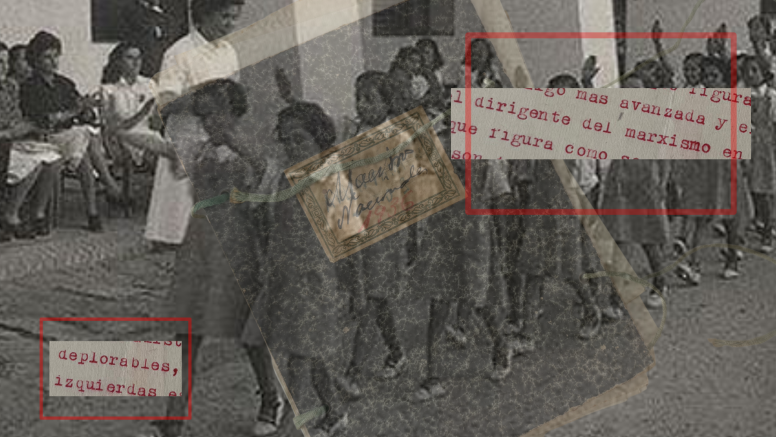
The teachers were a fundamental figure during the Second Spanish Republic (1931-1939) in bringing education to the villages, where illiteracy and poverty remained the norm. Republican governments advocated for free and secular schools, promoting the removal of crucifixes from classrooms and an increase in teachers throughout the country. At that time, teaching became one of the first professions that Spanish women began to conquer from the 19th century onwards.
With the coup d'état in 1936, one of the first measures taken by the Francoist side in the areas it conquered was to persecute and purge left-wing national teachers or those considered enemies of the regime due to their ideology, especially women who worked as teachers. Established in the Canary Islands since the coup d'état of July 18, 1936, Francoism carried out a purge to implement its national-Catholic school model throughout the country, with the return of crucifixes and the Spanish flag flying in public places.
Lanzarote did not escape that repression. In a document issued from the Mayor's Office of Haría on August 31, 1936, which is kept in the Municipal Archive of Arrecife and which La Voz has accessed, one can see how the Francoist regime requested the identification of teachers from the Local Council of Primary Education linked to the ideals of the Republican side. However, this political repression also served for decades to denounce and slander neighbors due to personal enmities or feuds.
After those ceremonies, teachers in the different towns of Lanzarote were identified for their ideology. Among the "confidences" shared in this telegram, several teachers from the north of Lanzarote were accused, such as **Manuel Paez Fernández**, who was the president of this Local Council. In the telegram, the Francoist forces accused him of being "the leader of Marxism" in Haría.
Another document accessed by this outlet reveals that shortly thereafter, Professor Manuel Páez Fernández was suspended from employment and salary "by order of superiors" and could not report to teach classes in the municipality on October 1, 1936
During the early years of the republic, this resident had risen to preside over the executive committee of the Haría People's House, associated with the socialist party and the General Union of Workers union, as recorded in the chronology presented in Memoria de Lanzarote.
The case of Josefa León Pavón, a teacher from Lanzarote
In Lanzarote, records show that 25 teachers were punished, sanctioned, transferred, or suspended and served as an example to others, as detailed in the work The Imposition of Francoist Moral Values in the Depuration Process of Teacher Josefa León Pavón.
In total, 42% of the teachers working on the island were purged by the Francoist regime. Of these, 16.6% suffered the most severe penalty, permanent disqualification. Others returned to their posts after being sanctioned and stigmatized.
The teacher Josefa León Pavón, who taught at the school in Tahíche, was removed from teaching and suspended from work and salary for four years due to accusations she described as slanderous. For example, she was accused of belonging to the socialist party, of being a "propagandist" for the Popular Front, of "displaying disturbing ideology in children's consciences," and of inciting "coeducation and promiscuity" among her students.
However, this teacher denied each and every one of the charges, emphasized that her feelings were "Christian" and she had three daughters to care for whom she could not support. Nevertheless, she was expelled from the teaching profession without considering the various witnesses who vouched for her
From the "dubious" to the "deplorable"
The repression of the regime that was beginning not only targeted Manuel Páez but also pointed to other male and female teachers in the north of Lanzarote. "The teacher Doña Rafaela Mesa, who is listed as right-wing, there are references that she is questionable," began Antonio González Izaguirre in a letter addressed to the Government Delegation.
The telegram pointed to other teachers, such as Carmen Toledo, about whom it spoke in these terms: "She is listed as a socialist, I understand she is something more advanced." Meanwhile, it said of Miguel Bermudez, "who is listed as a socialist, the references I have obtained are also deplorable."
Finally, the document highlights that teacher Isabel Martín, who was listed as left-wing in Francoist records, was "the wife of a prominent socialist."
Persecution of politicians and university professors
Not only school teachers were persecuted, but the same repression was also initiated against the only public university in the Canary Islands at that time, the University of La Laguna. In a telex sent by the Government Delegate of Lanzarote, it was requested to identify the "political and moral" conduct of each professor to determine if they were contrary to the regime's values and to proceed with their sanction.
The repression against national teachers was accompanied by other measures of persecution. The Franco regime initiated an active search for all "representatives or delegates" of political parties and unions that belonged to the Popular Front in 1936. To this end, it created a Supervisory Commission for Civil Responsibilities and requested the Arrecife Delegation to urgently send the data of all political representatives.
Add La Voz de Lanzarote as a preferred Google source.
Stay informed with the latest current news.