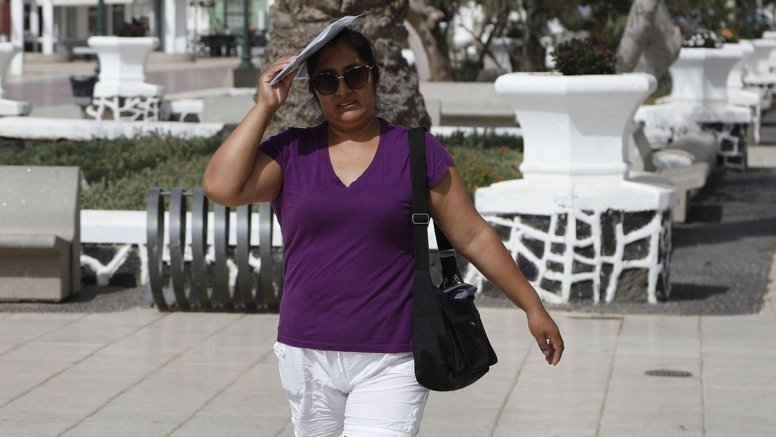
The Ministry of Health of the Government of the Canary Islands, through the Directorate General of Public Health of the Canary Islands Health Service (SCS), coordinates the Plan for Preventive Actions on the Effects of Exposure to Ultraviolet Radiation on Health, which establishes a series of recommendations to reduce the health effects on people associated with ultraviolet radiation (UV) according to the different levels established in this Plan.
In accordance with this Plan, the Directorate General of Public Health informs that according to data supplied by the State Meteorological Agency (AEMET), and the indicators established by this Plan, the UV radiation risk in the Canary Islands until next July 6 is extreme in La Graciosa and in the municipalities of Teguise and Haría in Lanzarote.
Also the municipalities of Barlovento, Garafía, Puntagorda, Puntallana, Tijarafe, El Paso, Villa de Mazo and Fuencaliente in La Palma, as well as Valverde and El Pinar in El Hierro. Also Alajeró in La Gomera, Santiago del Teide and Vilaflor de Chasna in Tenerife and Antigua and Betancuria in Fuerteventura.
For their part, the municipalities of Artenara, Tejeda. Moya, Teror, Santa Brígida, Valleseco, Vega de San Mateo, Valsequillo, Ingenio, Agüimes, Santa Lucía de Tirajana, San Bartolomé de Tirajana, and Mogán in Gran Canaria.
The recommendation for this risk level is to completely avoid sun exposure, at any time. In the rest of the municipalities of the Canary Islands, a VERY HIGH risk level for UV radiation is maintained.
Recommendations
Public Health reminds that the Canary Islands is the region of Spain with the highest level of UV radiation throughout the year, according to data provided by the State Meteorological Agency (AEMET). Protecting oneself from the sun is a responsibility that must be maintained not only in summer, but throughout the year and anywhere in the Canary Islands, even on cloudy days. It is also important to remember that UV exposure increases with altitude.
When the risk to health from exposure to solar radiation reaches the very high threshold, it is recommended to emphasize the daily use of sunscreen (SPF 50 +), stay in shaded areas during the central hours of the day, wear wide-brimmed hats and clothing that covers arms and legs, use appropriate sunglasses, and very particularly, protect children and the elderly from the sun. Without forgetting all those people who work with sun exposure and who must have protection from UV radiation.
Likewise, technicians from the Directorate General of Public Health insist that sun damage is cumulative and that excessive exposure and sunburn in childhood increase the risk of some types of skin cancer many years, or even decades, later. Likewise, it should be remembered that, on cloudy days, solar rays also filter through the clouds, although the sensation of heat may be less, which also happens when there is a breeze.
Risk Levels
The Plan for Preventive Actions against the Effects of UV Radiation establishes five risk levels (low, moderate, high, very high, and extreme) to which a series of protection recommendations for citizens are associated according to the health risks that each of the levels entails.
On a weekly basis, the Directorate General of Public Health of the SCS issues a map of the archipelago with the risk level according to the indicators established by AEMET.
Risks of UV Radiation
The acute effects of UV radiation can be varied: DNA damage, sunburn, phototoxic and photoallergic reactions, and immunosuppression, which can be considered a risk factor for cancer and lead to the reactivation of viruses, such as the cold sore virus.
Overexposure to ultraviolet radiation can also cause serious health problems, including cancer: the best known is melanoma, which is basal cell carcinoma or basocellular carcinoma and squamous cell carcinoma or spinocellular carcinoma. In addition, exposure to UV radiation increases the risk of developing eye diseases if adequate eye protection is not used.
UV radiation can also produce harmful effects in anyone, but the risks increase for the population that:
• Is exposed to the sun for many hours a day (either for work or leisure) or has had repeated episodes of sunburn throughout their life.
• Has fair skin, hair, and eyes.
• Takes certain oral and topical medications, such as antibiotics, birth control pills, and products containing benzoyl peroxide; similarly, some cosmetics could increase the sensitivity of the skin and eyes to UV radiation in all skin types.
• Has a family member with skin cancer.
• Is over 50 fifty years old.
How to protect yourself from UV radiation in extreme risk
The Directorate General of Public Health therefore recalls the main recommendation to adequately protect oneself from UV radiation given the current extreme level in the Canary Islands is to totally avoid sun exposure at any time.