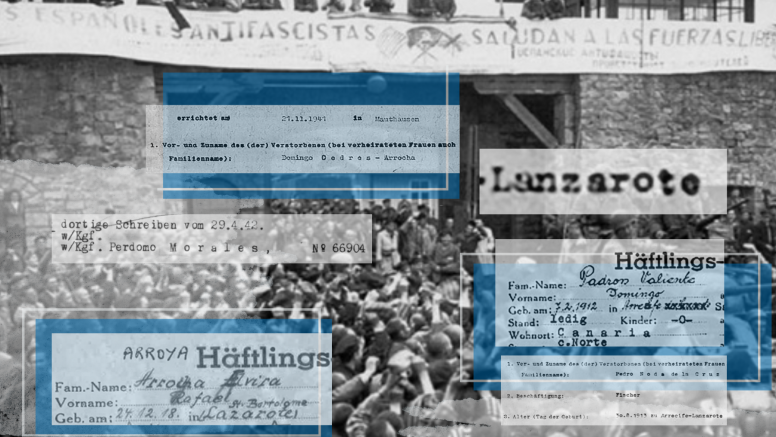
3480, 3615, 4546, 5075 and 6830. These four-digit numbers replaced for a time the name, identity and even the history of five Lanzaroteans who ended up imprisoned in a Nazi extermination camp: the Mauthausen concentration camp in Austria.
Domingo Cedrés Arrocha, Pedro Noda de la Cruz, Jacinto Morales Perdomo, Domingo Padrón Valiente, Rafael Arrocha Elvira. Four fishermen and a cook from Lanzarote ended up imprisoned in the only Nazi concentration camp classified as category III (due to its harshness and high mortality).
How did, at least, seven people from Lanzarote end up 3,000 kilometers away in that concentration camp? That was the question asked by the historian and retired bank employee Pedro Mayo and the genesis of his first book The Five of Mauthausen (Caballos Azules, 2026).
Surrounded by walls, electrified fences and under the gaze of the SS guards, with shaved hair and wearing striped pajamas, up to seven people from Lanzarote were actually found. To the story of the five islanders mentioned is added that of two other compatriots: Israel Cabrera Álvarez and José Cruz Barreto. In his work, Mayo delves into the story of how five of these people from Lanzarote ended up in one of the best-known Nazi camps and sets aside the story of the other two people from Lanzarote because they emigrated as children and rebuilt their lives on other islands or countries.
The "movie-like" story of a cook from Haría: Jacinto Morales Perdomo
Jacinto Morales Perdomo (Haría, 1918), number 4546, was born into a family of farmers in the north of Lanzarote. His brother Pedro Morales Perdomo worked on one of the correíllos, the ships that sailed between islands and through the Spanish colonies in North Africa, and one day he fell ill. "Jacinto replaced him as a kitchen assistant," states the historian.
In mid-March 1937, in the midst of the Spanish Civil War, the ship disembarked in Villa Cisneros (the current Sahrawi city of Dakhla), which at that time was occupied by Spain. That day, a group of political prisoners and Canarian republicans rebelled and took control of the Viera y Clavijo. Jacinto and other members of the crew joined the mutiny and sailed to Dakar, the capital of Senegal.
The man from Haría, Jacinto Morales, joined the republican troops in Valencia, but at the end of the war he went into exile in France. After being in the French refugee camp, he enlisted in the French Foreign Infantry Legion, he was the only one from Lanzarote to do so, the "most militarily committed," adds Pedro Mayo. Morales was captured by the Nazis.
In May 1942, the Spanish Red Cross requested information from its counterpart in Germany about Morales Perdomo, where it is recorded that he had been sent in August 1941 as a prisoner of war to Mauthausen and its subcamps. Actually, since September 1941, his family could not find his whereabouts because he had become part of the César Commando, a group managed by a Valencian who had gained some relevance for speaking German and having training. Then, the man from Lanzarote was exploited as a slave in the Austrian camps of Pirá, Ternberg, Redl-Zipf and finally in Ebensee, a subcamp of Mauthausen.
"When the Nazis saw they were going to lose the war, they were gathering the prisoners in specific camps with the aim of putting them into immense camps, blowing them up and leaving no trace," explains Pedro Mayo. Fortunately, Jacinto Morales was finally rescued by the Allied troops.
He lived his entire life in French exile, in the city of Champigny-sur-Marne, under the status of political refugee and with a pension. The Lanzarote native returned on a trip in the 60s to Lanzarote to visit his family in Haría. However, he returned to France shortly after.
The refugee camps of exiled Spaniards in France
At the end of the Spanish Civil War (1936-1939), the French Government had prepared different camps to host 30,000 Spanish exiles, but half a million people arrived. The French Executive treated them "like cattle" and distributed the Spanish refugees in three camps in the south of the country, battered by strong winds and under unsanitary conditions: Argèles Mar, San Cipriàn, and Barcabeles, guarded by Senegalese soldiers and surrounded by fences of thorns and wires. Meanwhile, women and children were distributed across dozens of cities throughout the country.
After trying unsuccessfully to convince the exiled Spaniards to return to Spain, where the regime of dictator Francisco Franco was executing those who did not share his values, the Spaniards lived in a situation of hardship in which diseases broke out, crowded in those camps.
When World War II breaks out (1939-1945) and France enters into conflict with Nazi Germany, the president of the French Government gave three options to Spanish refugees: "To work in sectors where labor was needed, to join the Legion for foreigners or in the Foreign Workers' Companies," explains the writer.
The other four people from Lanzarote, with the exception of Jacinto Morales who chose the military path, were forced to sign up for Foreign Workers Companies which were already militarized. "They had no weapons, they had been taken to work and were captured like rabbits," he adds.
From prisoners of war to stateless people
First they went to a prisoner of war camp in France, still sheltered by the Ginera Convention, but when the German government asked the Spanish Government what it was doing with those prisoners, the Francoist regime did not respond. The captured Spaniards then became stateless (marked with an inverted blue triangle) and from being guarded by the German Army, to depending on the Gestapo, the secret police of the Nazis led by Himmler.
"At that moment the Nazi government decided that they were not prisoners of war, that they were Rotter Spaniens, that they were stateless and enemies of Germany," explains Pedro Mayo. Since then, they become a target to be defeated. Which is why they were sent to Mauthausen.
In the main camp and its different subcamps they annihilated prisoners who were considered too weak, shooting them or incinerating them in a gas chamber, but being subjected to experiments by the Nazi doctors. In total, 119,000 people were murdered in Mauthausen and its subcamps.
Within the conglomerate of concentration camps that made up Mauthausen, three people from Lanzarote ended up in the deadliest of them, the Gusen camp.
The Gusen camp, "the slaughterhouse of the Spaniards"
Rafael Arrocha Elvira (San Bartolomé, 1918) and Domingo Cedrés Arrocha (Yaiza, 1906) were neighbors in Arrecife, they lived on Academia street, door to door. Both were fishermen and like many other sailors from the island they took refuge on the coasts of North Africa fleeing the Spanish Civil War (1936-1939).
Then, they ended up in the camp for Spanish Republican refugees of Argelès, in the south of France. After being forced to work on reinforcing the French border, they were arrested on the Belfort front and, as they were fishermen and did not have a trade considered useful by the Nazis, they ended up in the Gusen camp. Along with them, the Lanzarote native Domingo Padrón Valiente (Arrecife, 1912) also ended up detained in this subcamp, known as "the slaughterhouse of the Spanish".
Pedro Mayo explains that compared to the youth of Rafael Arrocha and Domingo Padrón, Domingo Cedrés was 35 years old and had a complex life story. He had gone through the Spanish Civil War (1936-1939), through an internment camp in France and finally, through Gusen, where he died of a supposed bronchopneumonia.
"That is the official cause of death given by the Mauthausen offices, but that was put down for everyone," explains the historian. "The normal thing is that he died from a beating or from a method that the Nazis used a lot in Gusen: they put weak people into showers with 20 meters of water and made them lie down and then left them outdoors, naked with -20 degrees," he narrates.
"If they had sent you to Mauthausen and they saw that you were weak, that you were sick, that you were not going to be very profitable, they would take you to Gusen and there they would finish you off," narrates the historian during an interview with La Voz. In this concentration camp there were around 5,000 Spaniards, of whom 3,500 died without being able to leave it.
Despite the high mortality rate of Gusen, two people from Lanzarote were able to leave the camp alive: the resident of San Bartolomé Rafael Arrocha and the Arrecife native Domingo Padrón. Both were liberated on May 5, 1945.
When Domingo Padrón Valiente, whose family lived in Tías, was liberated, he settled in the city of Alfortville, on the outskirts of Paris, and for fear of repression from the Francoist regime never returned to Spain. Meanwhile, Rafael Arrocha never returned to Francoist Spain and settled in northern France, in a village in Normandy. The Gallic government recognized both their status as political deportees, with a pension and aid.
Pedro Noda, the neighbor of Yaiza
Finally, Pedro Mayo also managed to decipher how the Lanzarotean fisherman Pedro Noda de la Cruz (Yaiza, 1913 - Evelangen, 1942) had ended up in Mauthausen.
Integrated into the XI International Brigade, he fought for the Republican side on the Aragon front and in the Battle of the Ebro during the Spanish Civil War (1936-1939). With the Francoist victory, he arrived in Barcelona and fled from the rebel side in 1939 and took refuge like hundreds of thousands of Spaniards in the south of France.
After working in the Foreign Workers Companies, he was captured by Nazi troops and sent to the Evelangen camp, a sub-camp of Mauthausen, in the Styrian mountains (Astruia), at an altitude of over a thousand meters. "The Nazis were creating experimental farms, trying to create a type of cattle that would withstand high temperatures with the idea of expansion towards Russia," Mayo explains.
Pedro Noda was killed while he was building the barracks and the roads that connected these experimental farms: he was murdered on May 6, 1942. His wife received a pension from the French government and that's how she learned of his death, but never where her husband's body was.
The family, the only one identified from Lanzarote, discovered that Pedro Noda de la Cruz had been in a Nazi extermination camp while his grandson, also named Pedro Noda, was looking for a handball sports result online.
The work of a professor Eva Fenstra, from the University of Graz, who had asked her students to do a project connecting the subcamp with the Spanish republicans who had been imprisoned in it, was crucial for this family from Lanzarote to find the whereabouts of Pedro Noda de la Cruz. "It was a very beautiful work, in fact a memorial came out of it," explains Pedro Mayo. Fenstra has also been in Lanzarote at the presentation of her book.
The historian points out that in Lanzarote there is still no joint monument that remembers the two Lanzarote natives who lost their lives in Mauthausen and its subcamps, nor to those who survived the Nazi horror.
Add La Voz de Lanzarote as a preferred Google source.
Stay informed with the latest current news.