The reflection conference "From the land to the table: food sovereignty in the new paradigm of sustainability", organized by the social and cultural association for Women Mararía, emphasized the connection between cooperative work, the economy of care and ecofeminism, due to its natural protective desire with respect to the environment and the relationship with the land.
During the opening ceremony, the president of the group, Nieves Rosa Hernández, thanked the public and the women speakers for their generosity in participating in a meeting "whose relevance is becoming increasingly important, with a global warming process that puts us at the feet of the horses of the ecological crisis and on which women and the ecofeminist movement have much to contribute".
The Deputy Minister of Education, Universities and Sports of the Government of the Canary Islands, María Dolores Rodríguez, also spoke, highlighting that "food sovereignty is presented, together with energy self-management, as the only formula to guarantee a quality existence in the island territories". Along the same lines, the Councilor for Education, Youth and Equality of the Cabildo of Lanzarote, Myriam Barros, stated, defending that food sovereignty "constitutes a challenge of the new times in which women must be a part". The Finance Councilor of the first Corporation, Rosa Callero, also attended the conference, representing the President of the Cabildo, who stated that "the role of women in the primary sector is a strategic pillar of the economy."
Equal opportunities between men and women in rural areas is the objective of the Confederation of Women of the Rural World (CERES), whose president, Inmaculada Idáñez, opened the conference. The training, the appreciation of the female potential and the role of women in this sector since time immemorial focused her vindictive speech and her defense of ecological agriculture that treats the land well.
The president of the Federation of Associations of Rural Women "Sol Rural", Francisca Gago, discussed the specific weight of the dispersed feminist associations in Andalusia, which came into contact through the celebration of women's and rural women's conferences and whose nexus and novel collective activism has attracted the interest of a good part of the rural female population and has increased its capacity for dialogue with the administrations. The director and coordinator of the training and projects area of that entity, Coral García Gago, focused on issues related to environmental protection and sustainable development goals.
The afternoon of that first day was dedicated to the screening of the documentary "Rural Women, the struggle for the territory in southern Europe", whose director and current MEP, María Eugenia Rodríguez Palop, spoke online and assured that women are the great champions in the fight against climate change and the defense of the territory, because they defend the common goods, which are the material and relational ones and maintain the links between people and these with nature, in an eco-dependence that is what sustains life.
She also recalled that since 2010, access to water has been considered a fundamental right and warned about the dangers of desertification.
Eco-dining rooms and community gardens
The coordinator of the Eco-dining rooms project in public schools of the Canary Islands, of the Ministry of Education, Universities, Culture and Sports of the Government of the Canary Islands, Georgina Molina,) and the technician of the Canarian Institute of Agri-Food Quality of the Ministry of Agriculture, Livestock, Fisheries and Water of the Government of the Canary Islands, Margarita M. Hernández, explained the advantages of the initiative to install kitchens in educational centers with dining service and obtain ingredients from local production. This is a benchmark project in improving the quality of school meals, which incorporates economic values for the territories, training and educational values and food health, in a community like the Canary Islands, where childhood obesity is at worrying levels. They pointed out that eco-dining rooms promote healthy eating for student diners, while promoting the consumption of agri-food products from kilometer 0 and therefore, support for the agricultural sector of the islands where they are implemented.
Rafael Torres and Javier Rodríguez, responsible for the Community Gardens project, promoted by the Tías City Council, explained the concept of collaborative work, "which implies the creation of a space for coexistence, where apart from knowing the importance of ecological agriculture, the management of waste, recycling, cooperative work and self-sufficiency are made known".
The round table "Experiences of agricultural and livestock women from Lanzarote and Fuerteventura, with the participation of the agricultural engineer and specialist in Food Sovereignty, Lidia Castañeda and the economist, winegrower and ecological farmer from Lanzarote, Ascensión Robayna, closed the morning.
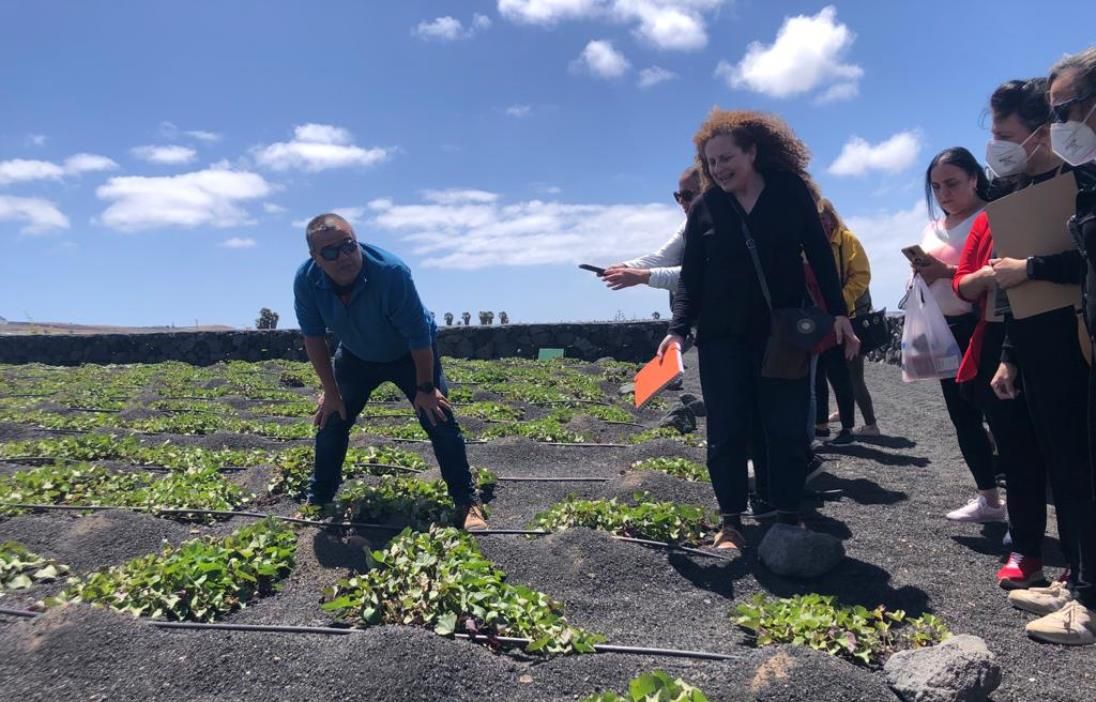
The visit to the Cabildo's experimental farm and the agroecological farm El Majuelo (Teguise) of the cooperative project S.A.T. El Jable completed the days of theoretical reflection held at the Lancelot hotel in Arrecife.
Add La Voz de Lanzarote as a preferred Google source.
Stay informed with the latest current news.