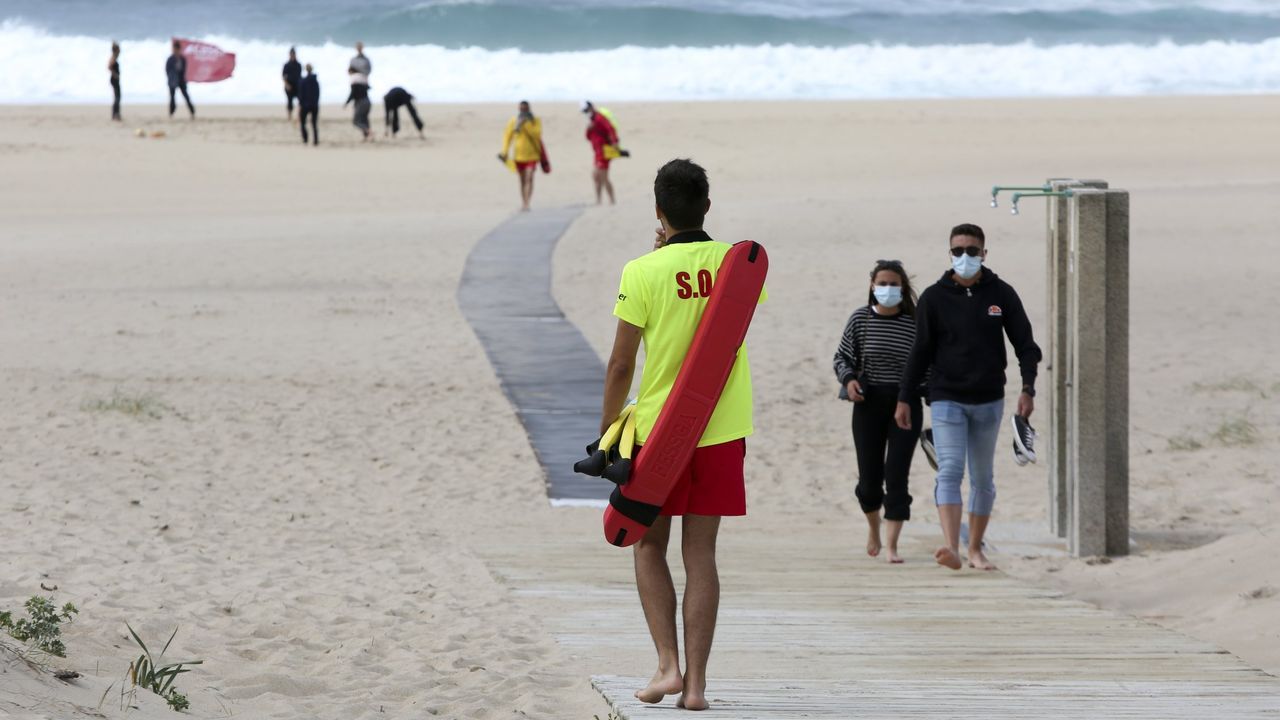
Drownings in the Canary Islands continue to be the leading cause of death: currently, they even double events related to traffic. Of the eight islands, Lanzarote usually ranks third or fourth in terms of the highest number of deaths for this reason.
According to data from the association 'Canary Islands, 1,500 km of coastline', which produces an annual report on aquatic accidents, in 2021 the archipelago recorded 64 drowning deaths. In the months of 2022, the figure stands at 46.
Regarding Lanzarote, 7 people died during the period of 2021, while in the present year there are also 7, but in this case, all have taken place during the summer months - between July and August 2022 -.
Whether this last figure increases during the remainder of the year will depend on two factors: individual responsibility and the work of lifeguards. Iván Soto and Cristian Sarrias are two of the professionals belonging to this profession, who have been attending to the needs of bathers for 2 and a half years and 10 years, respectively, through Emerlan.
Lack of care, the main mistake
Currently, Soto and Sarrias focus their work on the coastal area of Puerto del Carmen, specifically on Playa Grande and Playa Chica. The latter is one of the beaches with the highest number of drownings, both fatal and non-fatal.
However, Soto states that this situation is not due to these spaces being dangerous: "These beaches do not pose any danger. Rather, this situation occurs because a significant number of people, when they go swimming, do not take enough care or ignore the indications."
In fact, returning to the data of the aforementioned organization, of the total percentage of deaths that are recorded each year, an average of 80% corresponds to negligence.
"We encounter many people who violate the flag regulations or bathing recommendations. For example, in the case of Playa Chica, one of the biggest problems is divers, who do not compensate well for their ascents with air and can end up going into cardiac arrest," explains the lifeguard.
Foreign population: ignorance or indifference?
According to 'Canary Islands, 1,500 km of coastline', among the drowning deaths counted in all the islands in 2021, 85% were of foreign origin. In 2022, this population sector represents 63%, which means, in both cases, that they account for more than half of the registered events.
Soto argues, based on his experience, that the non-local population has a broad ignorance of beach regulations.
However, he does not attribute this fact to a general lack of awareness: "There is sufficient awareness, what needs to be seen is what each person does with it. Some do not take the indications seriously or think that they are not as serious as they are made out to be, and due to ignorance, they end up suffering accidents."
For his part, Sarrias adds that throughout the year, with special emphasis on the summer season, drowning prevention campaigns are carried out in various parts of the conejero territory.
"From Emerlan we give talks in schools, so that children become aware from a young age of what to do and not when they go to a bathing place. We also have courses for adults and seniors, in addition to being present in coastal areas offering information to all the people who gather there."
"The lives of people and also our own are at stake"
Continuously ensuring the safety of others is not an easy job. Even more so when this work is belittled, as Soto points out, who states that one of the most difficult parts of the job is dealing with people who consider "that lifeguards do nothing".
The professional details that there are people who "do not take into account that performing resuscitation or helping a person who is in trouble in the water, when the waves are strong, are very complicated situations."
Sarrias subscribes to these words, adding that "in both cases the life of a person is at stake, and in the second, ours too."
Therefore, the rescuer does not hesitate when asked what is the worst situation they face: cardiac arrest, a situation that is repeated quite frequently.
"This is the moment when we have to work the most seriously. When a user suffers a heart attack in the water and you have to get them out, you have to have a very cold mind and act quickly, because that's what it depends on whether they are saved or not. Suddenly, you have to act as a doctor, because you are the one who is going to perform the first action on the affected person. And it is essential."
Protection key: knowing oneself
Both lifeguards agree that reversing this reality and reducing the figures for the future is possible, as long as people "before coming to the beach, are well informed of how it is at that specific moment."
In addition, Sarrias emphasizes the importance of people "knowing their limitations": "If someone suffers from low blood pressure, they need to know that it is not good to go for a swim when temperatures are high. You have to know yourself and know what is right for each of us," he specifies.
Add La Voz de Lanzarote as a preferred Google source.
Stay informed with the latest current news.