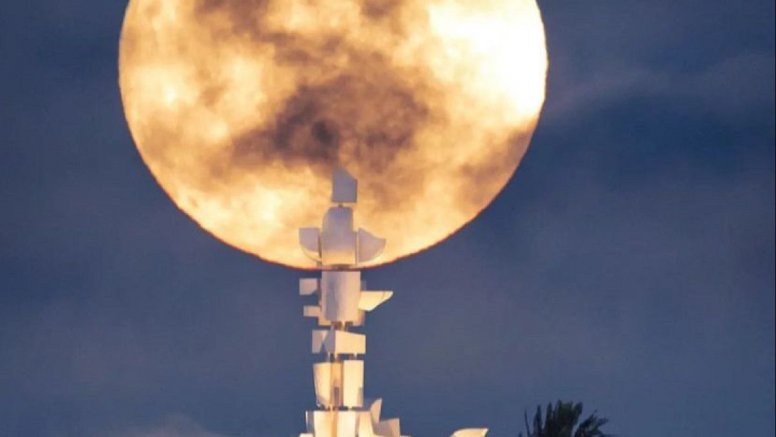
The blue supermoon that took place on Wednesday night has been captured from Lanzarote by the lens of photographer Rafael Sánchez. In a spectacular image in which you can see this unusual phenomenon, the Farmer's Monument, César Manrique's work, is also the protagonist.
"It took me three years to be able to take this photo, although I had the idea long before," he revealed in statements to La Voz. Since he got a telephoto lens, he "only" comes up with "ideas with the moon and the sun." This for him, "is a different way to enjoy photography, when we have haze and the sunsets are not as beautiful as I would like," he explained.
The graphic artist took advantage of this symbol of the fertility of the island's rural lands to turn it into the focal point of his photograph. Behind the monument, the blue supermoon. "The conditions for this blue supermoon were not ideal as the sky had numerous clouds," he wrote in a social media post.
"My idea has always been to show how beautiful the island of Lanzarote is and the magic that the different works of César Manrique give off," he explained to La Voz.
The clouds complicated his work. "Call it luck, but it happened that the moon could be seen behind the Farmer's Monument, if I had taken the photograph with the moon taking up the entire base, it would have been difficult for it to come out due to the clouds," he confessed.
"Being able to take the moon over the Farmer's Monument, a work by César Manrique, is difficult, as it is surrounded by numerous houses and volcanoes. Although coincidentally today was the perfect time to be able to take it," he added this time on social media.
What is the origin of the name blue supermoon?
The name Blue Moon refers to an astronomical phenomenon that occurs when there are two Full Moons in the same month. Since the Sturgeon Moon could already be enjoyed on August 1, this second Full Moon is called the Blue Moon.
But then you will ask yourself, where does the name blue supermoon come from? In this case, it is known as a supermoon because the Moon is closer to the Earth's orbit and looks larger and brighter than usual. As these two phenomena coincide, it is known as the blue supermoon.
Add La Voz de Lanzarote as a preferred Google source.
Stay informed with the latest current news.