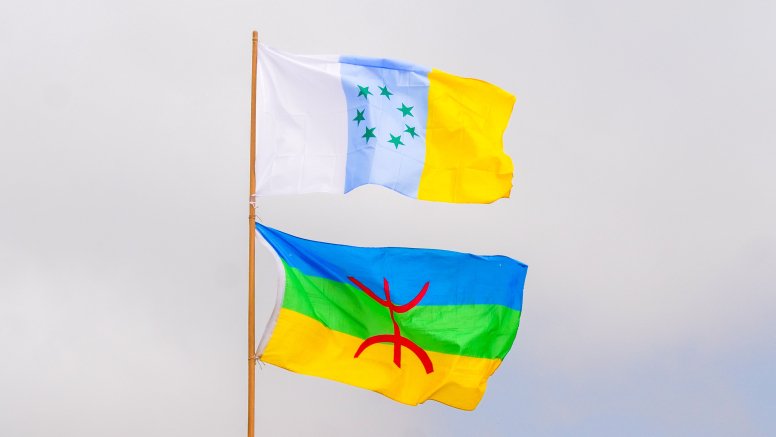
The Amazigh people, also known as Berbers, were the first inhabitants of the Canary Islands. Coming from North Africa, the Maho people of Amazigh origin settled in Lanzarote and Fuerteventura, known for centuries as Majos, and established a language and traditions, some of which are still preserved today.
The first island to be populated was Lanzarote, which they called Tyteroygatra or Tyterogaka; its meaning has to do with its volcanic environment and refers to "burnt island," "lit hill," or "the red one." Currently, the Titerroy neighborhood is a modern reconstruction of the island's original name, thus preserving part of the history of the first inhabitants.
According to a study by the ULPGC, it is estimated that the Amazigh people arrived in the Canary Islands between the 1st and 3rd centuries AD, with Lanzarote being the first island to be settled and then rapidly spreading to the rest of the archipelago.
Likewise, the study establishes that the Mahos settled in the coastal areas and not in the interior as previously believed, due to the possession of more reliable resources in the coastal zone, which they combined with agricultural production. They normally lived in caves or volcanic tubes, although they were also found on the surface in stone areas or huts.
The archaeologist and doctor of History José de León Hernández, nicknamed Pepe el Uruguayo, with Lanzarote roots, estimates that around the 9th and 10th centuries, the people who had settled in previous centuries were already rooted cultures, "Canarian, Guanche, Majorero with a clear but already evolved Amazigh root."
In the 14th century, the conquest by the Italian Lancelot arrived, to whom the change of the island's name is attributed, and who fixed Lanzarote on the medieval European map. It is estimated that his stay lasted 20 years until his expulsion or murder by the Mahos.
The Berber language, known today as Tamazight, has evolved to become the language of approximately 20 million North African people, including those in Algeria and Morocco. In the Canary Islands, considered a dead language, writings of the Iberian-Berber alphabet have been found on all islands, and the Libyan-Latin alphabet was spoken only on the islands inhabited by the Maho people, Lanzarote (Tyterogaka) and Fuerteventura (Maxorata).
Pepe el Uruguayo catalogs as very difficult to find evidence, but explains that “in Lanzarote there is another type of inscription” which has been “associated with a variant of Latin” found in some areas such as “Femés or tierra Mala”. It is not an isolated case on the rabbit island, “Lanzarote and Fuerteventura are culturally one”, where “two writings have appeared and we believe they are from the same language, from Amazigh” without knowing their duration over time.
The words that are preserved from the Amazigh culture in the Canary Islands are some like baifo, gofio or perenquén. Likewise, some of the names of the towns in Lanzarote also come from our aborigines, among which are Yaiza, Guatiza, Soo or Femés, among others.
Proper names also have their journey from the first settlers: Nayra, Abenchara, Acaymo or Ruymán are some of the many “Guanche” names that we preserve from our history. Others such as Fayna, Ico, Yaiza or Teguise come from the island of Lanzarote.
The historian also comments that in Lanzarote some of our origins have been lost, such as “the Tafiaque, they were stones used for cutting”. In the same way, some places where the Amazigh people lived have been greatly lost, although some places such as “the Malpaís de La Corona” still exist, concludes Pepe el Uruguayo.
Likewise, regarding Canarian gastronomy originating from the Amazigh, we find “gofio, herbs, goats, pastoral practices and derivatives".
Dissemination
The history of the island of Lanzarote has been colloquially known since the conquest of Lancelot; however, little is known about the first settlers. Its dissemination is of vital importance so as not to forget our roots.
For Orlando Hernández, president of the Maho People Cultural Association, dissemination is of great importance because if “a people that does not know where it comes from, will not know where it is going”. The Association has been engaged in this dissemination process for ten years and little by little they are encountering a “progressive increase in people who are more interested”.
This association carries out workshops that rescue the history of our aborigines, from the shepherd's leap, the blowing of the bucio to the whistled language, a language that “rescued and made known” the island of La Gomera, although it is a form of communication “from all the islands” that is being rescued and investigated.
For centuries the history of the Amazigh people in the Canary Islands was totally unknown to our population, for Hernández it is due to the fact that "we were and are a colonized people" where "they annul our history so as not to recover it". The archaeologist also states that "repression has played a very important role on this issue" and with the Spanish Inquisition "the Canarian language is lost very early".
In this way, a large part of our aborigines is unknown and there are those who do not feel identified with our history because "without knowing the culture, they do not defend it", concludes Orlando Hernández.
Currently, work is being done on this dissemination, some content creators are bringing young people closer to knowing our history, speaking from the names that come from our aborigines to the Amazigh symbol as a sign of identity. The latter is used today in different formats in emoji version or in costume jewelry, a way not to forget our roots.
Add La Voz de Lanzarote as a preferred Google source.
Stay informed with the latest current news.